
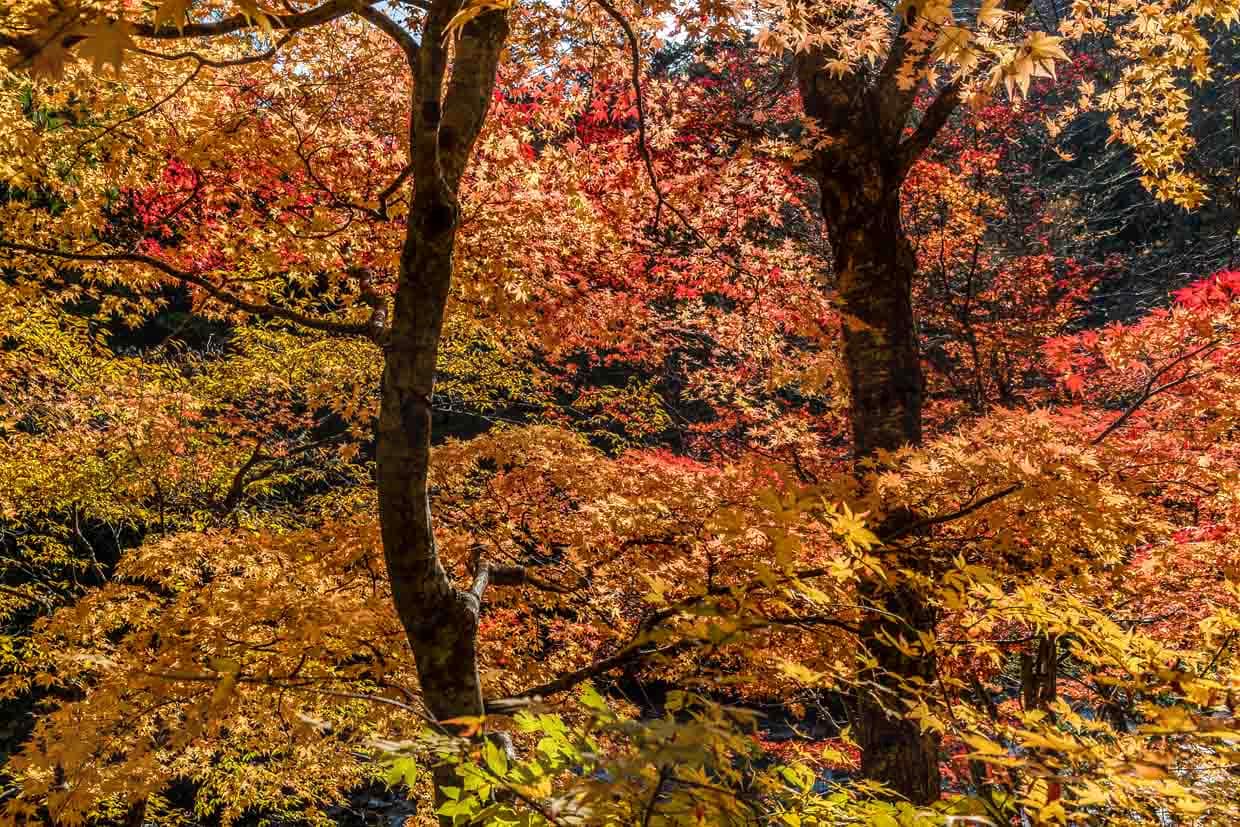
The Tokaido Shinkansen takes us to Nagoya, and from there we continue by regional train to Nakatsugawa, a small town at the foot of the Kiso Mountains in Nagano Prefecture. Our guide, Yuki, is already waiting for us here. He grew up in the Kiso Valley and knows the hiking trails along the Nakasendo like the back of his hand. Luckily, because even on the short drive to the trailhead he starts telling us stories: about the long history of the trade route, about the people who once used it, and about the hardships they endured to reach Edo – the administrative seat of the powerful shogun and what is now Tokyo. Outside, pine and cedar trees flash past; the foliage is beginning to take on its first autumnal colours and the air is growing cooler. After twenty minutes, we arrive at the starting point of our hike.
From here, we walk to Magome, the starting point of the most famous day hike on the Nakasendo. Just under eight kilometres separate the two post stations, Magome and Tsumago, and the path there is still paved in places with those old stone slabs over which princesses once travelled in palanquins to marry into the family of the powerful shogun. They were accompanied by a retinue of 20,000 people. A procession which, as Yuki explains, stretched over the distance of no fewer than three post stations.
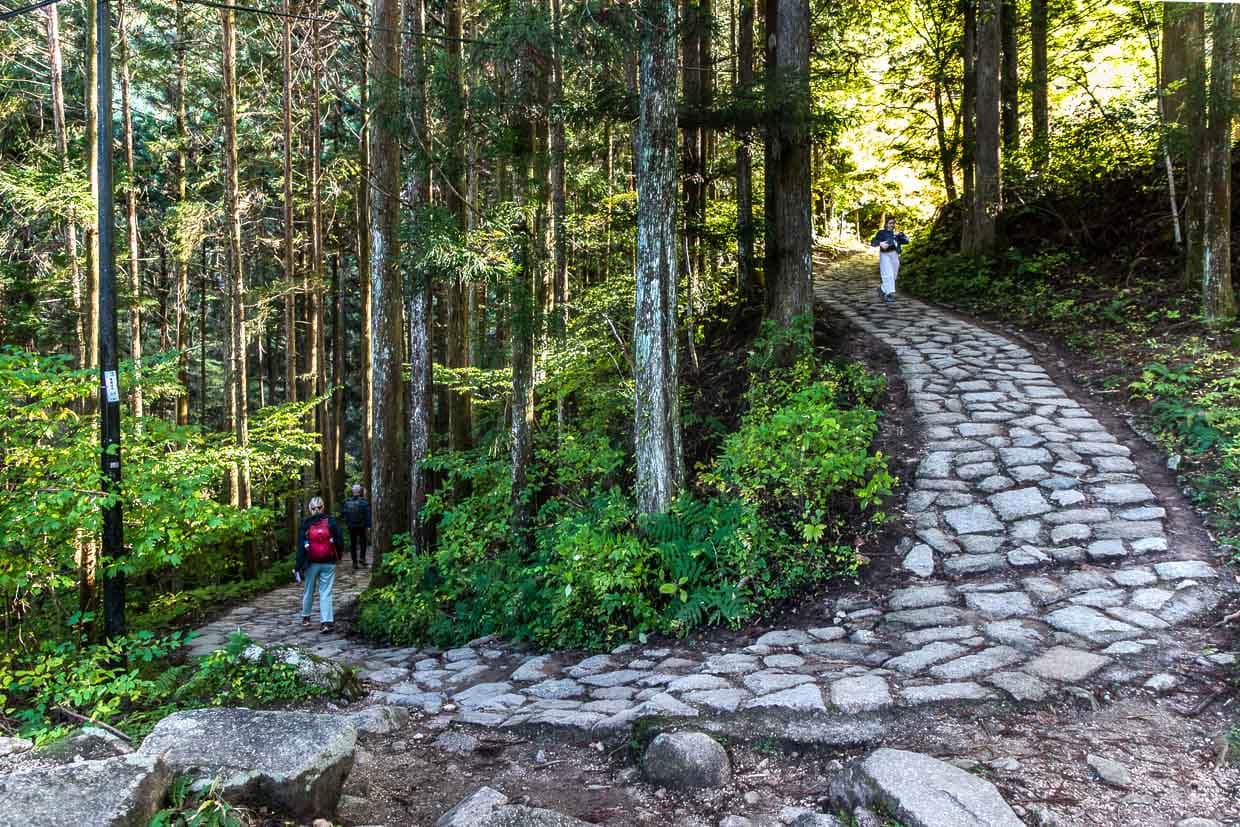
Today, things are much quieter along the Nakasendo. Mighty tree trunks tower into the sky; some of the cypresses are 350 years old and provided shade for a princess even back then. Yuki stops by one of these trees: a lower branch juts out horizontally to the side before growing upwards towards the sky again, almost like a seat inviting you to rest. Yet our guide explains that this resting place was reserved for the deities. Travellers in the Edo period would never have dared to sit here. In Shintoism, nature plays a central spiritual role: mountains, trees, rocks, rivers and waterfalls can be regarded as sacred because kami dwell within them.
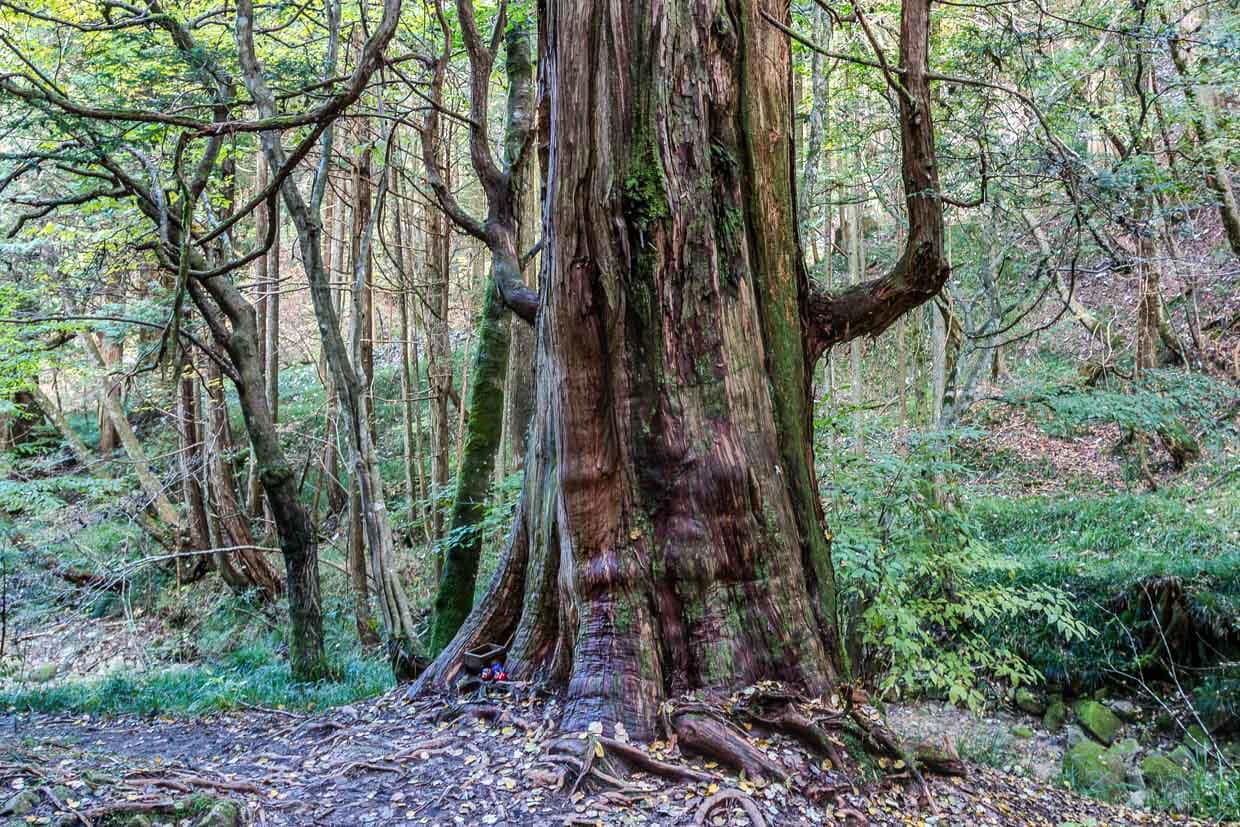
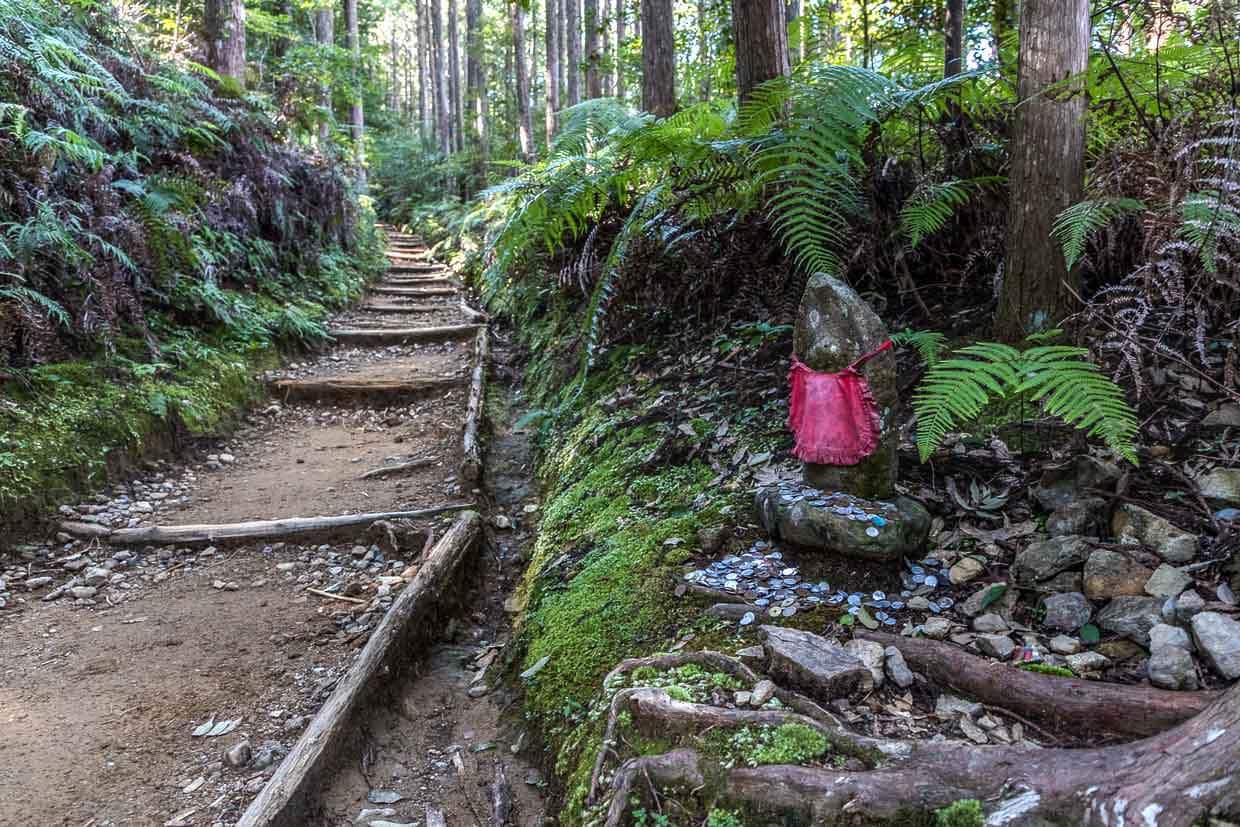
Kami are not ‘gods’ in the strictly Western sense, but rather divine, spiritual beings or forces that manifest themselves in places, natural phenomena or extraordinary things. An old tree is therefore never simply a tree, but is revered as the dwelling place of a kami. Without this explanation, we would have missed all of this. Stone Jizō statues, guardian spirits for travellers, children and the deceased, also stand at regular intervals along the roadside. Some are draped in red cloth to ward off demons, and even today locals still visit the Jizō to ask for protection.
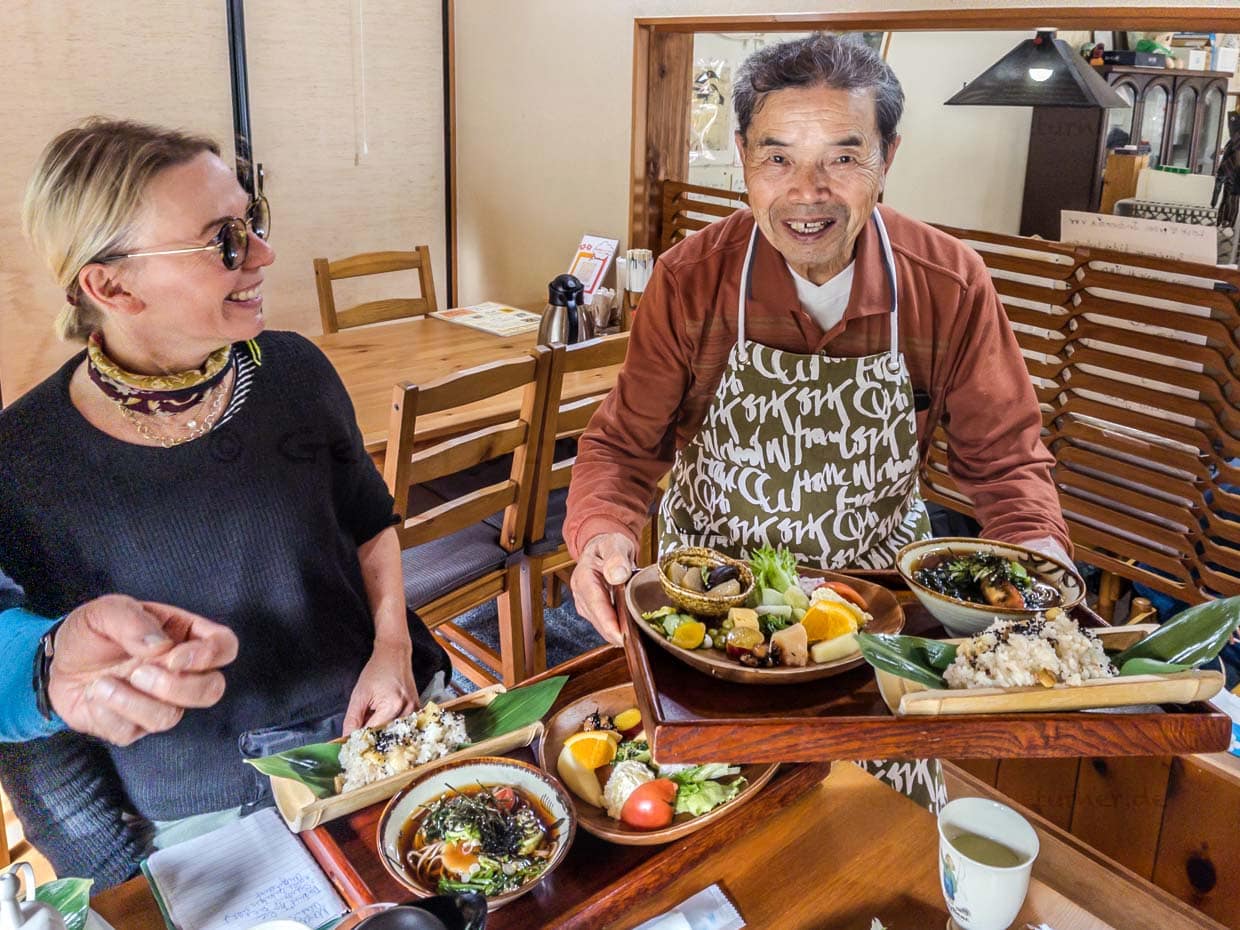
We stop for lunch at the Juri Inn, where Misae Owaki serves up her specialities made with home-grown ingredients. Her husband, a former postman, serves the guests with visible pride in his wife’s work; she refuses to come out of the kitchen for a quick chat, even when asked. Her popular chestnut rice, kurikowameshi, is studded with sweet mountain chestnuts, served with sansai – pickled wild vegetables from the surrounding forests – and a steaming bowl of ramen soup. We sit by the open window, gazing out at the dark-green trees, and immediately understand why this place is so highly praised.
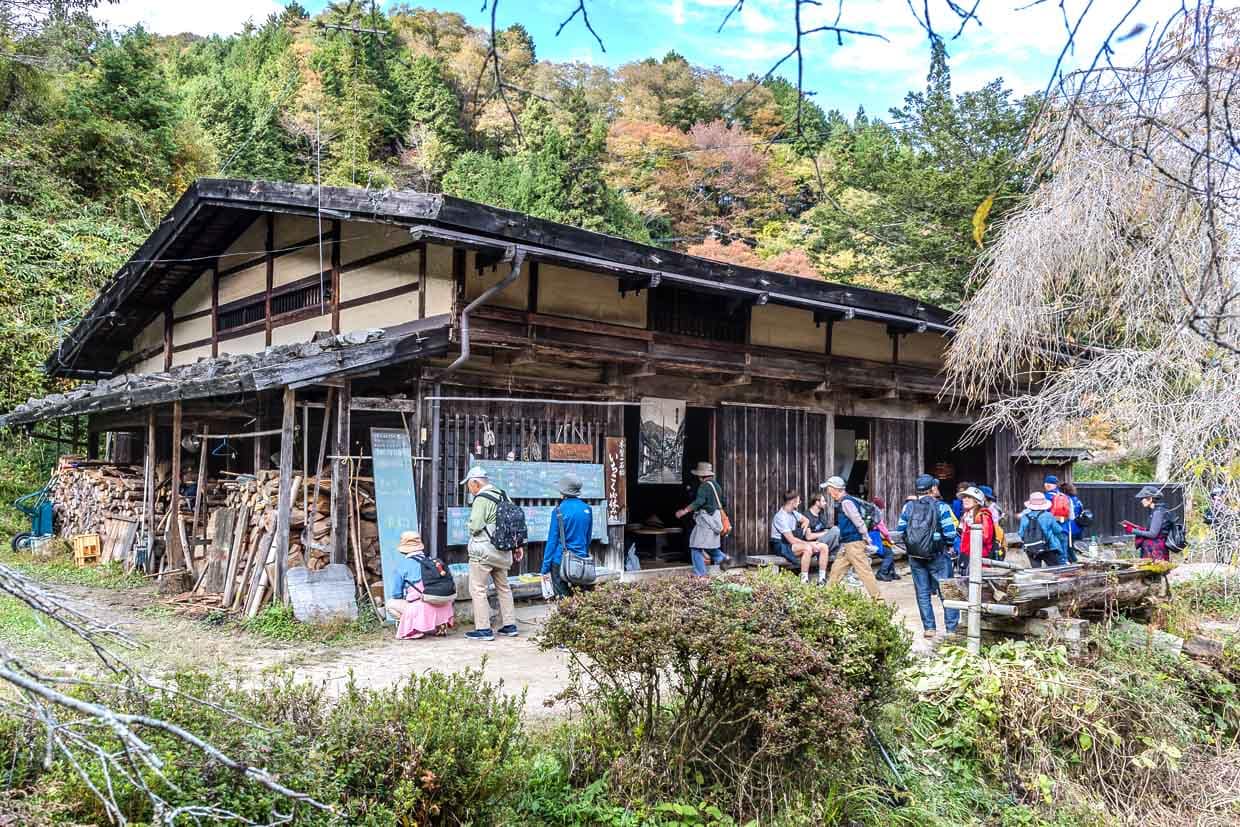
Just how popular this day’s stage is becomes clear a little later at Tateba Chaya, the oldest teahouse on the Nakasendo. As far back as the 17th century, traders, pilgrims and court officials used to rest here; today, locals serve tea on a voluntary basis. Hanging on the wall is a colourful board with a tally where walkers can mark which country they come from. We make our chalk mark next to ‘Germany’, though most of today’s walkers are from Mexico.
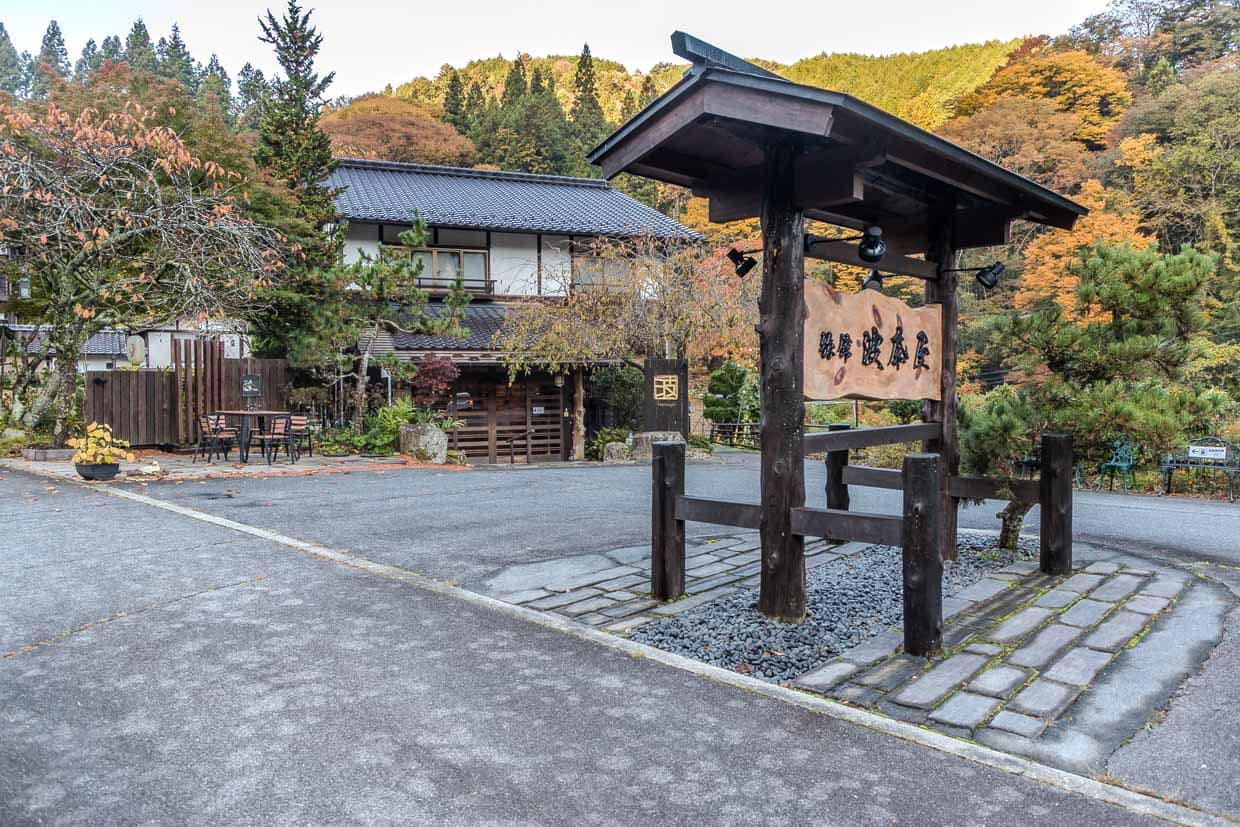
Just before Tsumago lies our accommodation for the night, the Ryokan Hanaya. It is early November, the best time of year to travel in Japan, and accommodation directly on the Nakasendo is scarce. Anyone wishing to stay here should book several months in advance. Behind the wood-panelled entrance, a world of sliding paper doors, tatami mats and the gentle splashing of an onsen bath opens up. We are shown to our Japanese-style room. Our futon is stored in a sliding cupboard in the corridor; as guests, we make up our own beds. But first, we head to the ryokan’s own onsen – separated by gender – to relax before dinner.
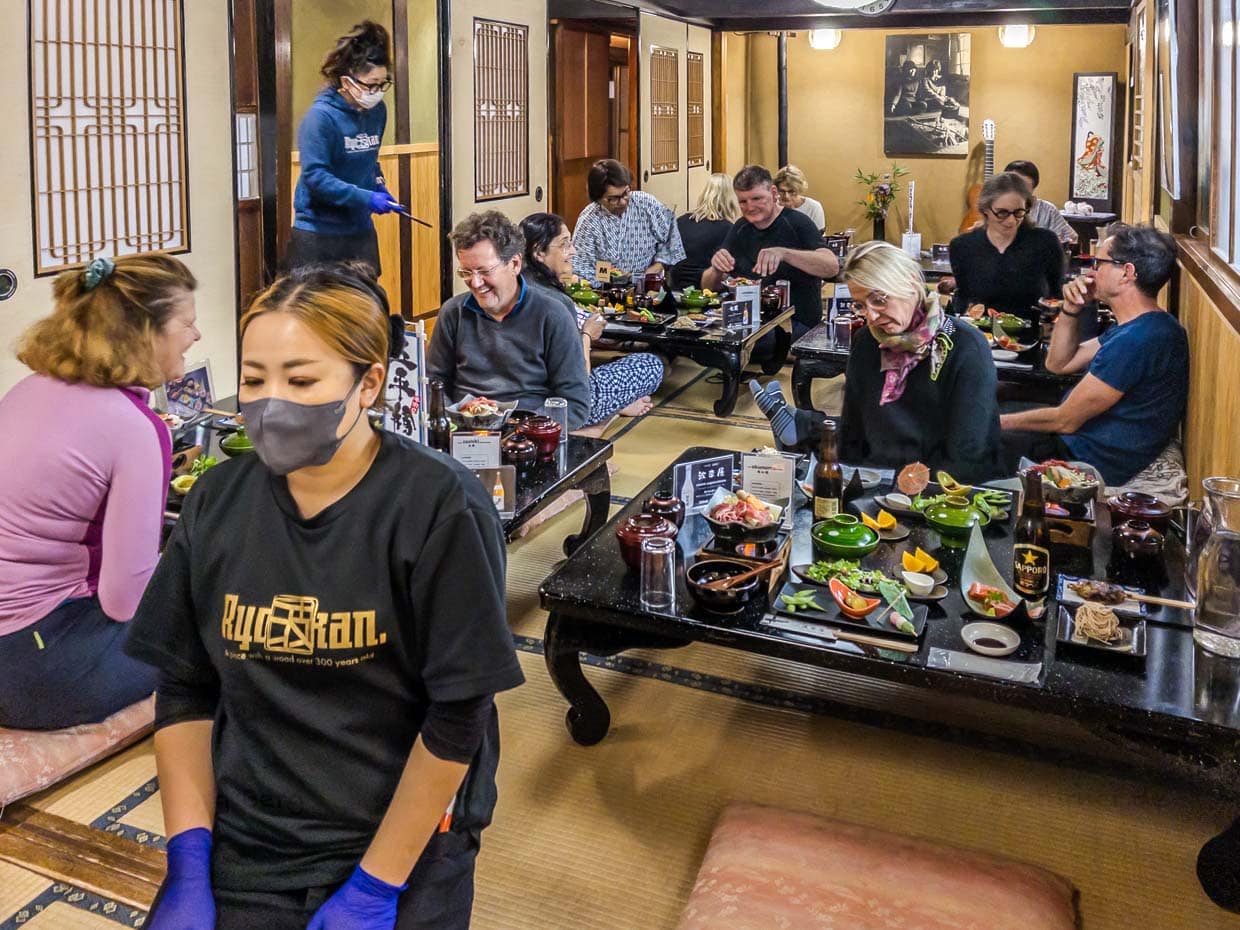
The guests in the few rooms dine together at low tables, and it’s amusing to watch how many of them struggle to fit their legs underneath. Almost every continent is represented this evening; we exchange impressions with Fran and Jeremy from South Africa. In front of us are small bowls of pickled radish, fermented soya beans and miso soup with mountain vegetables; then a sliding door opens, and fried Kiso carp and yuzu jelly are served on lacquered trays. The unfamiliar sitting position is forgotten at this moment. Now it’s simply a case of marvelling and enjoying the moment.
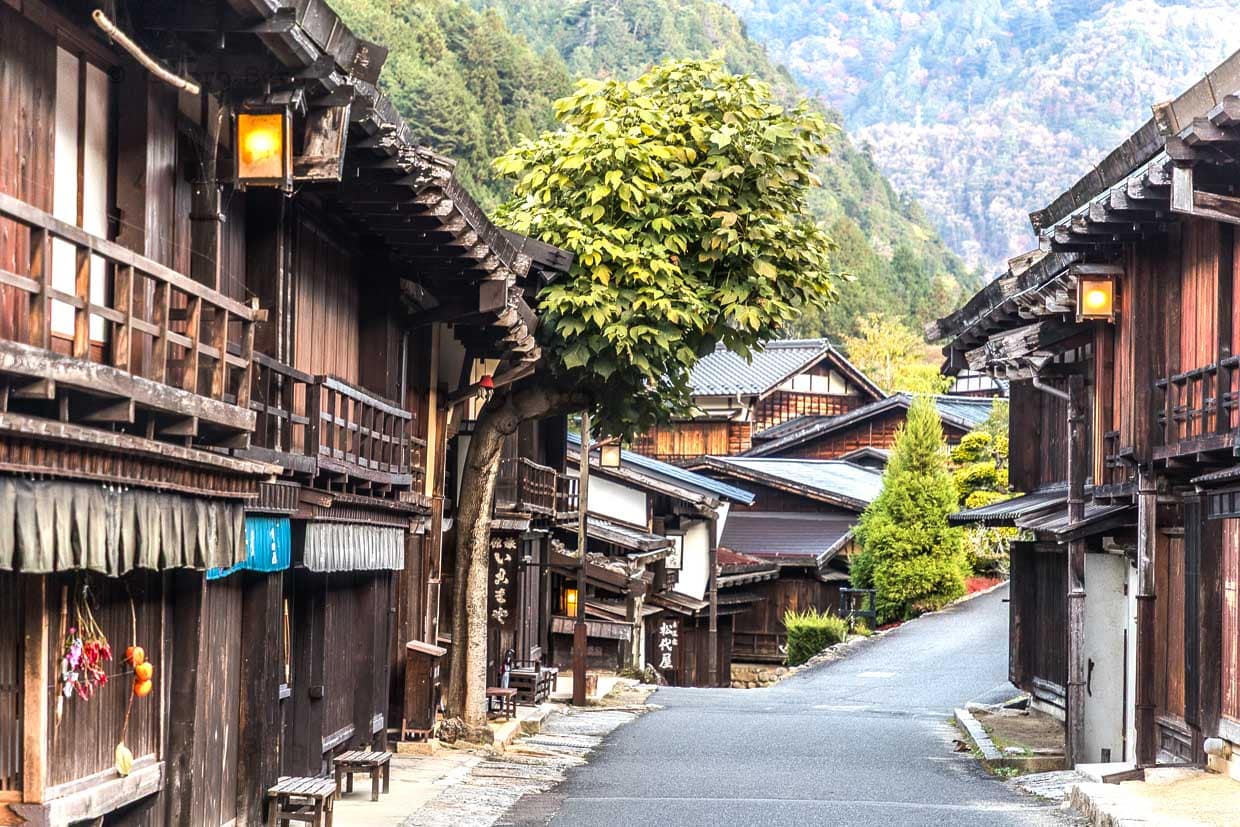
The next morning, before breakfast, we walk over once more to nearby Tsumago. The day before, it had been teeming with visitors, but in the morning light the post village seems like a completely different place. The Edo-period machiya houses, with their dark wooden façades and low-slung roofs, stand still; not a tourist or souvenir seller in sight. Just one young Japanese woman walks towards us backwards – I can’t help but smile; apparently, a TikTok trend has made its way even to this car-free village with no visible cables. The old irrigation channel gurgles, birds chirp, and since the 1970s, new buildings, demolitions and advertising hoardings have simply been banned in Tsumago. The result: a place where time seems to have stood still.
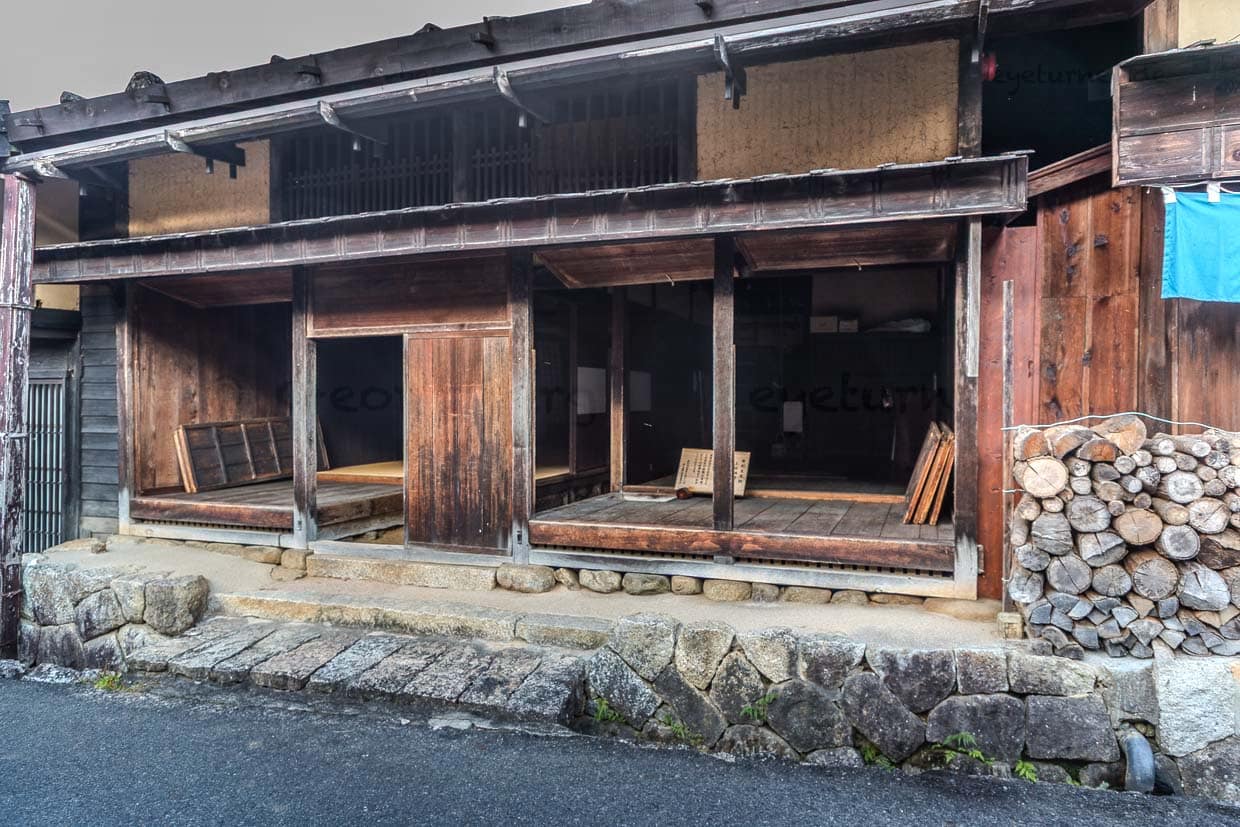
In the centre of the village, an old Edo-period lodging house has been preserved. It is a simple room with a hearth in the middle, once providing accommodation for the poorest travellers. A place to sleep in the communal room was paid for with a little firewood, so that the hearth could be kept alight, where everyone cooked their rice.
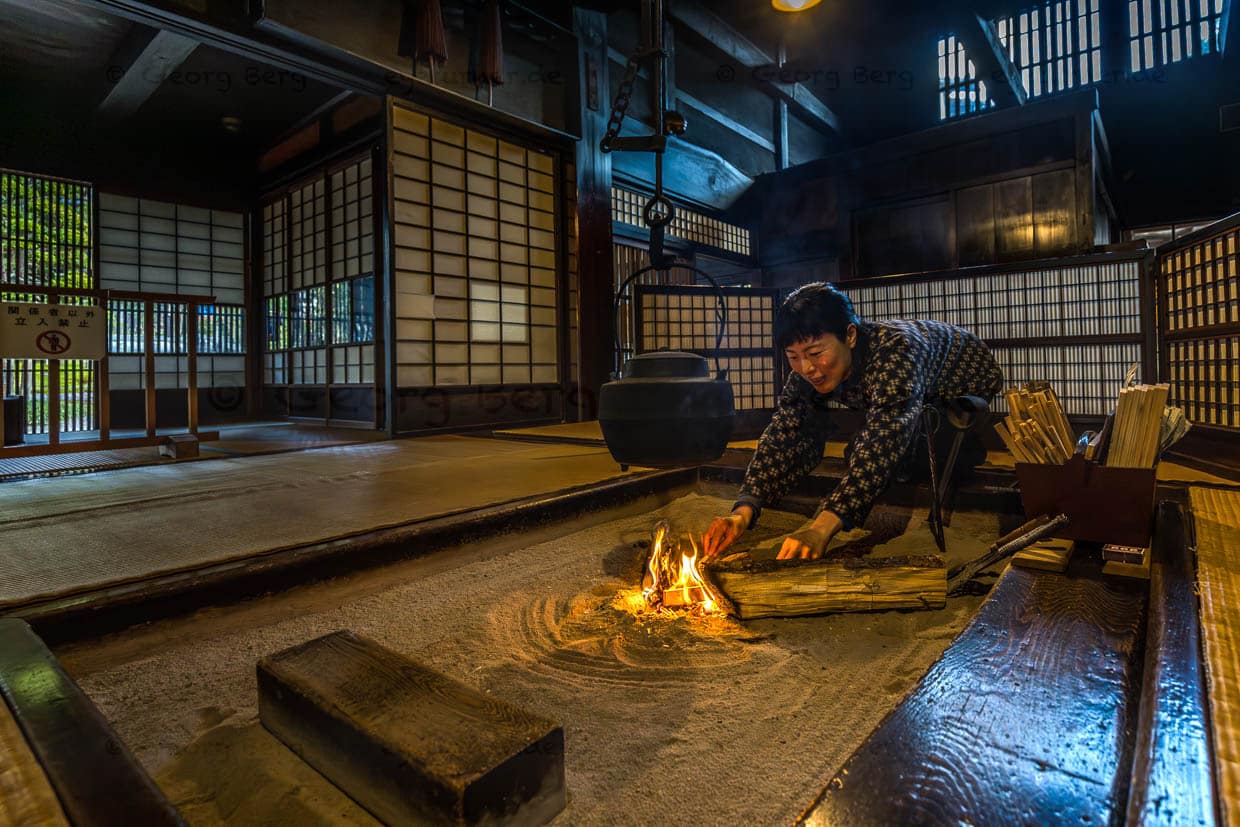
The Kumagai Family House offers a glimpse into how wealthy families lived in those days. The Kumagai family not only farmed the fields but also earned a living from silkworm rearing. Dating from the early 19th century, the house is one of the best-preserved buildings in the village centre. Every day, a fire blazes in the irori, the traditional ash-lined hearth set into the floor. Suspended above the flames is a cast-iron tetsubin kettle, hanging from a height-adjustable chain hook. The irori was central to everyday life in Japanese machiya houses.
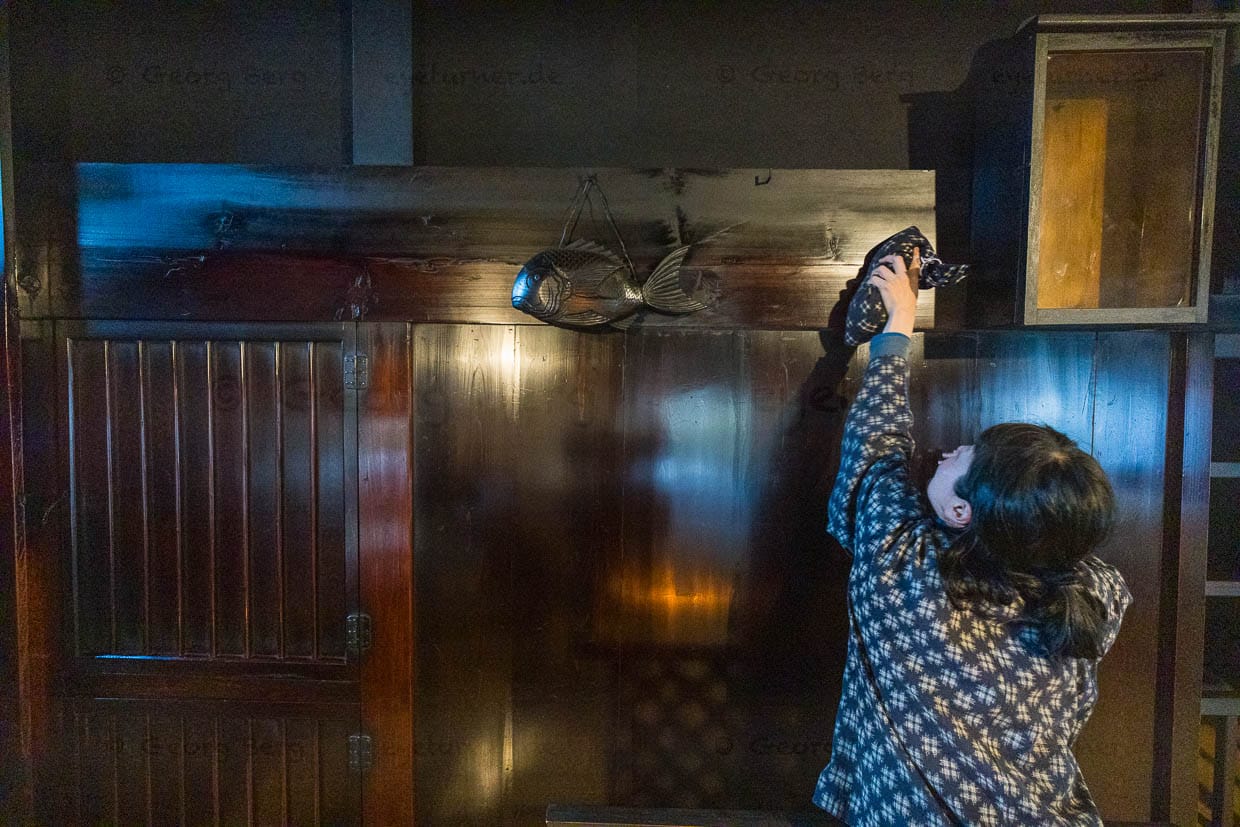
The black wooden walls around the hearth gleam strikingly. The sheen stops at a certain height. We ask about this and receive a surprising answer, which the museum staff member immediately demonstrates vividly. She picks up a cloth, stands on tiptoe against the wooden wall and explains with a laugh: the shiny part of the wood panelling extends only as high as an average-height Japanese woman can reach with a cleaning cloth.
Post villages such as Tsumago and Magome offered travellers rest, food and accommodation. There were 69 such stations along the route between Kyoto, the seat of the Emperor, and Edo – now Tokyo and then the seat of the Shogun. They catered for travellers and, in some cases, also provided entertainment. Over time, entire town centres grew up at these hubs. From the early 17th to the late 19th century, the Nakasendō was one of Japan’s most important transport routes – though originally it served primarily as a means of control by the shogunate
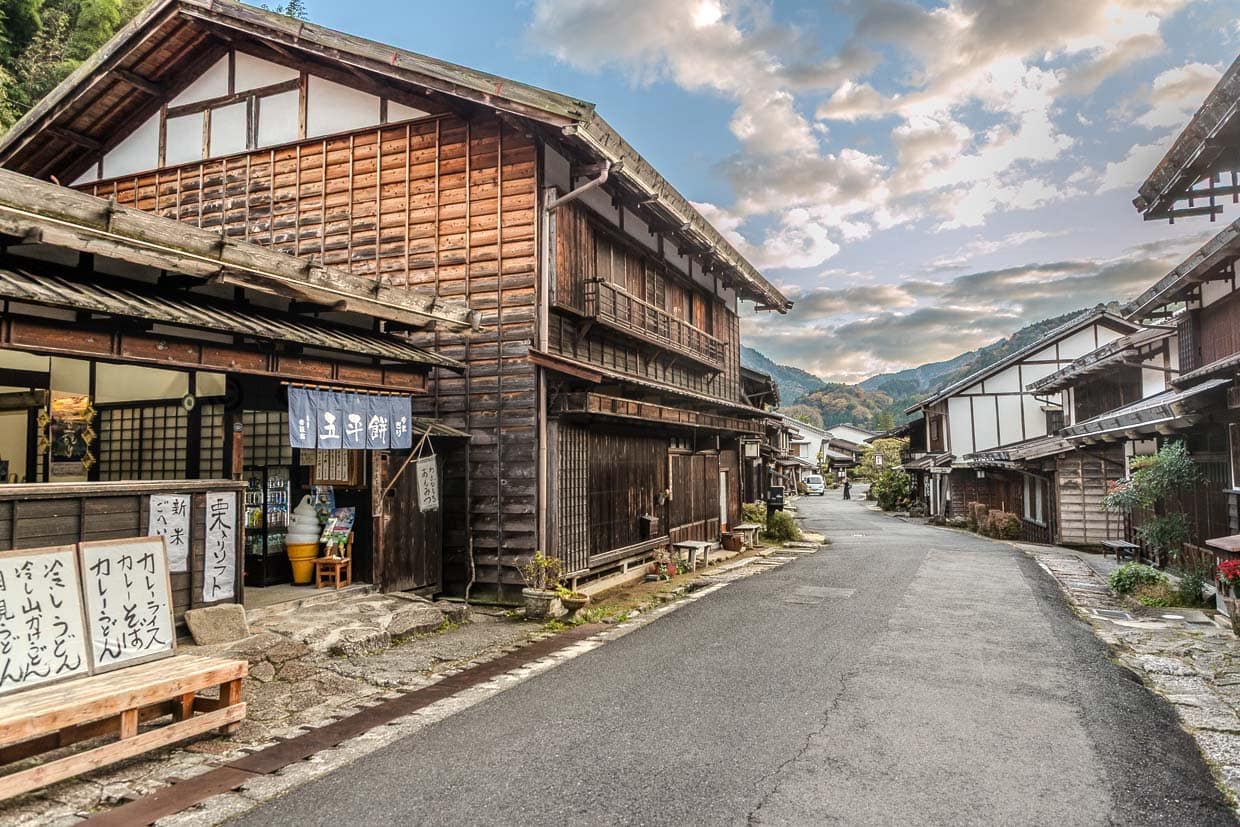
In the 17th century, the Kiso Valley was less a trade route than a strictly monitored area that secured the shogunate’s power. The authorities controlled the movement of people and goods. The route was not open to everyone: it was used primarily by daimyō, government officials, messengers and soldiers; traders and pilgrims followed only later. Here, too, we see how a good guide brings history to life. Yuki leads us to the end of the main road in Tsumago to explain the military function of the post villages. The long main road leads into a lower-lying road that turns sharply to the right at a right angle. Enemies who invaded here were caught in a trap.
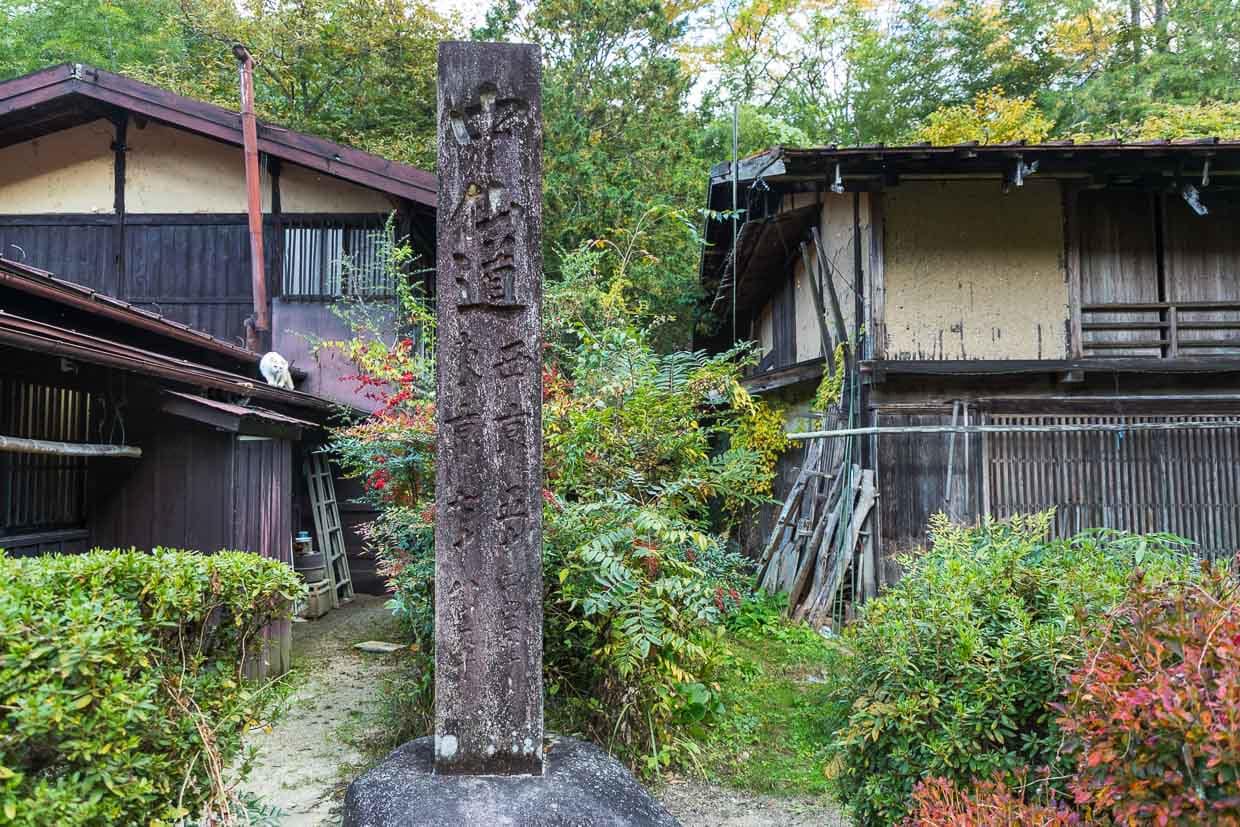
We are glad to have Yukinobu Koshi, a knowledgeable guide to history, by our side. There is an incredible amount to discover along the way; much of it would otherwise simply be overlooked. On the outskirts of Tsumago, Yuki even leads us into the garden of a private house. There stands one of the old waymarks. During the Edo period, the Nakasendō was not only divided by post stations. There were also distance markers set at irregular intervals and sections of the route that were partly paved. The clearest surviving traces of this today are the old stone roads in the Kiso Valley. The post stations were each about ten kilometres apart. For travellers, this provided a rough but important guide on the long journey to Edo.
More episodes from Japan
Spiritual, culinary, fascinating. On our trip through the Japanese prefectures of Wakayama, Mie and Nagano as well as the cities of Osaka, Nara and the Hakone region, we hiked pilgrimage routes and ancient trade routes, bathed in hot springs and drifted through the street food streets of Osaka and packed lots of red tins from Nagano into our suitcase. There is no way around octopus there – especially not a takoyaki, the legendary dough ball with a tiny piece of octopus inside. In Tanabe, another world opens up: that of Umeshu, the amber-coloured plum liqueur, the nuances of which you can get to know in a small bar. If you can still walk afterwards, it is best to head straight for the famous Kumano Kodo pilgrimage route – and if you want to do it in style, wear a kimono. Yunomine Onsen is home to the oldest onsen in Japan, where hot water has been bubbling up from the earth for 1800 years for cooking, bathing and relaxing. You can learn about the history of the ama, the women of the sea, their tradition and their endangered craft in Mie. If you are looking for a souvenir, you can choose an oyster in Ise-Shima. You can only find out what’s inside at the Pearl Picking. In Ise itself, Japan’s most important Shinto shrine holds a secret that has been kept for twelve hundred years – by rebuilding it every twenty years. The somewhat quirky bag charm culture, in which soft toys dangle from bags, is a nationwide phenomenon.
The research trip was supported by the Nagano Tourism Organisation