
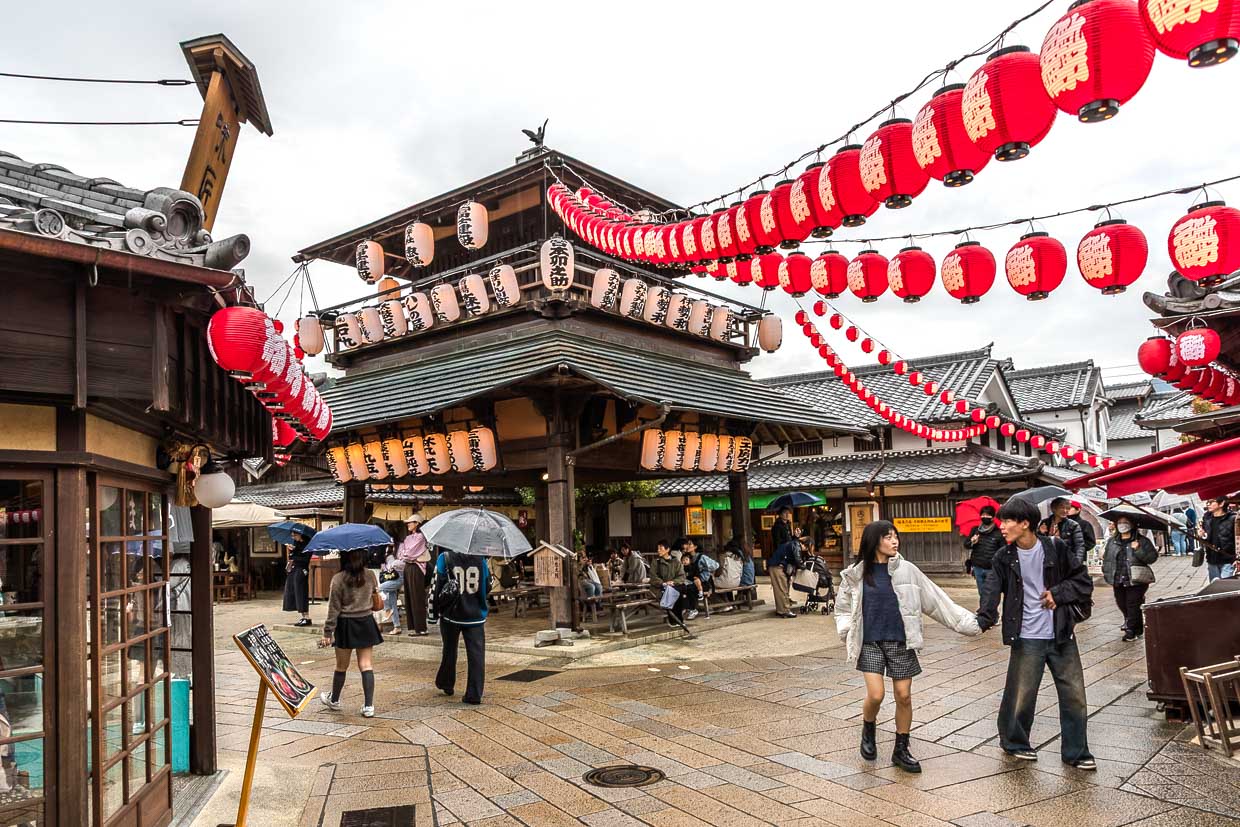
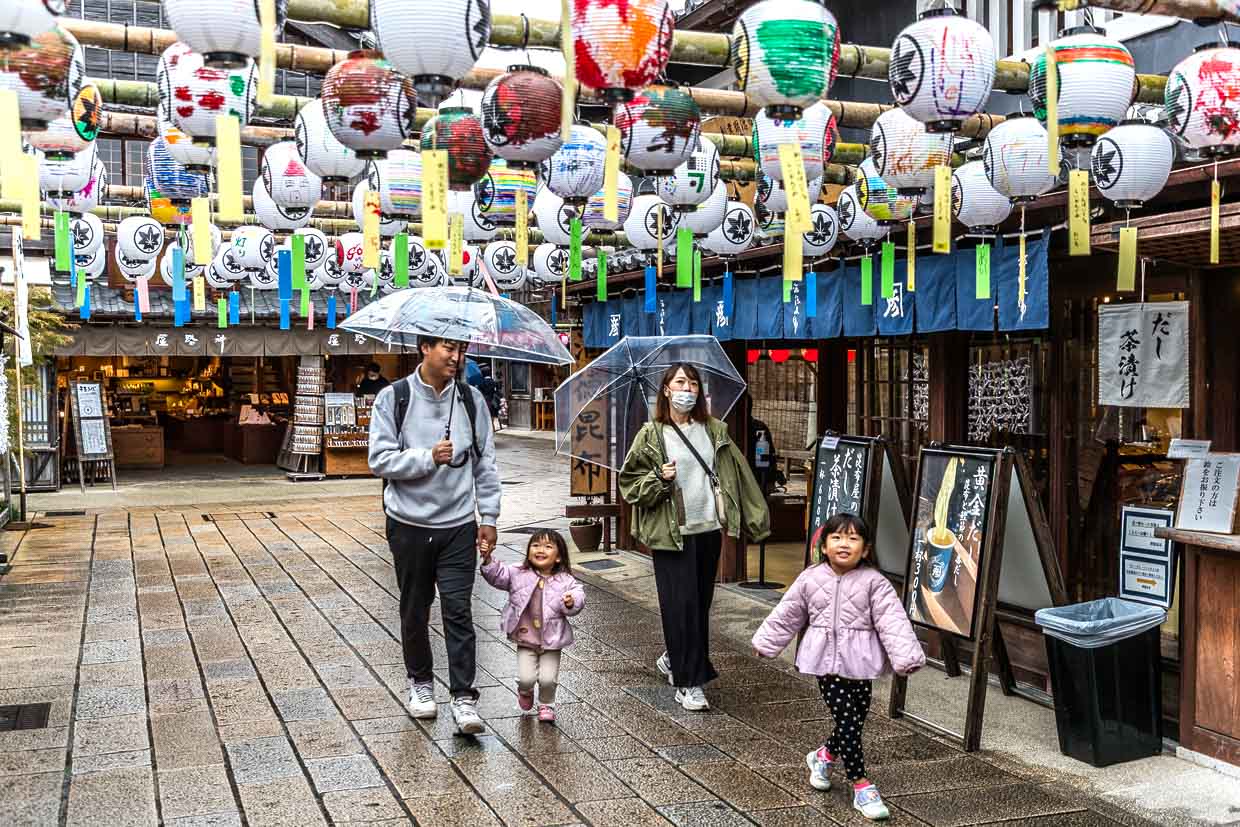
Oharai-machi is loud. Souvenir shops, akafuku mochi vendors and sake tasting stands line the pilgrimage route. Lampignons painted by children stretch across the street. Today, in the drizzle, the tourist street is not quite as crowded as usual. It lies between Japan’s holiest shrines, which are six kilometres apart.
Sightseeing rules that are not explained
We wear armbands with Japanese characters. They identify us as journalists, i.e. as people who receive more explanations than most. However, we actually see less than we would like to. Many things are not allowed to be photographed. Unlike at other tourist destinations, there are no signs that we could decipher. Only Japanese characters. Our guide hints at secrets. We quickly learn the limits.
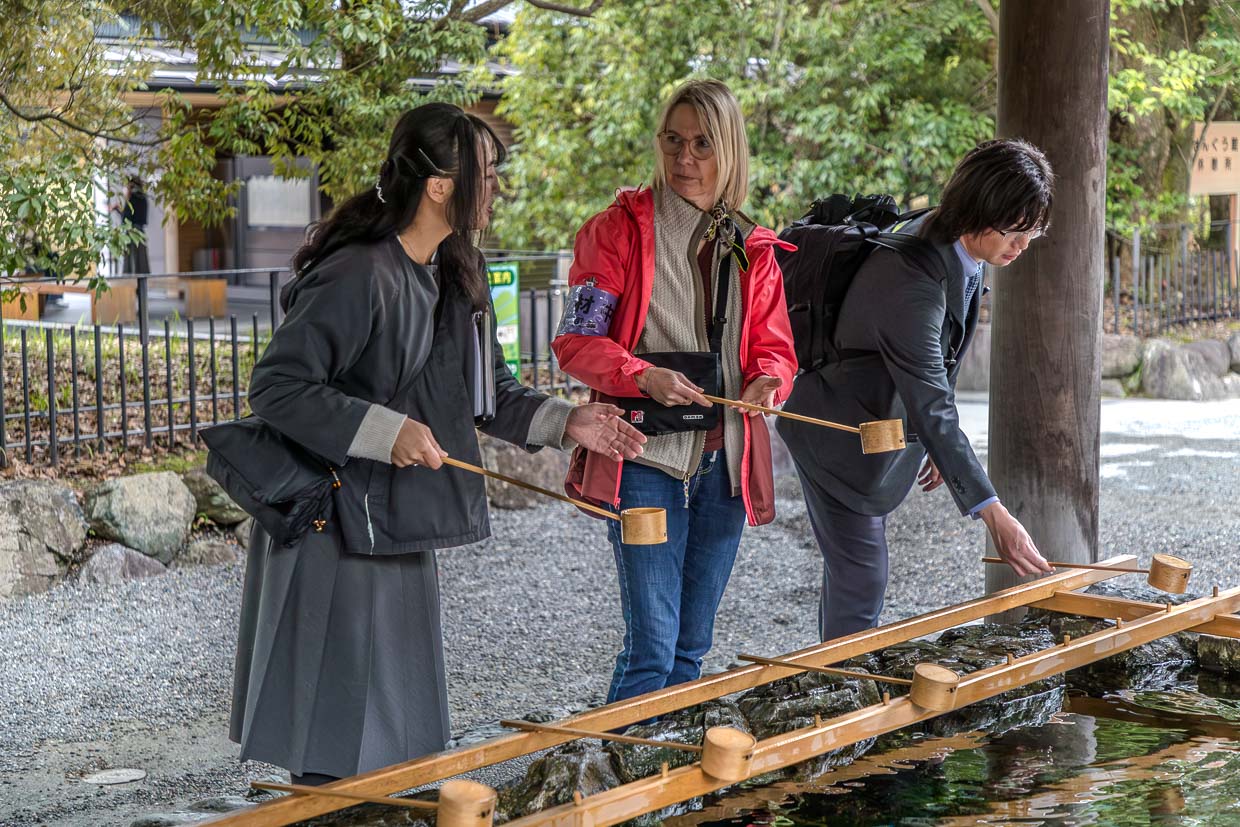
Before entering the grounds, you wash your hands. The ladle is called hishaku, the action temizu. It is a purification to get rid of impurities before meeting the saint. Our guide Chifumi Takahashi demonstrates it. Those who take part understand: This is not a symbol. This is a realisation.
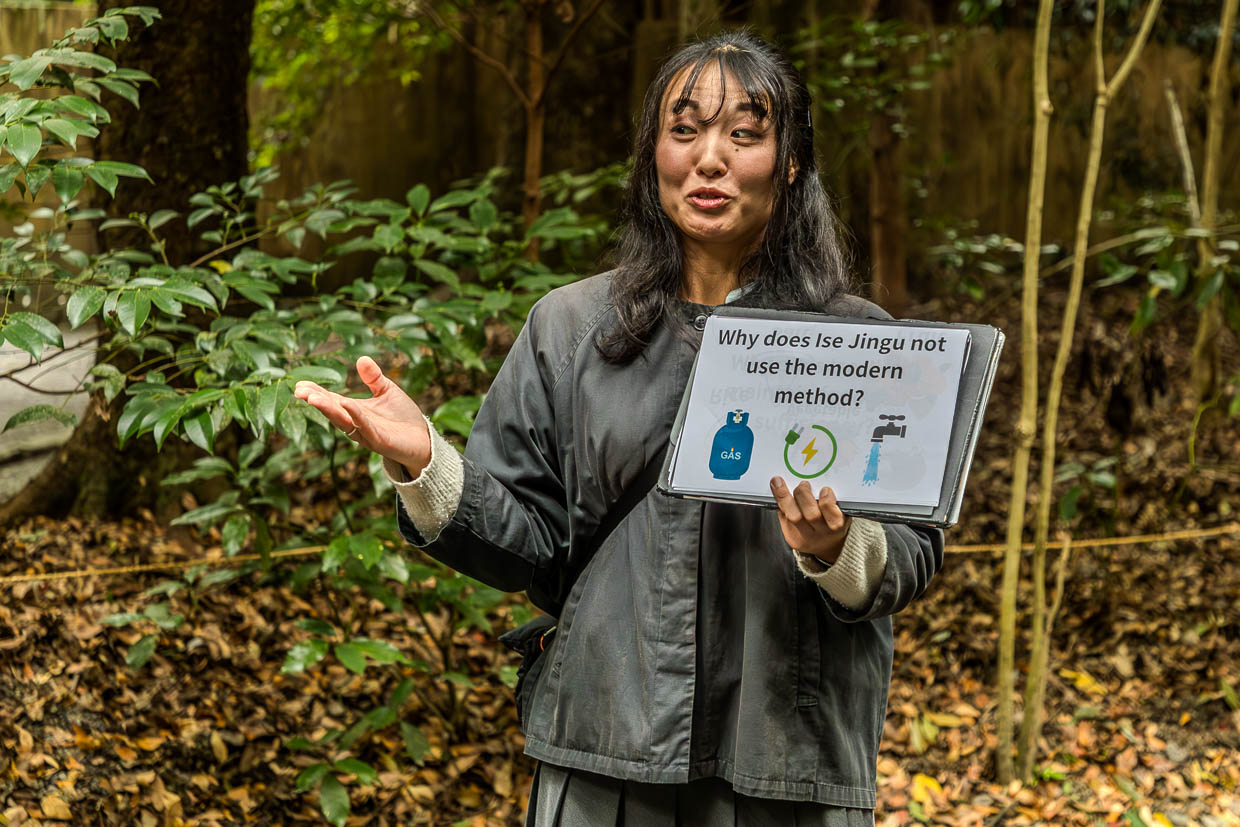
She also explains why there is no gas cylinder burning here, no electricity connection and no dripping taps. She carries the answer with her in laminated form. The sign reads in English: Why does Ise Jingu not use the modern method? Underneath are three symbols: Gas, electricity, water. There is no answer. Because the answer does not fit into words. It lies in the principle that underpins the entire shrine: The craft must be carried out as it was twelve hundred years ago. Otherwise it is no longer a craft that can be passed on.
Company outing to the company devotion
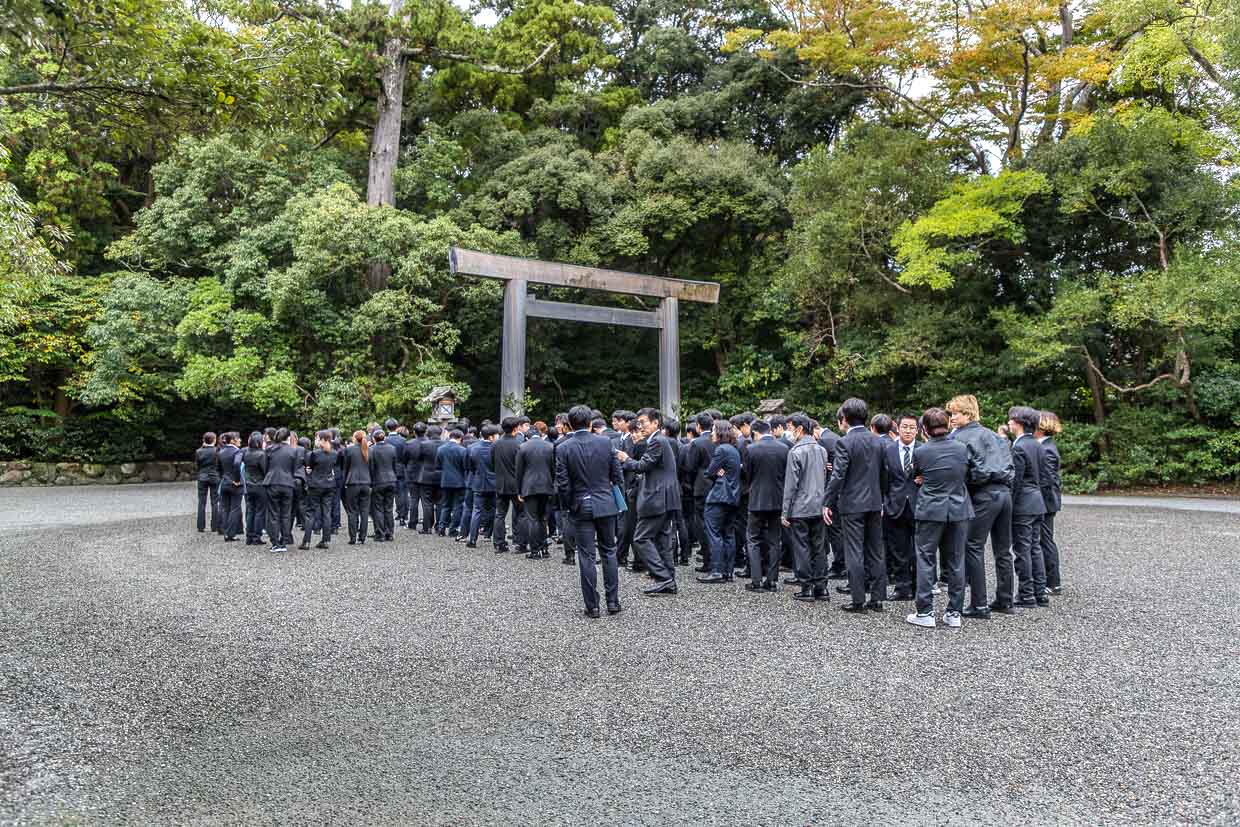
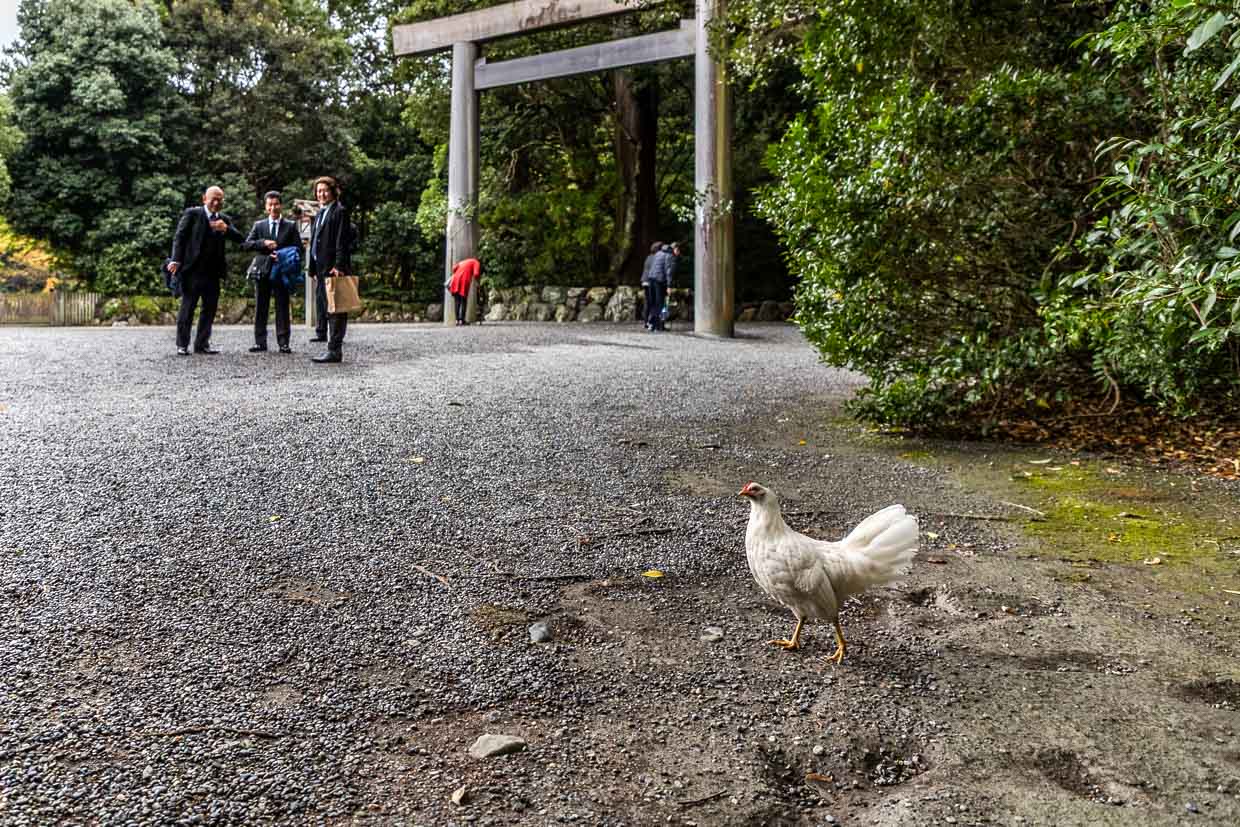
The gravelled forecourt in front of the first torii is wide. Japanese companies send their staff on a pilgrimage to Ise. Kigyō sanpai, company worship, is part of Japanese working life, especially at the beginning of the year. Men and women in dark suits, with business card holders in their jacket pockets, bow their heads in formation. It seems natural. Perhaps that says more about the Shinto than any explanation.
Ise-jingū is the most important Shinto shrine in Japan. It is almost two thousand years old and the home of the sun goddess Amaterasu. Over six million people visit every year. The Sengukan Museum at the entrance to the outer shrine shows what no one can explain on the site itself: carpenters’ tools, construction plans, craft techniques, the full-size model of the shrine. It also shows the principle of shikinen sengu, the ritual in which the entire shrine is completely rebuilt every twenty years. The same wood, the same shape, the same silence. Only the material is new. You are not allowed to take photos in the museum either.
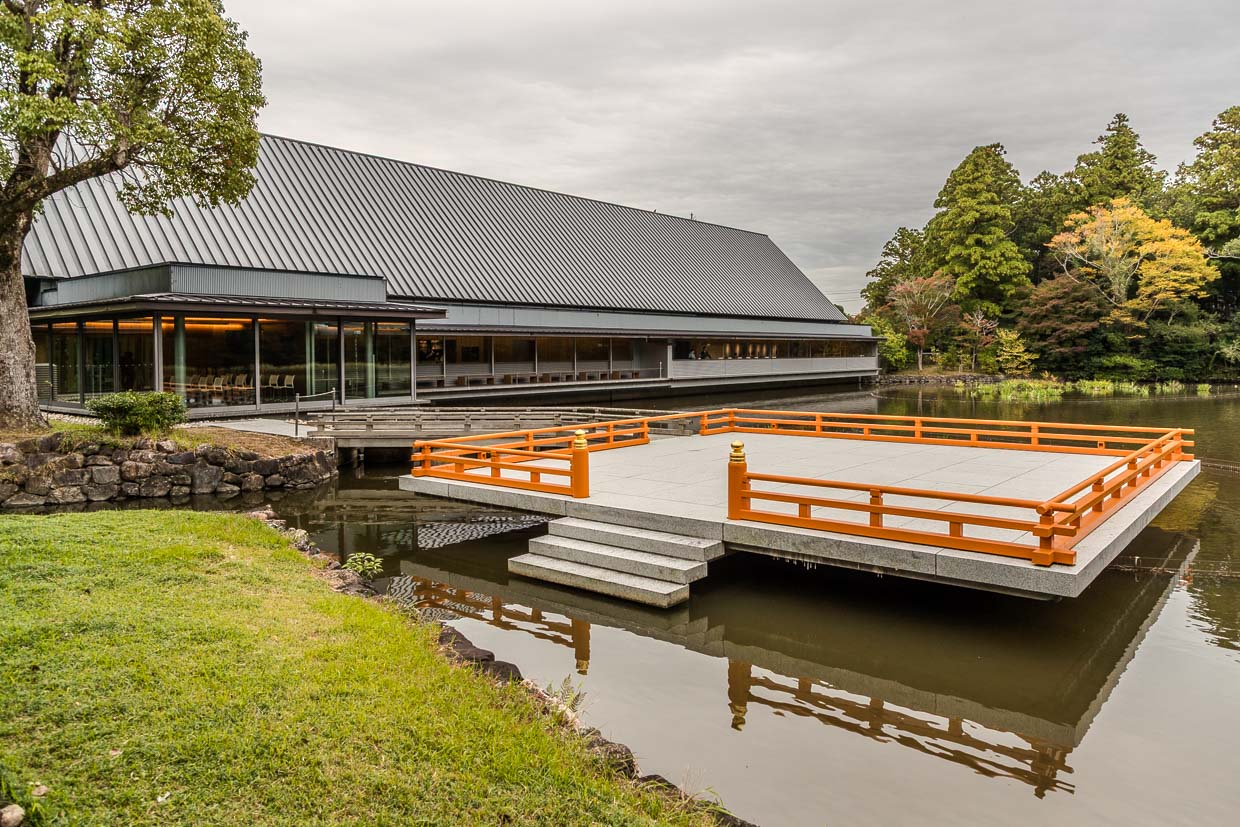
When the Ise Shrine was rebuilt, not only the buildings were replaced, but also exactly 1,576 cultic and practical objects: including ceremonial sword blades, the sacred mirror Yata no Kagami (八咫鏡), the chrysanthemum lacquer box Kiku-Makie Tebako and 125 types of sacred robes such as the 12-layered kimono Junihitoe. After the deity moved to the new shrine, the old parts were not disposed of, but continued to be used: large wooden components such as the mighty torii gates and other striking elements were reused in later buildings of the Ise Shrine, while other wood went to other shrines in Japan. In this way, the material remains in a sacred context, craftsmanship techniques live on and the connection between Ise and other shrines remains.
First Geku then Naikū
There are two shrines. It sounds simple, but it is not. The outer shrine, Geku, and the inner shrine, Naikū, are six kilometres apart. They follow the same building rules, but house different goddesses and have different functions. The rule is: first Geku, then Naikū. The provider before the mistress. No sign explains why.
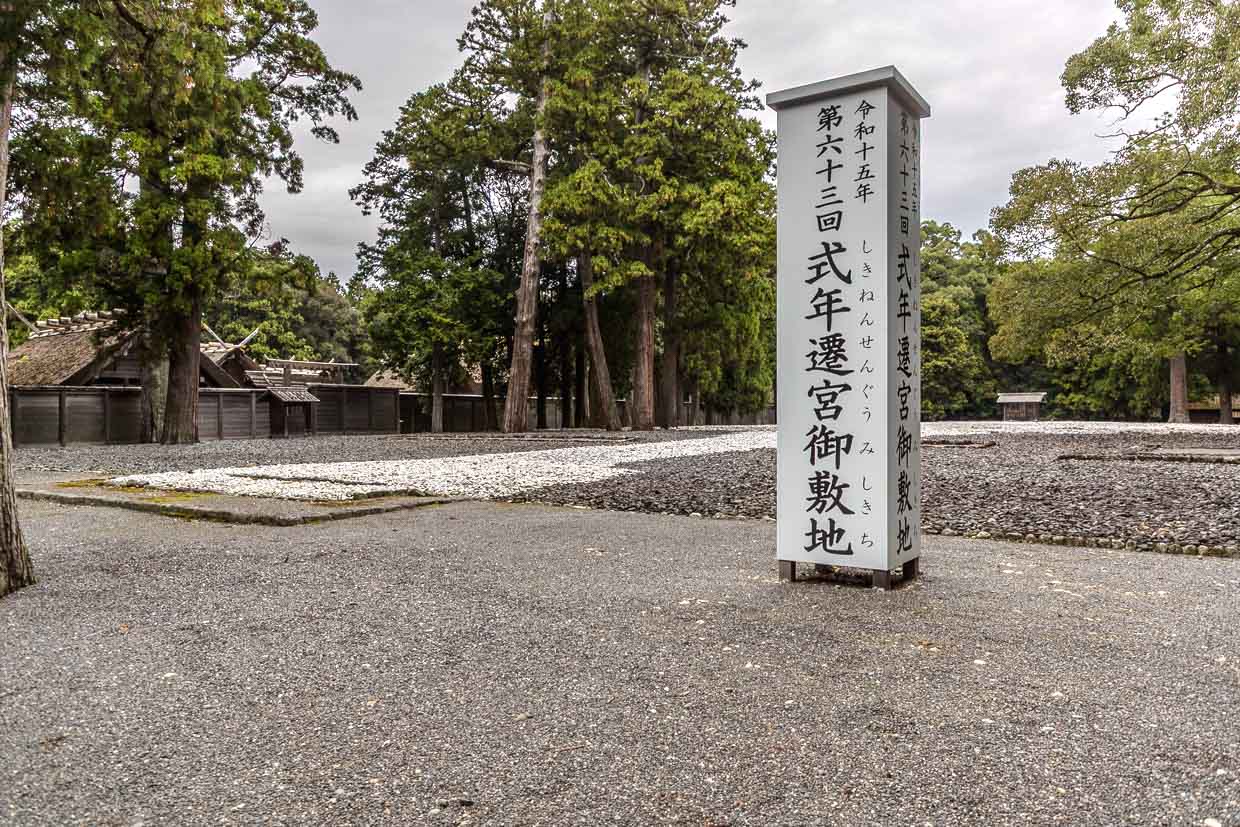
The Geku is the shrine of Toyouke-Ōmikami, the goddess of food, clothing and living. According to ancient chronicles, Amaterasu had her specifically summoned to Ise. Since then, priests have brought her fresh food twice a day – morning and evening, without interruption for fifteen hundred years.
Through the city to the second shrine
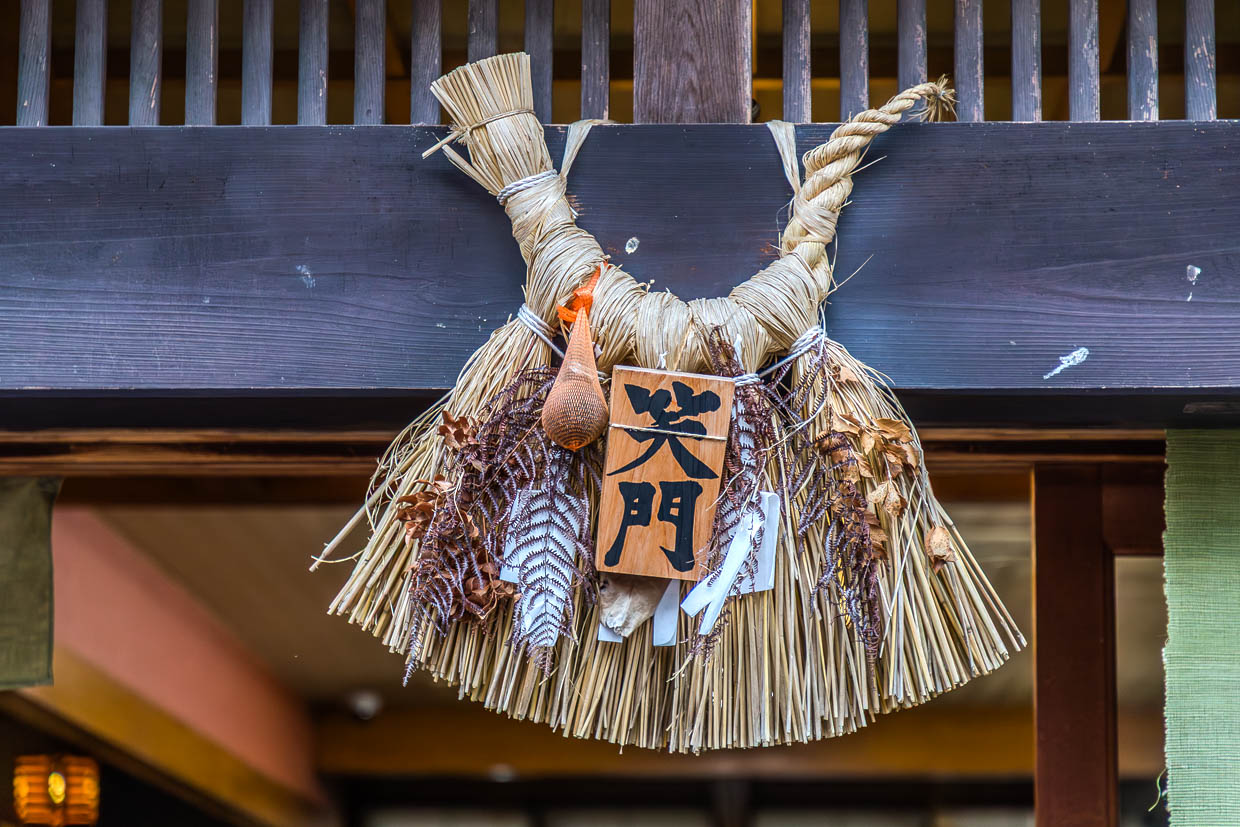
Between Geku and Naikū lies the Oharai-machi again. If you keep to the order, you have to go through here a second time. Above the shop doors hang straw bundles made from woven rice straw, along with dried plants and strips of paper. Shimekazari: a sign of purity, protection for the entrance. A wooden plaque reads 笑門. The gate of laughter. A Japanese proverb says: Happiness enters the house where laughter comes from. Here it hangs above the entrance to a fish shop.
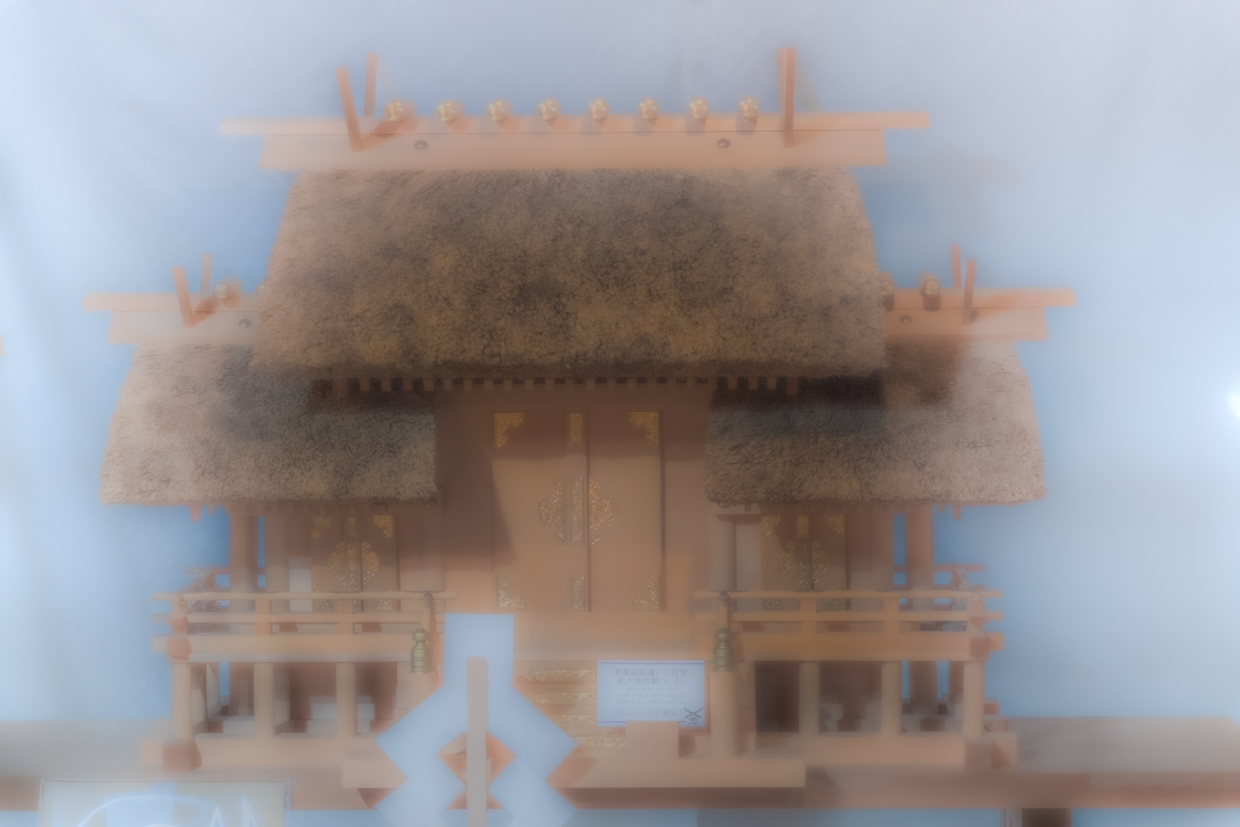
What no one is allowed to photograph can be bought. In the Oharai-machi souvenir shop is a scale model of the Naikū main shrine, payable by credit card. We took a photo of it. Out of respect for local customs, we have blurred the photo in the article. If you want to see it in full sharpness, click on the image.
Naikū – the second shrine
A white chicken runs along the gravel path. This is no coincidence and no decoration. The chickens at Ise-jingū are sacred. In Amaterasu mythology, it was the crowing of the rooster that lured the sun goddess out of her cave, where she had retreated, and thus provided the world with light again. The chicken reminds us of this without the need for a shield. Because the pilgrims know the legend.
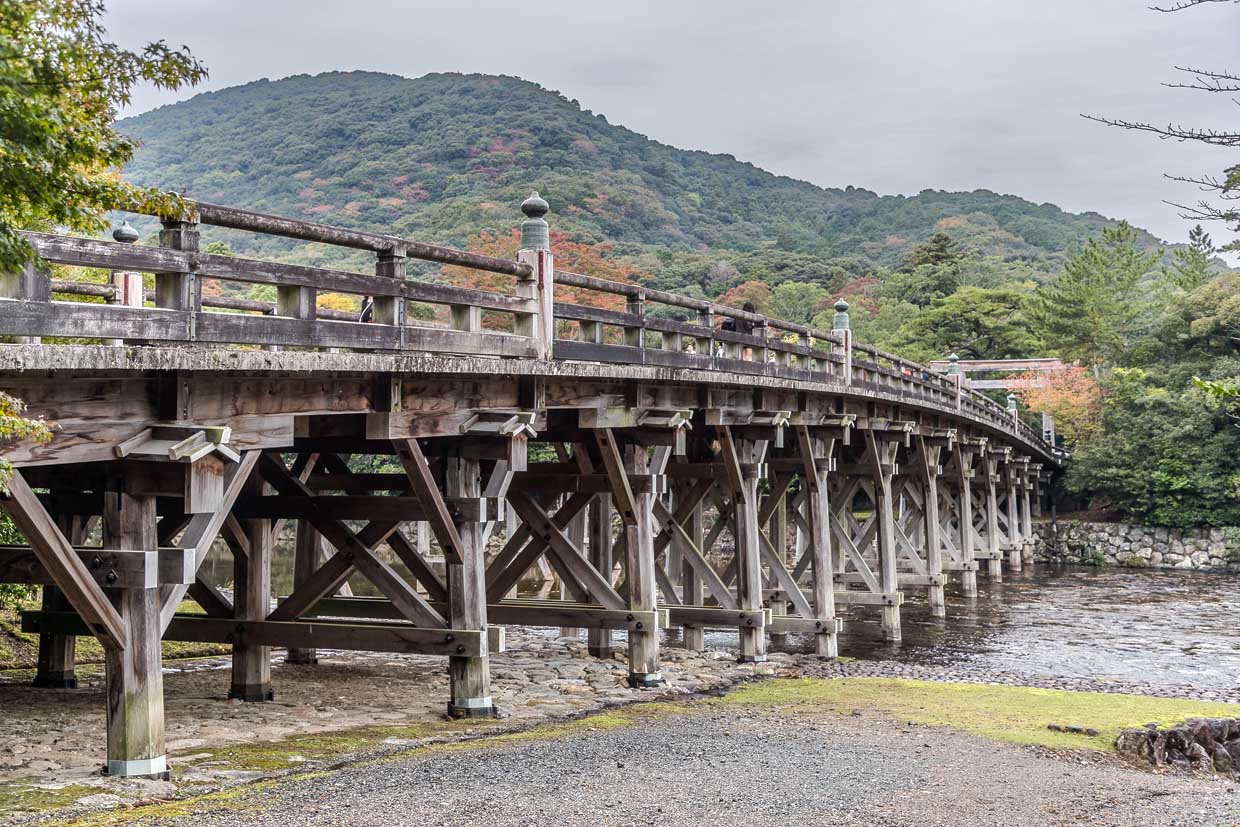
The Uji Bridge is the crossing point. Behind it begins the Naikū, the inner shrine, and the real reason why six million people come to Ise every year. Amaterasu-Ōmikami, the sun goddess, lives here. It rains. That is not insignificant.
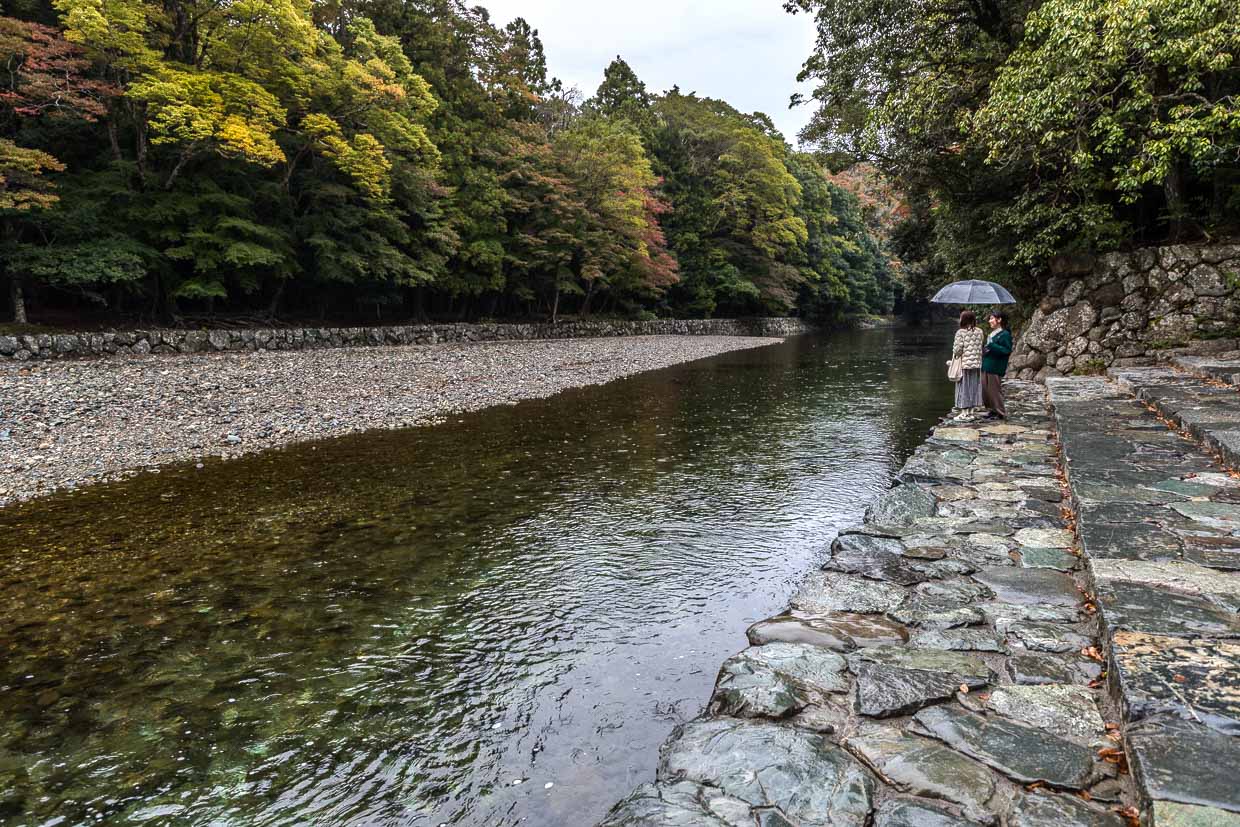
Before entering the forest path, steps lead down to the Isuzu River. This is the Mitarashiba, the Naikū purification facility. Here you don’t wash your hands in a basin, but in the flowing water of the river itself. The water comes from the sacred mountains behind it. It moves, it renews itself. That is the difference to the stagnant water of other shrines. If you want to go further, stop here.
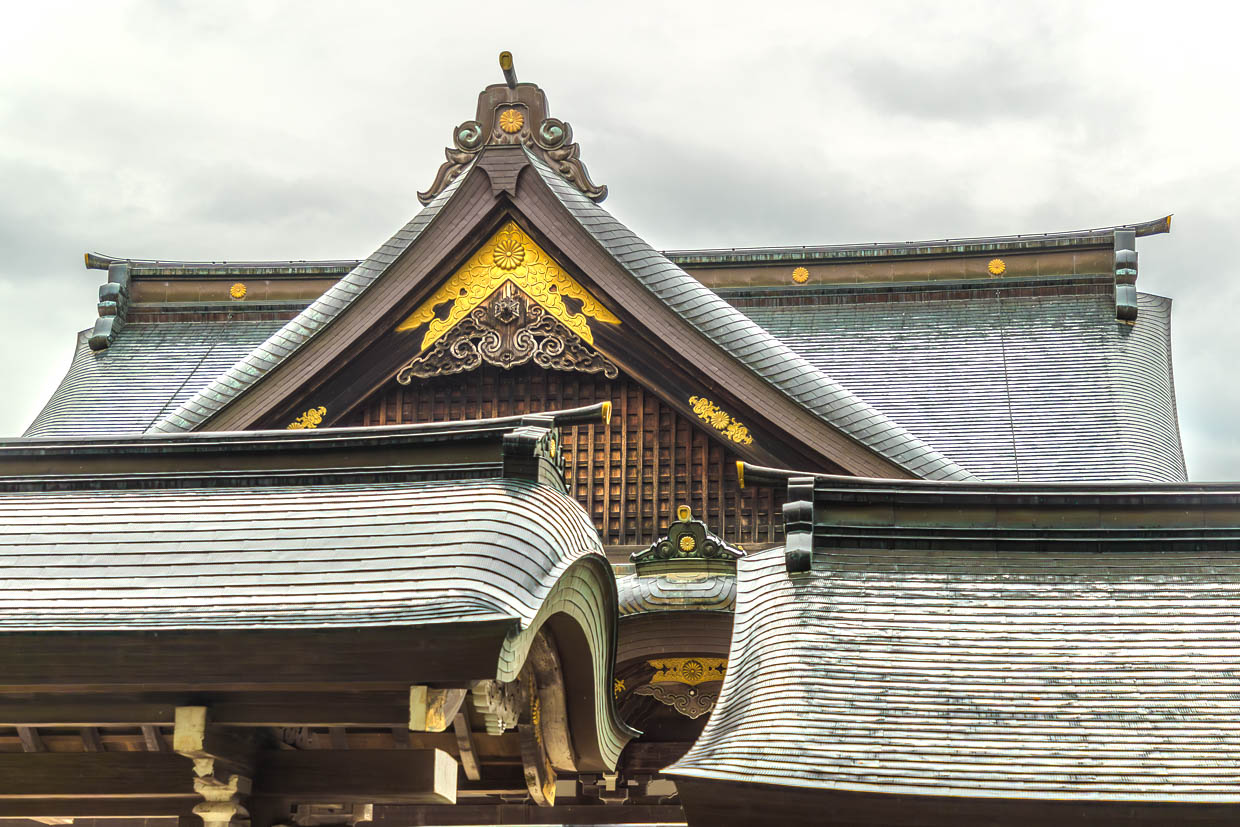
The kagurads are the most magnificent buildings to be photographed on the site. Lacquered wood, gilded chrysanthemum emblems, curved roofs made of hinoki bark. Here you can buy amulets, have your shrine stamped and book a kagura ceremony. The more public the function, the more elaborate the construction. The actual shrines behind them are simple, without lacquer or ornamentation. You are not allowed to photograph them. The simple is the sacred. The magnificent is the accessible.
We meet a family on the grounds. They are all wearing kimonos. A professional photographer accompanies them. There are no-photography signs behind them. The guide does not intervene. The girl looks into the camera.
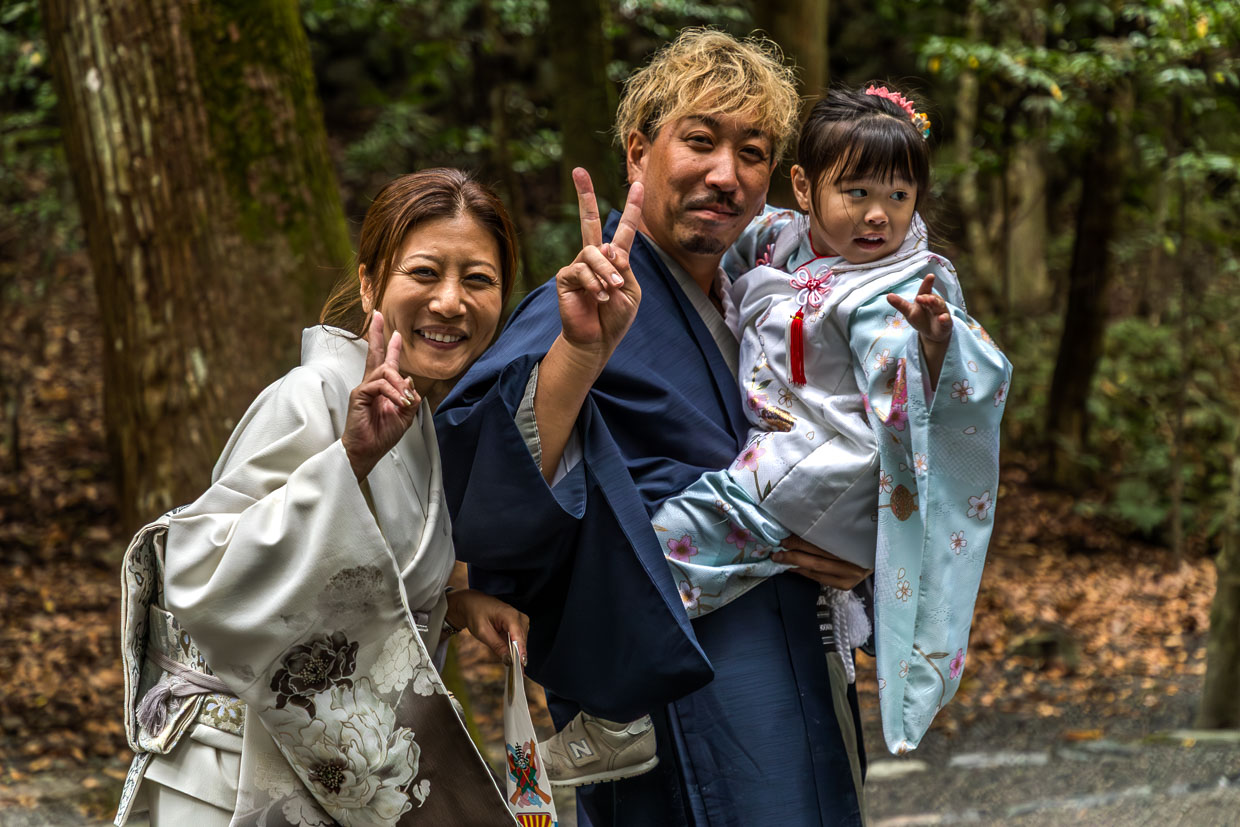
The ban does not protect the site as a whole. It protects the sacred behind it: the buildings, the curtain, the invisible. What can be shown is the visible: people who live their faith. What the family performs is called Shichi-Go-San. Girls aged three and seven and boys aged five are formally introduced to the kami. The child will not remember. But they will know the photos. At some point they will be standing here with their own child. This is how Shinto is passed on without ever being taught.
The great secret
Behind four wooden fences, one behind the other, lies the innermost part. If you’re lucky, you can see the thatched roofs. The Yata no Kagami mirror, one of Japan’s three imperial insignia, remains in the dark. Literally and deliberately. Only a few priests and the tennō’s family are allowed to enter the central building. What is inside has never been photographed. Does it even exist?
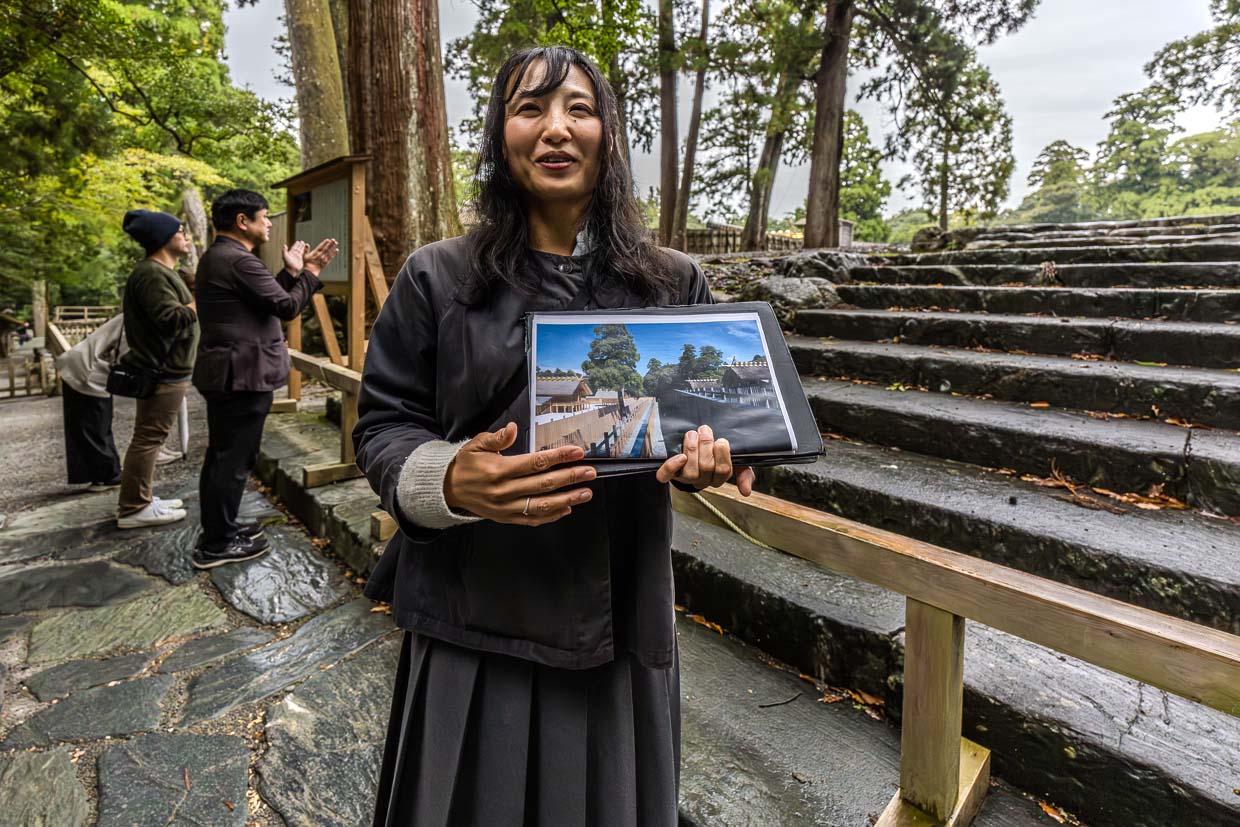
Chifumi Takahashi shows us two shrines next to each other in a photo – as if time were just a different arrangement of the same space. The official website shows what lies behind them and what will be created in 2033 in pictures that we were not allowed to take: https://www.iseshima-kanko.jp/en/highlights/sengu_eg
The wood
Somewhere in the forests of Nagano Prefecture, in the Kiso Valley, a tree stump lies under a canopy. A straw rope is tied around the stump. Strips of white paper hang from it. The tree was felled in June 1985, with axes and from three sides, using the Mitsuhimogiri technique: three notches, three ropes, controlled fall, no chainsaw. It was a Goshinboku – a sacred tree, intended for the sacred container of the deity at Shikinen Sengu 1993. The wood was in Ise. The stump is still here.
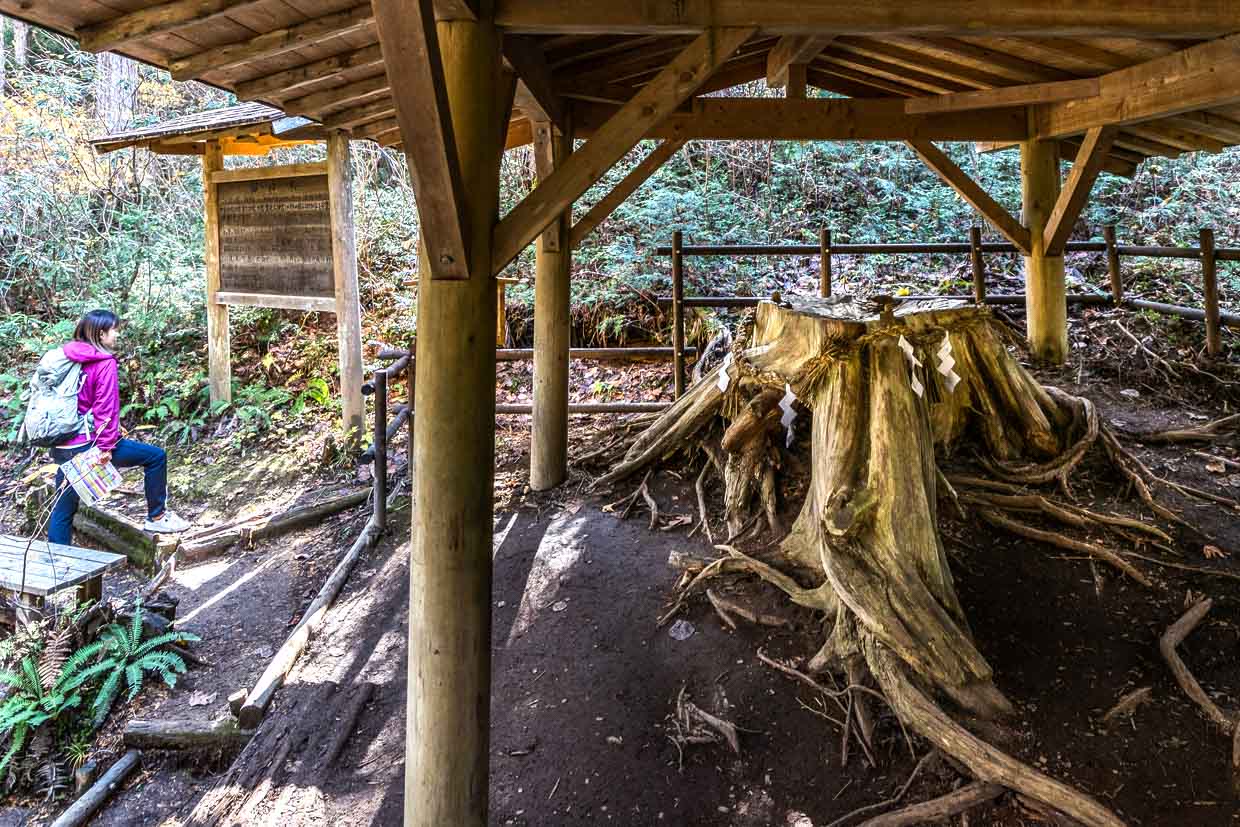
The Akasawa Forest is located in the Kiso Valley of Nagano Prefecture, 160 kilometres from Ise as the crow flies. The wood for the shrine has come from here for centuries. In the past, it was transported on the Kiso River, which flows directly into Ise Bay. The logs were tied together in the water and floated downstream by men with poles and ropes, according to traditional rules and in fixed roles. If you want to know what this looked like and why it has stopped almost everywhere in the world, you can read about it in another article. In Ise, the practice lives on, every twenty years, when the Okihiki procession pulls the tribes the last kilometres to the shrine, with ropes, on foot, under the call Enya, enya.
Today, the wood comes by land. A complete Shikinen Sengu requires around 13,000 Hinoki cypress trees. Since 1923, the shrine administration has been replanting its own forest, the Kyuikurin, directly on the banks of the Isuzu River in front of the Naikū. A Hinoki cypress tree takes 200 years to reach building maturity. The stock from 1923 will not be ready until 2123 at the earliest. The transport route would then be reduced from 160 kilometres to zero. The wood for the shrine would come from the shrine’s forest.
More episodes from Japan
Spiritual, culinary, fascinating. On our trip through the Japanese prefectures of Wakayama, Mie and Nagano as well as the cities of Osaka, Nara and the Hakone region, we hiked pilgrimage routes and ancient trade routes, bathed in hot springs and drifted through the street food streets of Osaka and packed lots of red tins from Nagano into our suitcase. There is no way around octopus there – especially not a takoyaki, the legendary dough ball with a tiny piece of octopus inside. In Tanabe, another world opens up: that of Umeshu, the amber-coloured plum liqueur, the nuances of which you can get to know in a small bar. If you can still walk afterwards, it is best to head straight for the famous Kumano Kodo pilgrimage route – and if you want to do it in style, wear a kimono. Yunomine Onsen is home to the oldest onsen in Japan, where hot water has been bubbling up from the earth for 1800 years for cooking, bathing and relaxing. You can learn about the history of the ama, the women of the sea, their tradition and their endangered craft in Mie. If you are looking for a souvenir, you can choose an oyster in Ise-Shima. You can only find out what’s inside at the Pearl Picking. In Ise itself, Japan’s most important Shinto shrine holds a secret that has been kept for twelve hundred years – by rebuilding it every twenty years. The somewhat quirky bag charm culture, in which soft toys dangle from bags, is a nationwide phenomenon.
The research trip was supported by the Iseshima Tourism and Convention Organisation and the Nagano Tourism Organisation