
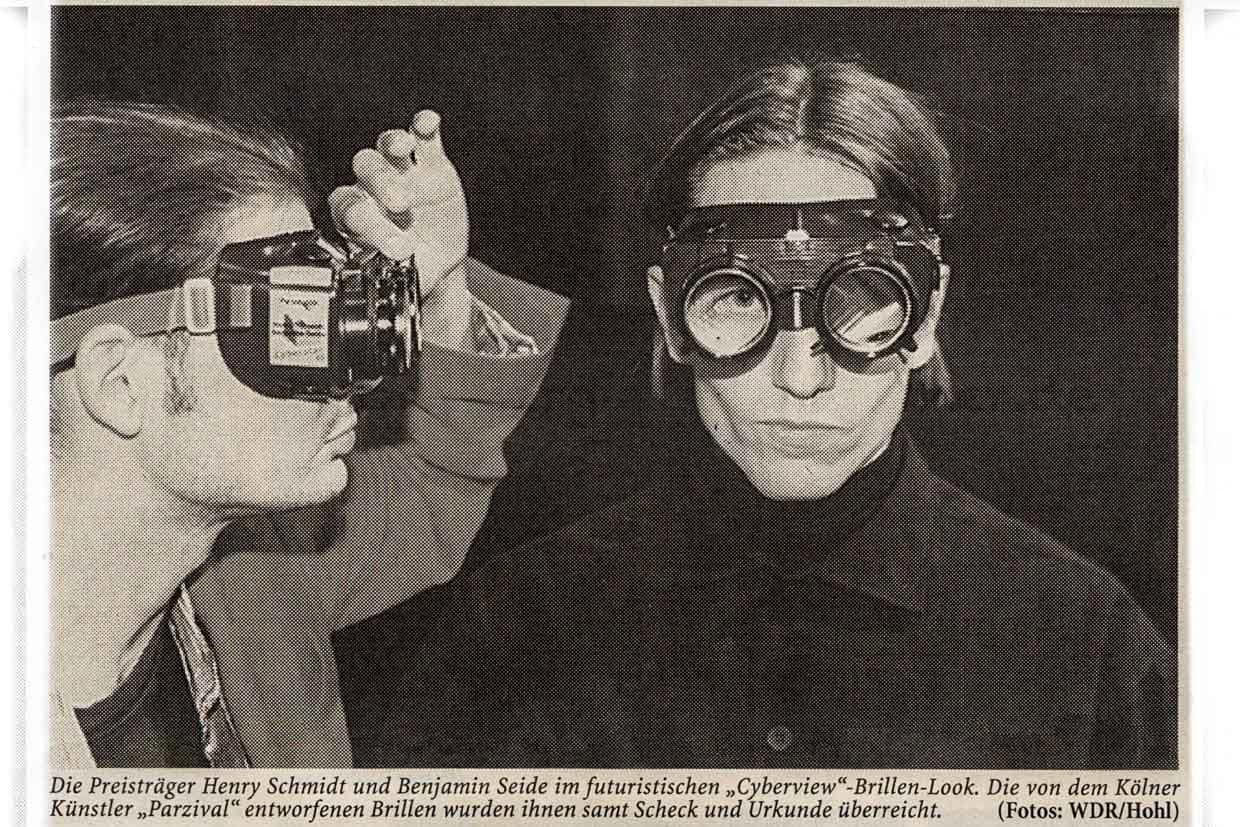
On 20 June 1995, two young men stood on stage in the main broadcasting hall of WDR in Cologne. They wore futuristic glasses, specially designed for the evening. Henry Schmidt and Benjamin Seide, film students from Ludwigshafen and Saarbrücken, had just won 14,000 German marks (around 7,200 euros, a good annual student wage at the time) and a three-month scholarship from the Society for Mathematics and Data Processing – for a concept that was to describe the television of the future.
The prize was called Cyberstar. Hardly anyone remembers it today. This text aims to change that.
1994: A look back
Before the story begins, let’s take a brief look at the time in which it was written. If you didn’t experience it yourself, you don’t have a yardstick.
There were no smartphones, no apps. Photography was analogue. Digital photography existed, but was rare and delivered resolutions that no mobile phone would accept today. The Internet is accessed via modem over the telephone line. During the connection, the line remains busy – nobody can call. A website with three images takes longer than a minute to load.
The Internet is not a web, but a labyrinth called Gopher – a text-based menu system reminiscent of a university library’s card index. You navigate through folders without a search engine. You know addresses because you have copied them from mailing lists. The World Wide Web has been around for three years, but most people know nothing about it. The Mosaic browser, which combines text and graphics for the first time, has been circulating in universities for a year. Netscape Navigator, which would popularise the web, appeared in December 1994, but Internet Explorer was not yet available.
If you google “cyberstar” today, you will find IT security companies. The word “cyber” has changed its meaning: from a vision of the future to a threat. Back then, it stood for the opposite of fear.
Three worlds that were alien to each other
The networked world had a problem – or rather three. Broadcast television, telecommunications and computers existed side by side without understanding each other. Each world spoke its own language and followed its own logic.
At the time, Georg Berg was head of the Technical Information department at WDR. Because the unit had moved to public relations, he was able to work more editorially. Georg’s previous observation in the Technical Directorate: inventors often develop what is easy to invent – not necessarily what is needed. What if the creativity of the three worlds was not channelled through planning, but through an open competition? A swarm intelligence that generates ideas that no single organisation could develop on its own.
At WDR, the idea initially met with little interest. But Knut Fischer, the television culture editor, understood it. Although in poor health, he refused to be deterred. Together with me, he developed the Cyberstar. The name said it all: an alternative to the Telestar, the established television award that favoured ARD and ZDF productions. The Telestar was a glamorous gala featuring celebrities, live performances and self-congratulation within the industry. The Cyberstar was intended to be the opposite: not an award for existing television, but for the television of the future. Not a gala for the established, but a competition for ideas. The jury was to judge independently, and the participants were to be respected as sources of ideas. The Cyberstar was a call to envision a media future that, until then, many had sensed and glimpsed in its scope, but which no one had yet truly seen.
Anyone who knew Knut Fischer and remembers this time should get in touch: 1995@tellerrandstories.de.
The competition and the submissions
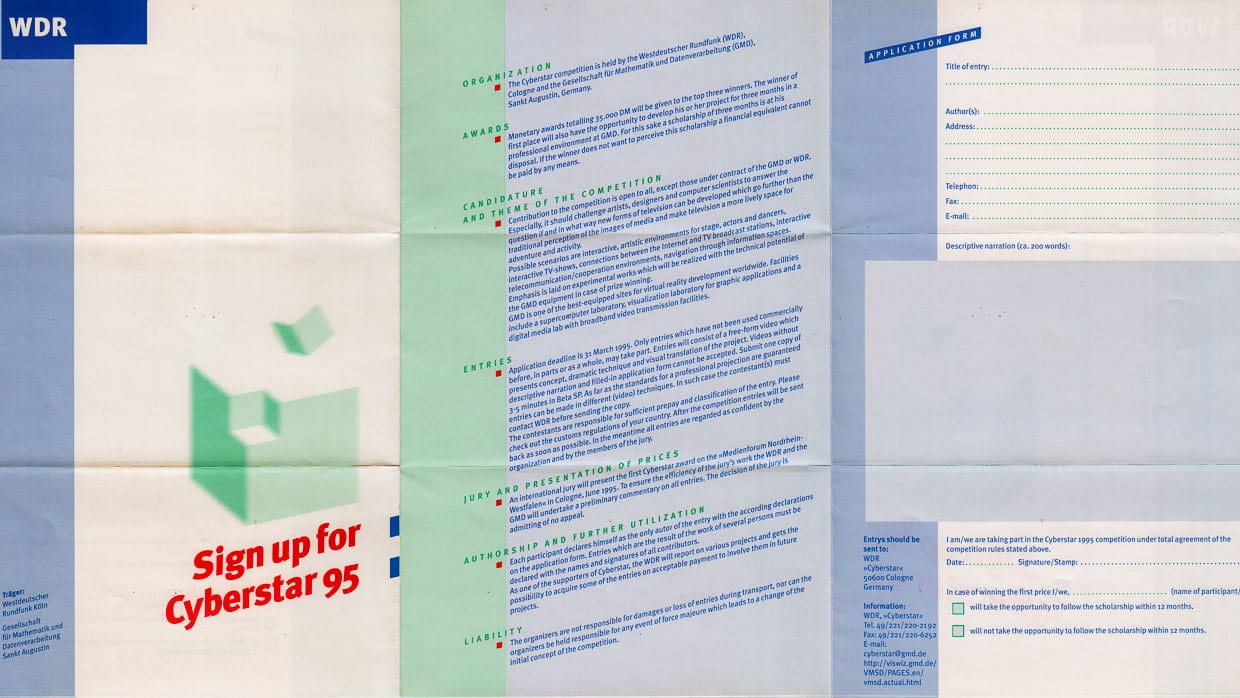
On 28 March 1995, WDR and GMD signed the cooperation agreement. The prize money: DM 35,000 (around 18,000 euros), financed by WDR. The GMD provided the first prize winner with a three-month scholarship.
The competition was advertised early and internationally. As early as February 1995, we presented the Cyberstar at Imagina in Monte-Carlo, the leading European festival for computer graphics and interactive media. A joint press release from GMD, WDR and the French Institut National de l’Audiovisuel publicised the competition. The response was surprising: the first entries came from the USA, not from Germany.
In the end, 88 video exposés were submitted by post on video cassettes. They came from Germany, the USA, Canada, France, Great Britain, Spain, the Netherlands, Austria, Switzerland, Belgium, the Czech Republic and other countries. The submissions ranged from interactive stage installations and telematic sculptures to early Internet projects.
Among the participants was the Swiss collective etoy, which submitted one of the earliest documented projects with its INTERNET-TANK. The Cologne collective Knowbotic Research presented Dialogue with the Knowbotic South, later honoured twice at the Prix Ars Electronica. The Canadian Luc Courchesne showed Family Portrait, an interactive installation. David Rokeby and Paul Sermon also submitted groundbreaking works. Rafael Lozano-Hemmer and Will Bauer presented The Trace, a work about telepresence and digital body extension.
Were you one of the 88 entrants? Do you still have any documents or the video exposé from that time? Write to: 1995@tellerrandstories.de.
The jury and their decision
The jury met at Schloss Birlinghoven, the headquarters of GMD, from 22 to 24 May 1995. They viewed the video tapes and made handwritten notes. No search engine, no database, no server.


The five jury members were selected to represent the three worlds of the competition – art, media theory and the practice of making. None of them were bound by the logic of a German television station.
Jill Scott came from the practice of interactive installations. At a time when computer artists were often either technicians or conceptualists, she combined both: the body in space, the machine, the narrative. As an artist at the ZKM Karlsruhe, the leading centre for media art in Germany at the time, she was familiar with the tensions between artistic experimentation and institutional expectations. She knew what could be realised – and what only sounded like it.
Valie Export was considered one of the most radical media artists in Europe at the time. From the 1960s onwards, she used the human body as a medium, thematised surveillance and identity in public space and coined video as an art form. As a professor at the Berlin University of the Arts, she represented a tradition that saw television not as an entertainment device but as an instrument of power – and as a place where this power could be broken.
Derrick de Kerckhove, a close associate of Marshall McLuhan, translated his work into French and continued it as director of the McLuhan Institute in Toronto. McLuhan was interested in television as an “extended nervous system” that not only transports content but also shapes ways of thinking. De Kerckhove transferred this idea to the emerging Internet. He brought the question to the cyberstar: How does a new medium change the consciousness of its users?
John Thackara had been head of the Dutch Design Institute in Amsterdam since 1993. This institution was not concerned with product design, but with the social consequences of technological decisions. Thackara saw television not as a medium, but as an infrastructure: Who decides who broadcasts? Who shapes the experience? What are the social consequences of technology? His handwritten notes from Birlinghoven reflect these questions.
Peter Krieg, documentary filmmaker, director and artistic director of the High Tech Centre Berlin-Babelsberg, thought in terms of stories and productions. He asked what remained of a concept when it was realised and what a real television audience could do with it. Krieg was the pragmatist of the jury, who insisted on feasibility and reach. He died in 2009.
John Thackara wrote: “No submission completely solves the task of creating new forms of television. But four works stood out.
First prize: Paramatrix by Henry Schmidt and Benjamin Seide. An open interface architecture that grows like a virtual organism and makes the Internet navigable on the television screen. Jill Scott praised the intelligent, humorous approach.
Runner-up prizes: The Venus Home Page by Lynn Hershman Leeson, Neighbourhood Works by Dan Northrup and The Trace by Rafael Lozano-Hemmer and Will Bauer. (We found an installation by Lozano-Hemmer decades later in the foyer of a Polish hotel).
The CyberSphinx by Catherine Ikam and Louis Fléri received an honourable mention.
Memories of the jury session? Write: 1995@tellerrandstories.de.
The award ceremony
On 20 June 1995, 6.30 pm, in the main broadcasting hall of WDR. Over 600 guests. WDR television director Jörn Klamroth declared that the Cyberstar should shine above cyberspace and show the way.
Henry Schmidt and Benjamin Seide wore the futuristic glasses of the artist Parzival. Instead of a show band, a three-piece combo played. The Medienforum newspaper wrote: “For the first time, WDR awarded the ‘Cyberstar’ for the development of interactive television concepts.”
The musical accompaniment also emphasised the alternative concept to Telestar. Instead of a show band and star performances, a three-piece combo – grand piano, drums, dancers – played under the name Mike Herting & Partner. Anyone who was there still remembers it.
Who was there and has photos, notes, memories? Write to: 1995@tellerrandstories.de.
What the cyberstar foresaw
The award-winning projects from 1995 look like a map of the future today. Paramatrix anticipated personalised media consumption. The Venus Home Page thought about identity on the Internet long before social media. Neighbourhood Works dreamed of digital community before Facebook and Twitter arrived. The Trace explored telepresence – a topic that is now part of everyday life with remote work and virtual reality.
The difference between what the cyberstar envisioned and what became: The concepts of 1995 were thinking in terms of empowerment: More opportunities for creatives, more voices for communities, more tools for individuals.
But reality followed different rules. The cyberstar asked: What should be built? The market answered: What makes money?
An archive that almost got lost
I am writing this text with an archive in front of me: faxes, minutes, notes, contracts, flyers. Photos from the evening? None. In 1995, hardly anyone thought of documenting experiences digitally. Photography was analogue, and anyone with a camera was the exception. The web was too new to serve as a memory.
In 1998, there was a second edition of Cyberstar, this time under the title Shared Visions. But the first was the more radical: it took place before institutions canonised the topic.
Knut Fischer, without whom the first Cyberstar would not have been created, did not live to see the second edition.
What we don’t know
This article is based on Georg Berg’s personal archive and is the beginning of a search. What became of the artists? What do the participants remember? Are there any photos of the evening? If you were there, write to: 1995@tellerrandstories.de. The Cyberstar thrived on swarm creativity. The memory of it too.