Beurre Bordier from Saint Malo

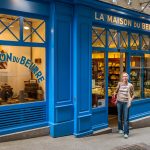
In the Rue de l’Orme lies La Maison du Beurre. Jean Yves Bordier started here in 1984 with a small butter shop. He wanted to make butter again the way his grandfather had done it, with a lot of time, wooden tools and traditional techniques. Today, top restaurants from all over Europe order Bordier’s butter. It tastes milky, almost creamy fresh. Within three days, a delicious product is created that has nothing whatsoever to do with highly industrialized butter production.

At the beginning of the numerous steps in the process, the Breton Riendvieh stand on a lush sea-salted pasture and receive organic feed in summer and winter. The cows give much less milk than the high-yield cow from the large dairy. The cows’ feed affects the taste of the butter. The milk goes into a stainless steel vat and is stirred for 90 minutes. This step gives the butter the additional name Beurre de Barratte = barrel butter. It flocculates white and floats in a white whey. The mass is cooled down with ice water, thus contracting further, is skimmed off and then rests for three days.

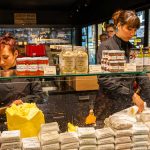
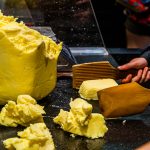
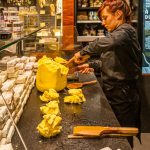
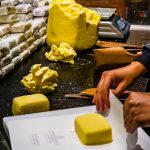
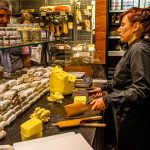
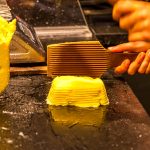
Blick durch die Arbeitstheke im Maison du Beurre. Aus einem Butterblock werden kleine Portionen abgeteilt / © Foto: Georg Berg
View through the work counter at the Maison du Beurre. Small portions are cut from a block of butter / © Photo: Georg Berg

When butter cries all will be well.

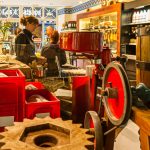
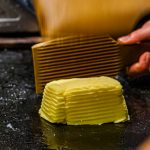
The next step in butter production is malaxage, or kneading. Bordier relies on wood as a material here. The butter is kneaded between a wooden blade and a wooden roller. Until it starts to weep. The butter cries, from the moment it loses water drop by drop through the kneading. In the store on Rue d’Orme, you can watch this final step of processing. Skilled hands pry portions of 125 g each from a large block of butter and beat them into shape with two wooden paddles. The butter weeps here for the last time. Again, drops of water remain on the work surface.

The Bordier butter is now soft and tender. The last work step turns the staple food butter into a delicacy. The butter refiner malaxes ingredients such as Madagascar vanilla, piment d’Espelette, yuzu, smoked salt or seaweed into the natural butter. The result is fantastic creations with intense flavors. No wonder fat is the flavor carrier par excellence.

Our works are inspired by human encounters and always culinary discoveries. What format do you need? A newsworthy report, an entertaining reportage, a short travel tip or a picture gallery? At the international photo agency Alamy you can see all the photos of Georg Berg on the subject of Butter Le Beurre Bordier. Clicking on one of the images below will take you directly to the agency image.
Content Protection by DMCA.com

This post contains advertising links (also called affiliate or commission links) that lead to intermediaries of goods or services.

More Food Stories

Inspirated by Dona Antónia

Osh’s oven-baked bread

Canada and maple syrup

Food tips for Halifax

The Gourmet King of Nancy

Nova Scotia and the lobster

Shichimi and the red tin from Nagano

Umeshu Tasting in Tanabe

Osaka’s famous octopus snack

Ürgüps women’s co-operative

The food scene in Tbilisi

Blueberry bliss in the Black Forest

Cognac – The elegant one

Spirit tourism – Enjoyment while traveling

Wallonia: Sacred beer at Bullette

Stockholm food tips

Krukmakeri: the star restaurant

Seafaring cuisine in Bremen

Culinary delights from San Marino

Culinary journey through Curaçao

Viticulture Conquers the North

Herring, Eel and Schiller curl

Dezerter Bazaar in Tbilisi

Ta‘ Rosina on Gozo

Kaiseki dinner with Atsuko Kato

Snack board with the scent of stone pine

Bénichon, Kilbi? Definitely Fribourg!

Made in Chicago: Snacks & Sweets

Sea salt from Gozo and Malta

The carp – an underestimated fish

From show-off Stollen to Stollen etiquette

Tea cultivation in Malawi

Bananas from Malawi

Malawi’s main dish: Nsima

Sweet Salzburg

Cyprus traditional cuisine

Beer powder from Brandenburg

Iceland and the beer

How Icelanders bake bread

Hákarl. Shark snack from Iceland

The market hall of Avignon

France and the desire for beer

Mediterranean oysters

Helmut Schmidt culinary

Curry Eggs

Cholera Swiss Specialty

Cooking with Lavender

Cake from the city of Deventer

Lavender flower in Drôme Provençale

Halloumi? Hellim? Grilled cheese from Cyprus

Pfefferlechner craft brewery

Frigoulette chocolate from São Tomé

Cassoulet. Stew with history

Olive oil from Provence

Dijon mustard in dilemma

Licorice and licorice

Beurre Bordier from Saint Malo

Truffle – Favorite of gastronomy

Oysters always suit

Smoked cheese from Denmark

Specialty smoked beer

Absinthe, legendary cult drink

Top chefs and their white brigade

Winter truffle with chefs of Provence

Tuscany wild asparagus

Culinary specialties in Ticino

Truffle: Great delicacy – Big business

Carraturo – archetype of the pasta machine

Olive growing at Château Léoube

Zoigl Inn in the Upper Palatinate

Zoigl – Beer tradition in Germany

Raclette – the original from the Valais

The truffle and its host, the oak tree

The Aups truffle syndicate

Fly, dog or pig? In search of truffles

Farina Bona, a Ticino specialty

Panettone in perfection

Burgundy and its truffle specialty

Absinthe – forbidden and rediscovered

Bamberg – Food from the Middle Ages

Culinary Bad Kissingen

Beer with best after date

Tenuta San Giorgio on Lake Lugano

World Heritage Site dedicated to the Gardener

Food tour through Zurich

Ticino cuisine on Lake Lugano

Zincarlin – Speciality from Ticino

Bamberg and the beer

Northernmost olive Grove in Europe

Rye bread baking experience

Zoigl from the community brewhouse Falkenberg

Bento – the snack for every situation in life

Breakfast in Japan – Miso soup and more

Food tour in Basel

Culinary rarity – Saffron from Switzerland

Markgräfler Küche im Hotel Krone

Hotel Mühle brings Apulian cuisine to Binzen

Saffron, spice and remedy

Shoyu – The black seasoning of the Japanese

Grenada’s oldest rum manufactory

Our mode of operation is characterized by self-experienced, well-researched text work and professional, vivid photography. For all stories, travel impressions and photos are created in the same place. Thus, the photos complement and support what is read and carry it further.

Never miss new Tellerrand-Stories again! Mithilfe eines Feed-Readers lassen sich die Information über neue Blogartikel in Echtzeit abonnieren With the help of a feed reader, all stories about the Tellerrand (edge of the plate) can be subscribed to in real time.

Permalink of the original version in German: https://tellerrandstories.de/beurre-bordier-butter-saint-malo