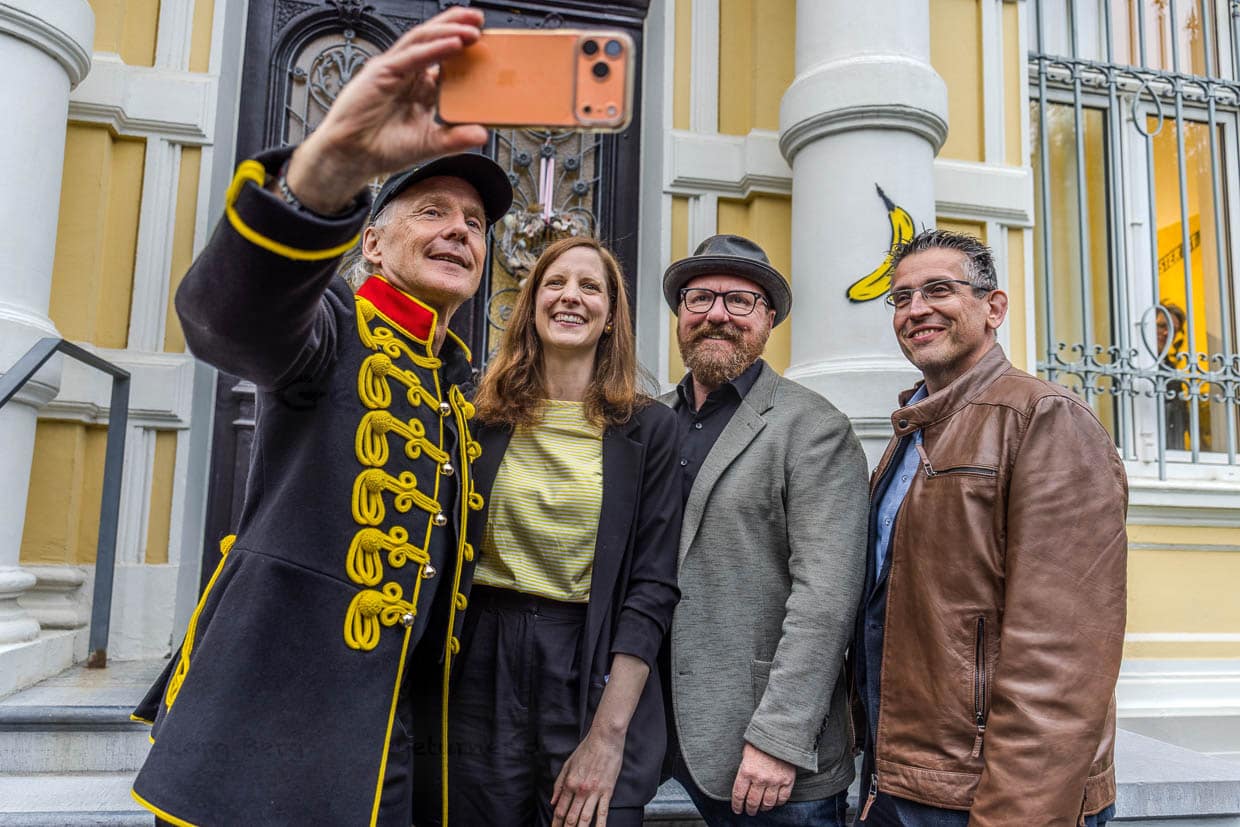
All the chairs in the lecture theatre are taken. The audience at the Museum der Niederrheinischen Seele in Grevenbroich is already waiting. Meanwhile, Thomas Baumgärtel walks through the exhibition rooms like a circus director. He is wearing a black military jacket with an opulently trimmed banana-yellow knitted border. He has not yet seen the hanging of his large-format stem paintings himself. It’s day four of his Lower Rhine tour, and Baumgärtel hasn’t slept much. It was just three hours yesterday, he says. The project revolves around the number 40, or in Roman terms: XL – in every respect.
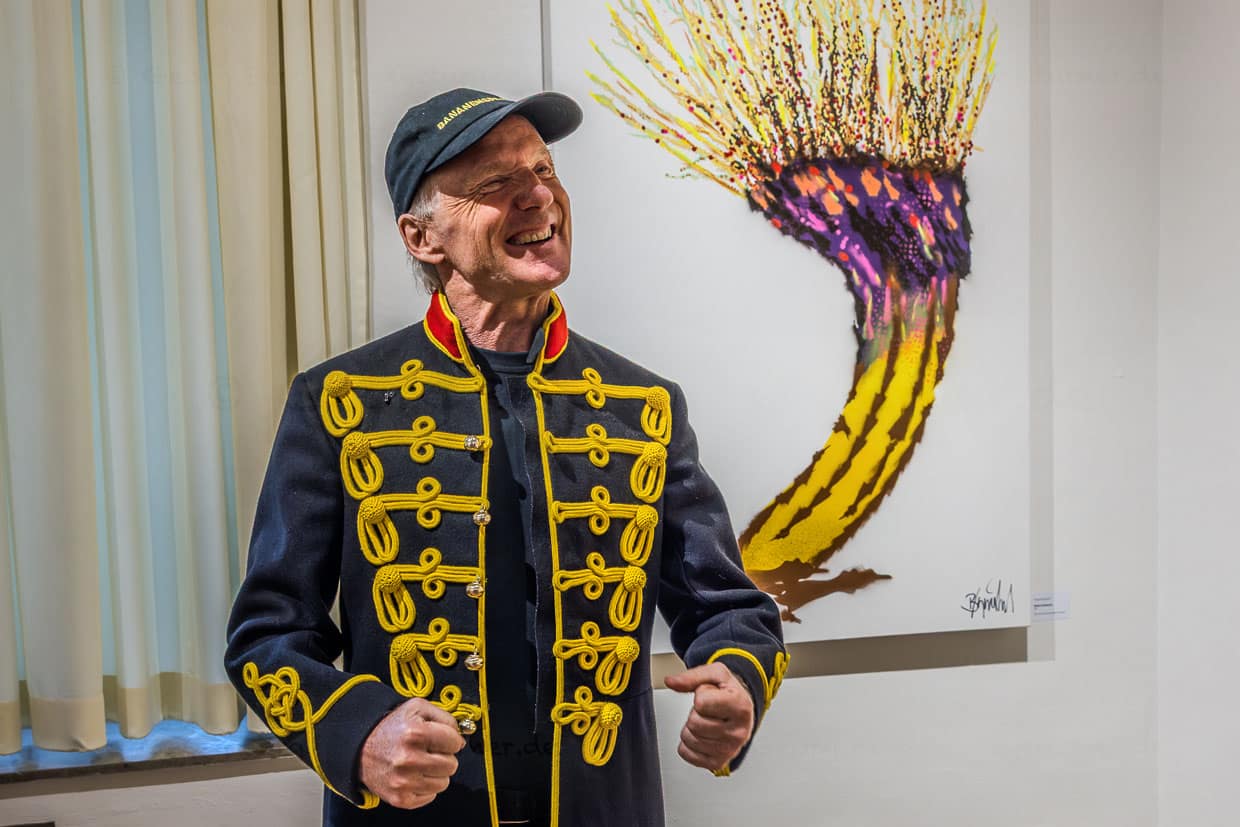
The NiederrheinTour 2026 exhibition project shows 40 groups of works from 40 years at 40 art locations. The tour is a tribute to the artist’s homeland. Its unique natural landscape and the high density of historical buildings alone make it worth seeing – even without the tropical fruit. The banana is the motif that made Thomas Baumgärtel famous. Since 1986, the Rheinberg-born artist has been marking art and cultural sites all over the world with his spray banana. The banana symbolises an overarching concept of freedom, diversity of opinion and cultural openness. Baumgärtel uses the motif to take a political and social stand. He created the Niederrhein banana especially for the tour of the same name. It ends in a shaggy willow.
40 art locations – record-breaking
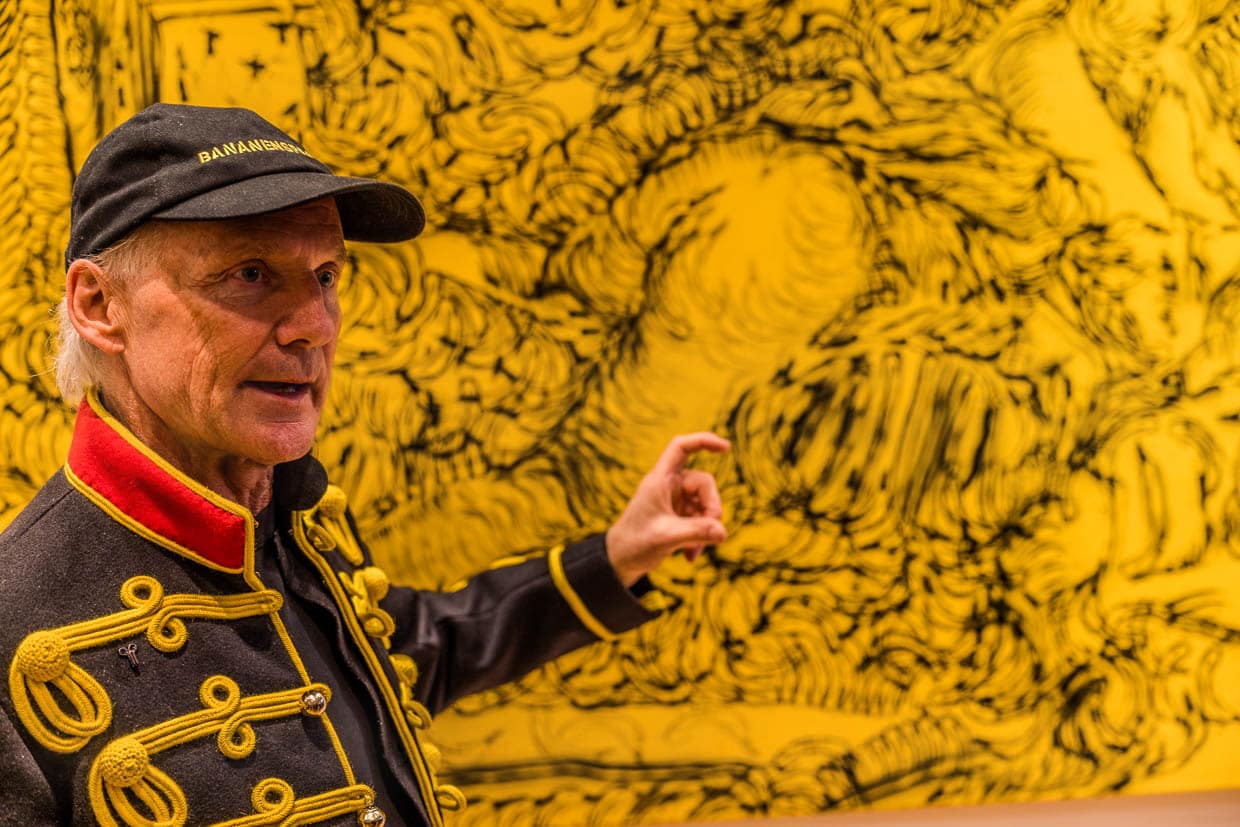
Baumgärtel is showing banana motifs at two art venues in Grevenbroich. Large-format stem paintings can be seen in the Villa Erckens. In the nearby shipping hall, his bright yellow banana pointillism hangs on all the walls. While the exhibition in Grevenbroich has already opened, work is still underway elsewhere. Paintings from his depot in Cologne are still being transported. Openings and construction run in parallel. In May 2026 alone, 19 exhibitions will begin. Baumgärtel himself was not familiar with many of the locations in the Lower Rhine region before planning began in 2025. It has become an exciting mix of art locations, he emphasises. In summer 2026, his works can be seen in castles and palaces, a water tower, manor houses, factory halls, a church and a mill. Visitors are encouraged to follow the banana trail. Cycle tours have been designed around the art locations. A stamp booklet is designed to awaken the collector’s instinct. As different as the exhibition venues are: There are always metamorphoses and abstractions of the original spray banana from 1986 on display, which in turn goes back to Andy Warhol ‘s comic-like banana that adorned the cover of the Velvet Underground & Nico ‘s debut album in 1966.
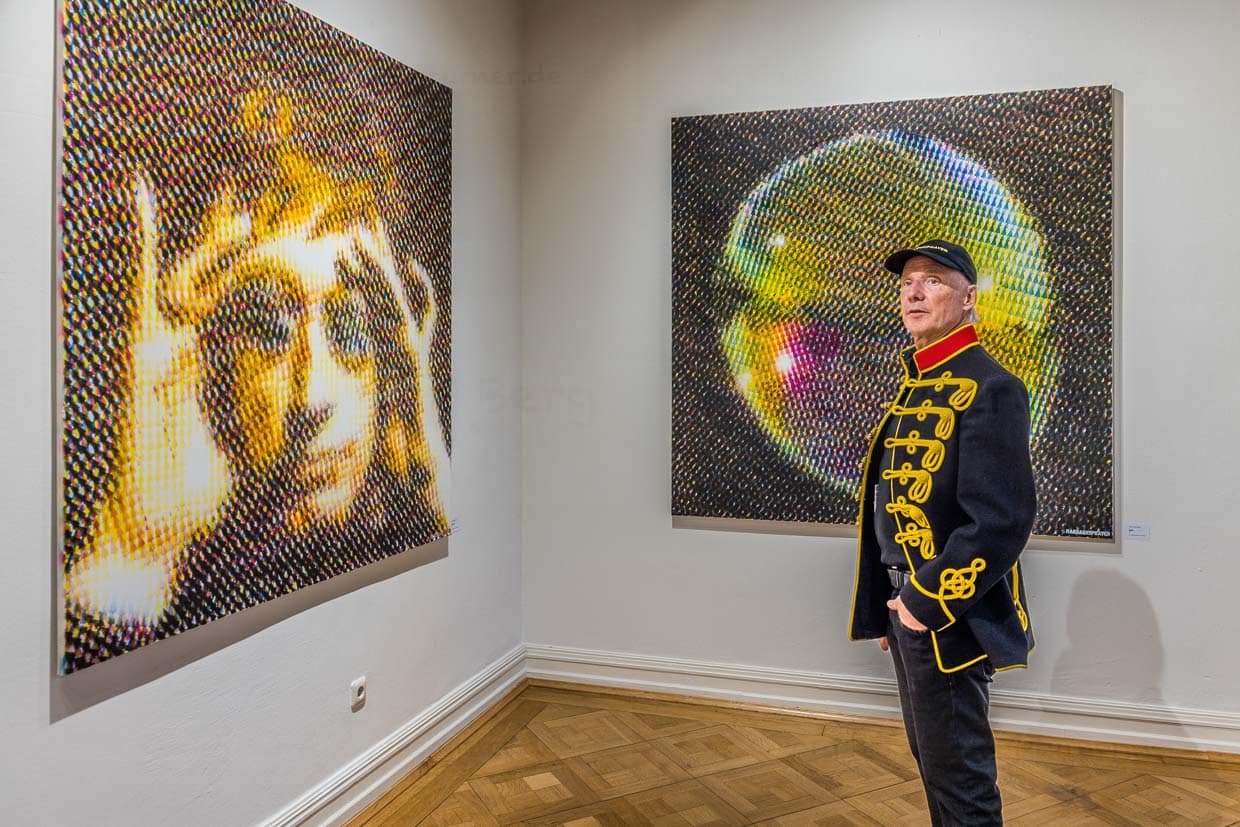
His very first stem painting shows a bowl of fruit. But you have to stand a hell of a long way away to recognise the kiwi, says Baumgärtel during the tour of the exhibition at Villa Erckens. For the next pictures, I placed the stems closer together. From 2012 onwards, he created large-format paintings with up to 20,000 hand-sprayed banana stems. He spent days in a fogged room with an airbrush, breathing mask and protective suit. In the Stielbilder group of works, Baumgärtel focusses on the distinctively shaped stem of the banana.
From grease monkey to excellence spayer
It is a story that begins with a civilian service and leads all the way to the great art temples of the world. Thomas Baumgärtel was born in Rheinberg on the Lower Rhine in 1960. In the early 1980s, he did his community service in a Catholic hospital in his home town. When a wooden cross fell off the wall there one day, the young civilian simply nailed his breakfast banana in place of the broken Jesus figure. This was a first act of artistic provocation. The patients were amused, the nuns horrified. In 1985, Baumgärtel began studying fine art at the Cologne University of Applied Sciences and became a master student of Professor Franz Dank. At the same time, he studied psychology, which, as he emphasises, helped him to understand the reactions of gallery owners and museum people and to deal better with the rejection and criticism of the early years.
German Urban Pop Art
In 1986, Baumgärtel marked an art location with the spray banana for the first time – at night, illegally, with a stencil and spray can. It was not a smooth ascent. When he turned up with a friend at the Museum Ludwig in Cologne in 1986, the police surrounded them with guns drawn. The officers initially suspected a bomb. When the word “spray banana” came over the radio, the situation eased. But the banana still had to be taken away. The police in Munich even arrested Baumgärtel, and insults such as “greaser” were among the milder reactions. It was only when the Museum Ludwig, under its new director Siegfried Gohr, recognised the artistic significance of the banana campaign that the banana leaf began to turn. More than 20 years after Andy Warhol’s comic banana and long before Banksy, Baumgärtel went out onto the streets and gave the banana a new meaning in a completely different context: as a signpost to art locations.
Artistic perseverance
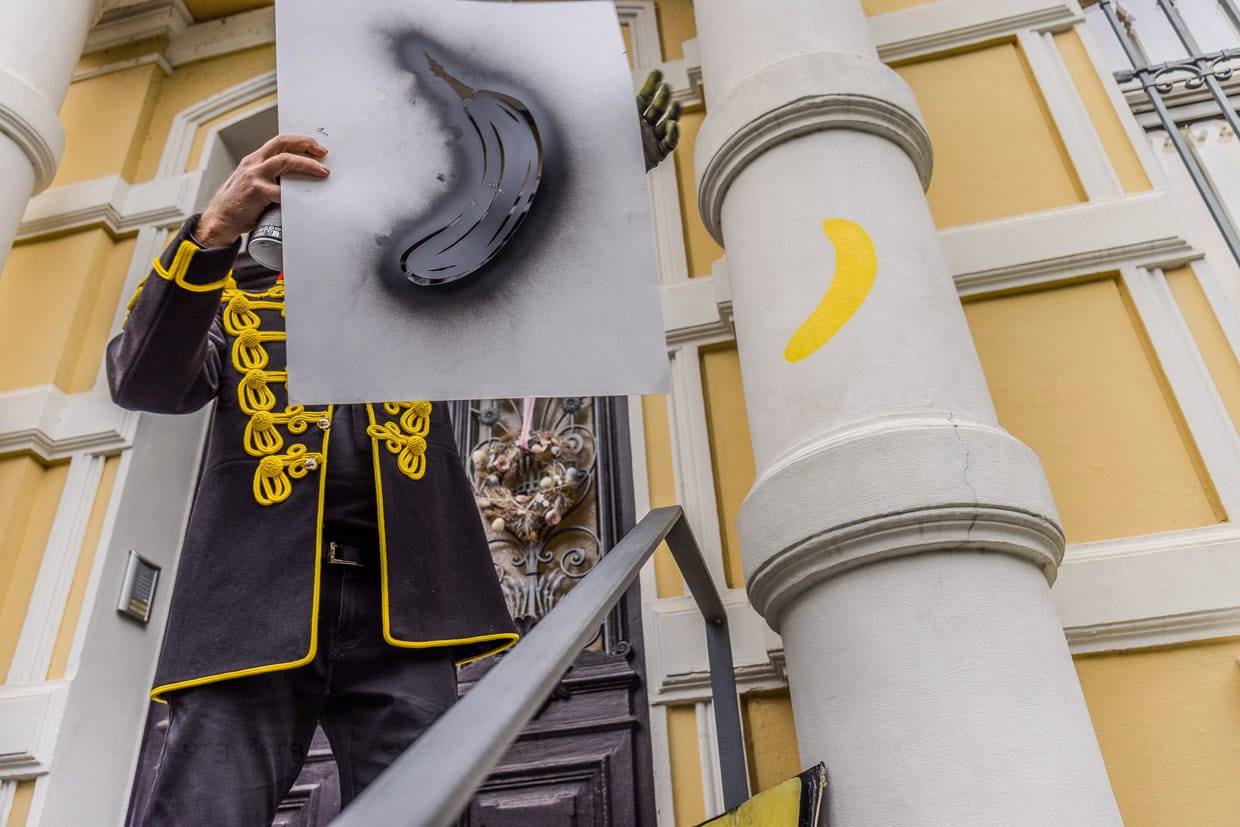
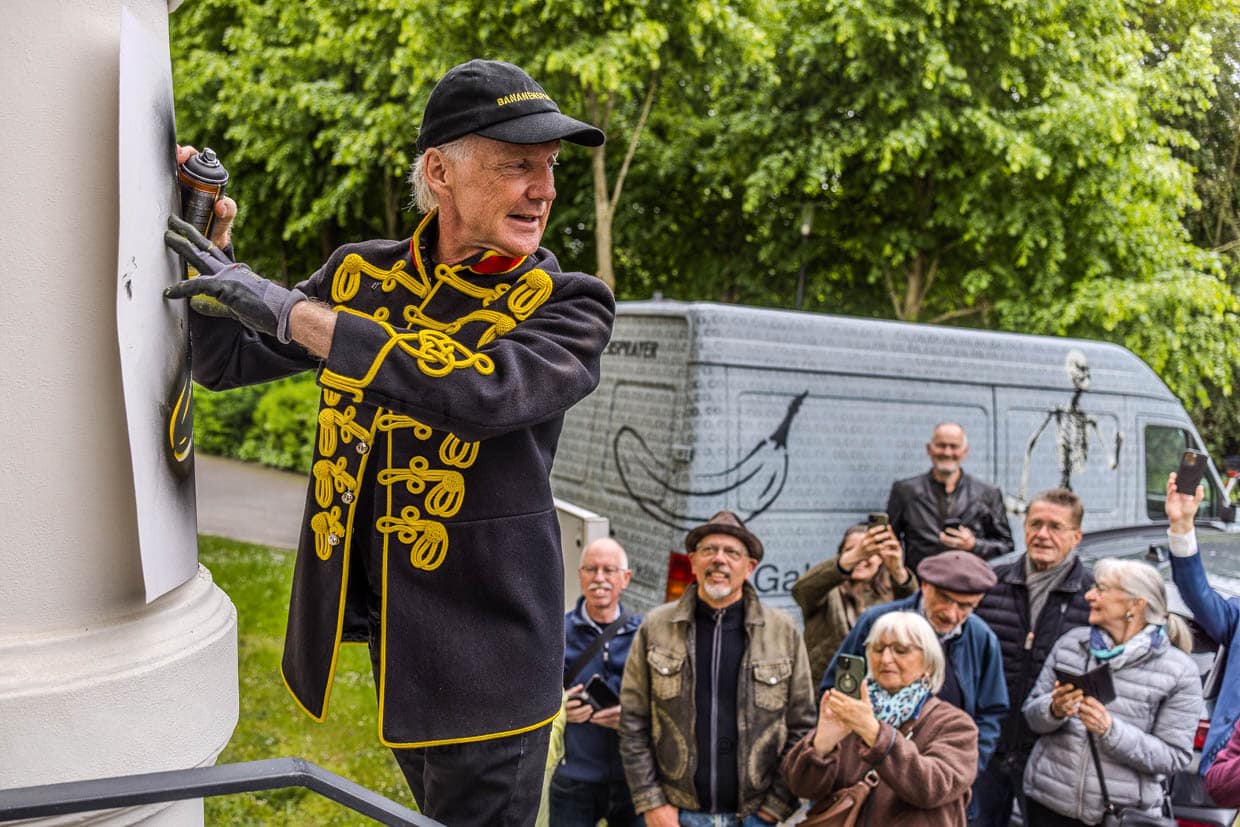
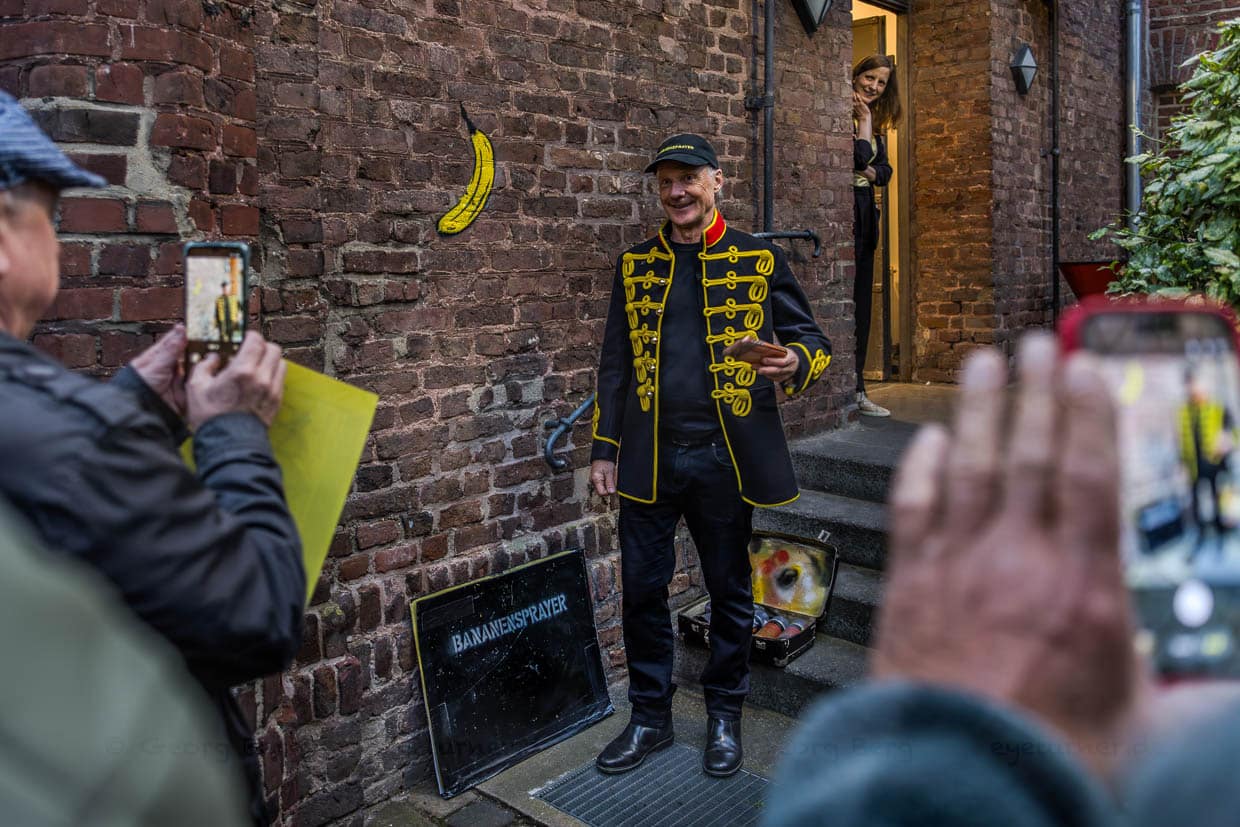
Grevenbroich received two spray bananas for the opening of the exhibition in May 2026. Dressed in a black and yellow guard uniform, Baumgärtel sprayed the entrance pillar of the old factory owner’s villa and the brick façade of the shipping hall with stencils and spray cans in the last light of day and in full view of the opening guests. What looked like vandalism in the early years developed into an unofficial seal of quality on the international art scene. Today, the MoMa and the Guggenheim Museum in New York as well as the Tate Modern in London and other institutions in Athens, Basel, Moscow and Zurich bear a spray banana. Baumgärtel has now “labelled” around 4,000 art locations worldwide. Galleries and museums have long considered it an honour to carry the yellow fruit at their entrance. In her speech, museum director Eva Struckmeier emphasises the artistic perseverance with which Baumgärtel carried the spray banana into the world.
“You’re a real artist!”
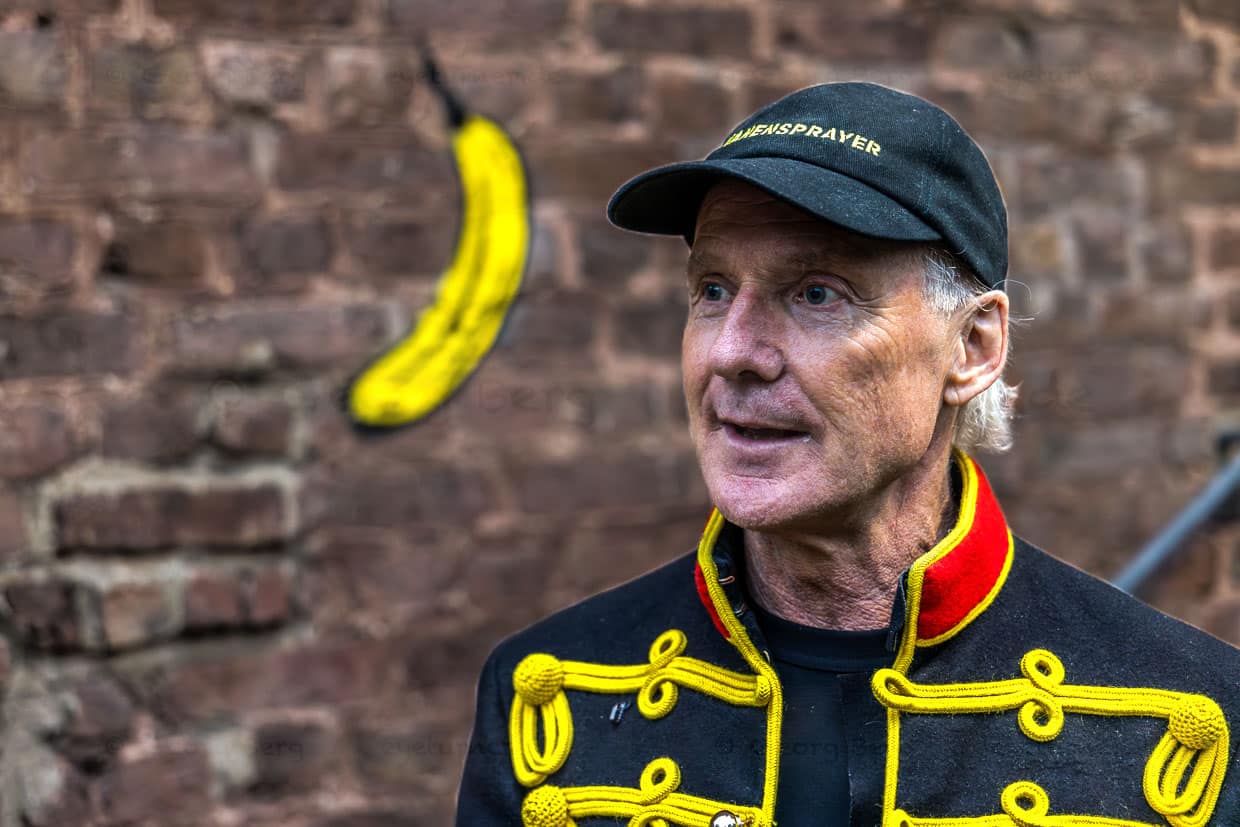
Reducing Baumgärtel to a banana sprayer is not enough. His artistic contribution lies in the consistent expansion of the concept of graffiti. He turned an act of vandalism into a global sign system for cultural quality. He has also created a wide range of painterly and graphic works: large-format acrylic works, installations, serigraphs and political art. His series of works range from the “Holocaust” series and the “Medical Block” to campaigns for Amnesty International and political commentaries on Erdoğan, Putin and the coronavirus pandemic. The “Medical Block” also includes the world’s first surgical graffiti from 2018. In 1996, he founded the CAP Cologne studio community, which today brings together 28 artists. To this day, when people leaf through his catalogue of works, they are amazed to recognise the artist in this range.
The Lower Rhine Tour 2026
The large-scale project runs from May to the end of September 2026 under the motto Freedom for Art. The central opening took place on 8 May 2026 at the Niederrheinisches Museum Kevelaer. The central finissage is planned for 27 September 2026 at the Museum Kurhaus Kleve. Visitors can expect to see a different group of works at each of the 40 stations: from German Urban Pop Art and Grey Paintings in Kevelaer to the Europe Block in the Lower Rhine Museum Wesel and the Stem Paintingsand Banana Pointillism in Grevenbroich. The range of work groups is wide. Exhibition posters, German Unity, the Holocaust series, kinetic objects, political works and spray programmes form only part of the tour’s spectrum. Wherever possible, each station has been customised to the collection or the history of the respective location.
Anyone wishing to explore all the stations can find an interactive overview map on the official website 40jahrebananensprayer.de as well as an event calendar with vernissages and exhibition durations. Bicycle tours along the so-called B(anane)9 route have been specially designed for cycling enthusiasts. Further information can be found on the tour website. The Museum der Niederrheinischen Seele Villa Erckens in Grevenbroich is well worth a visit with two important groups of works and a varied programme to accompany the exhibition.
Everything banana?
True banana connoisseurs know that bananas grow on the bush and not on the tree. Contrary to what the spray banana would have us believe, the fruit bends from the stem towards the light, so it is actually upside down and a banana hand usually consists of seven fingers. More banana lingo in the report on a banana plantation in Malawi. Different countries, different street art: the street artist MifaMosa has been hanging out in France since 2017. He plays with the street names of French cities, placing his mosaics directly next to a street sign and referring to its meaning. Angoulême is the French capital of comics. What began as a small comic festival in the 1970s is now a UNESCO cultural heritage site. In 2009, UNESCO awarded Angoulême the title of “Creative City of Literature” – a distinction that also recognises the link between comics and urban development.