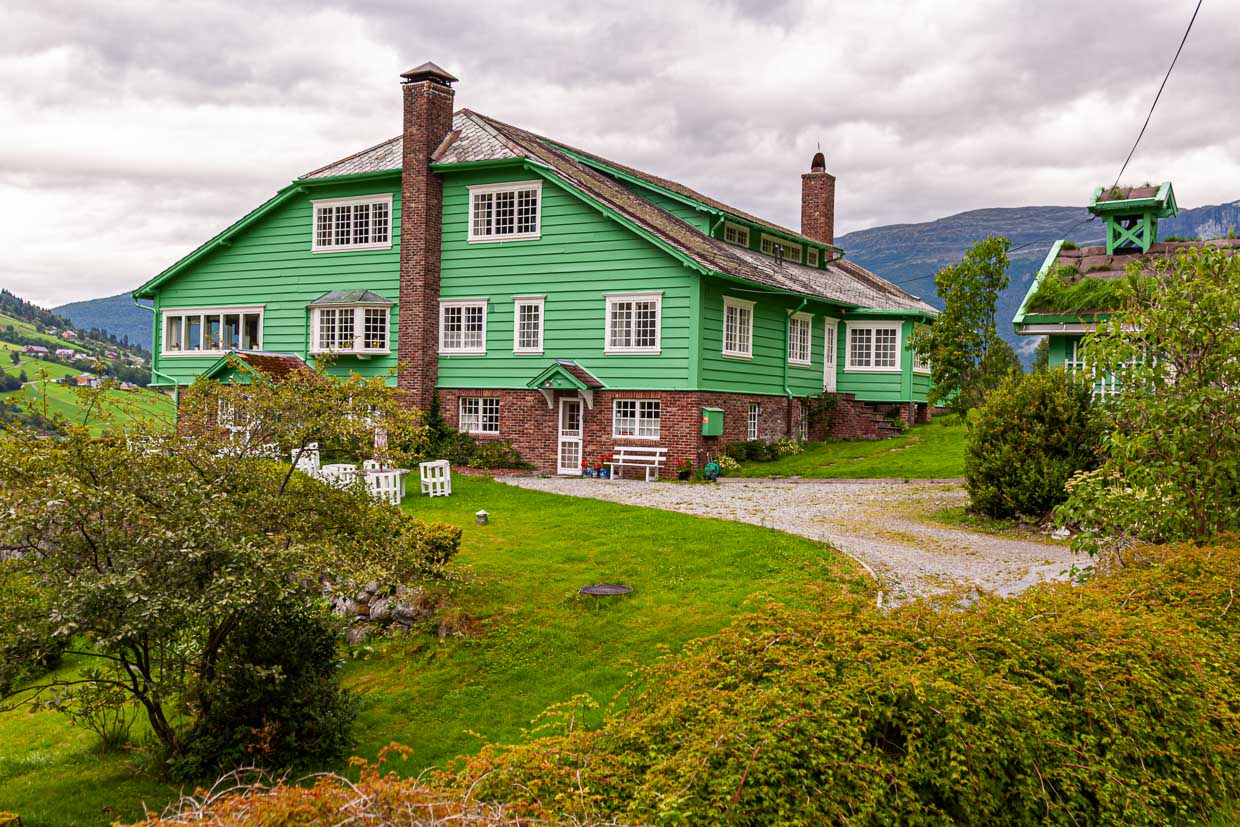
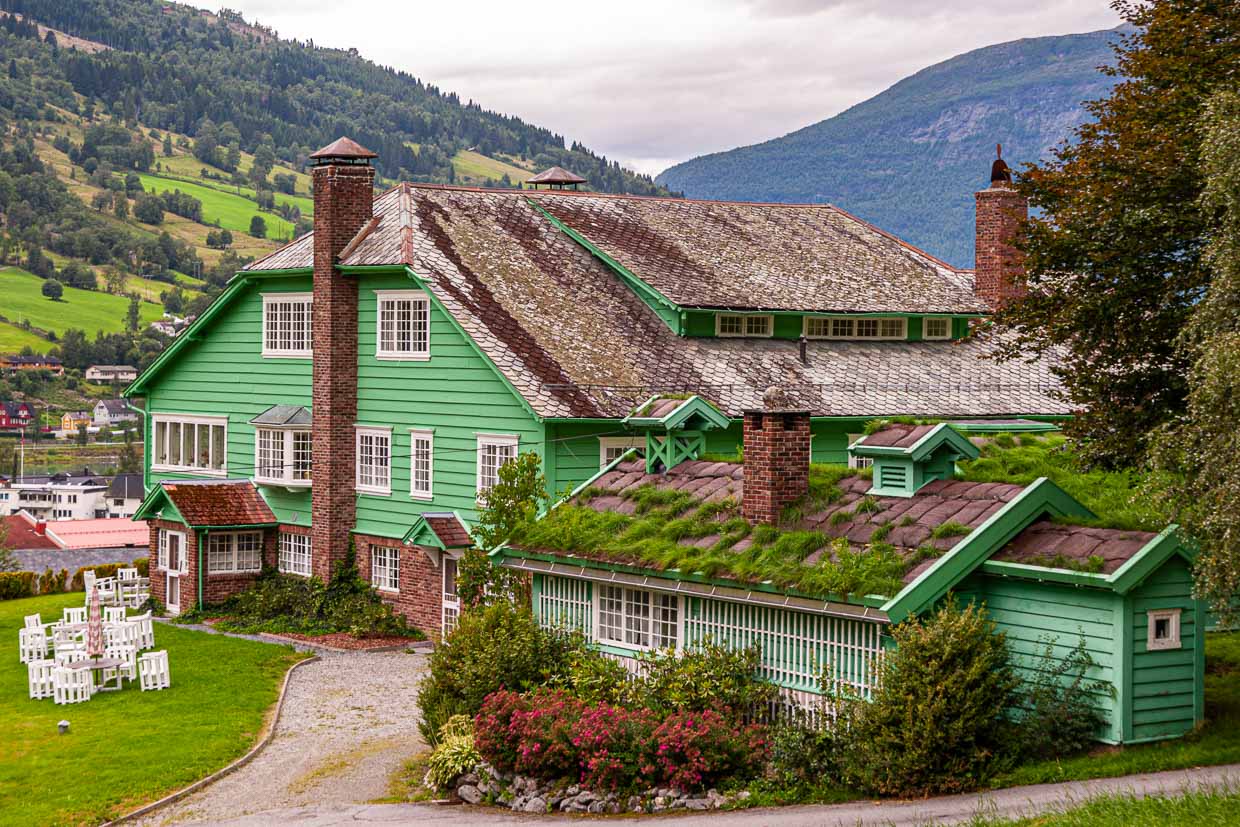
I’d actually intended to go to the little red church. A path leads uphill from the bay in Olden, where a cruise ship is often moored in summer. To the left, amongst gentle grassy hills, wooden houses came into view. Not red. Not saffron-yellow. Not white. They glowed in a shade of green that had little to do with nature. An arsenic green. The church would have to wait.
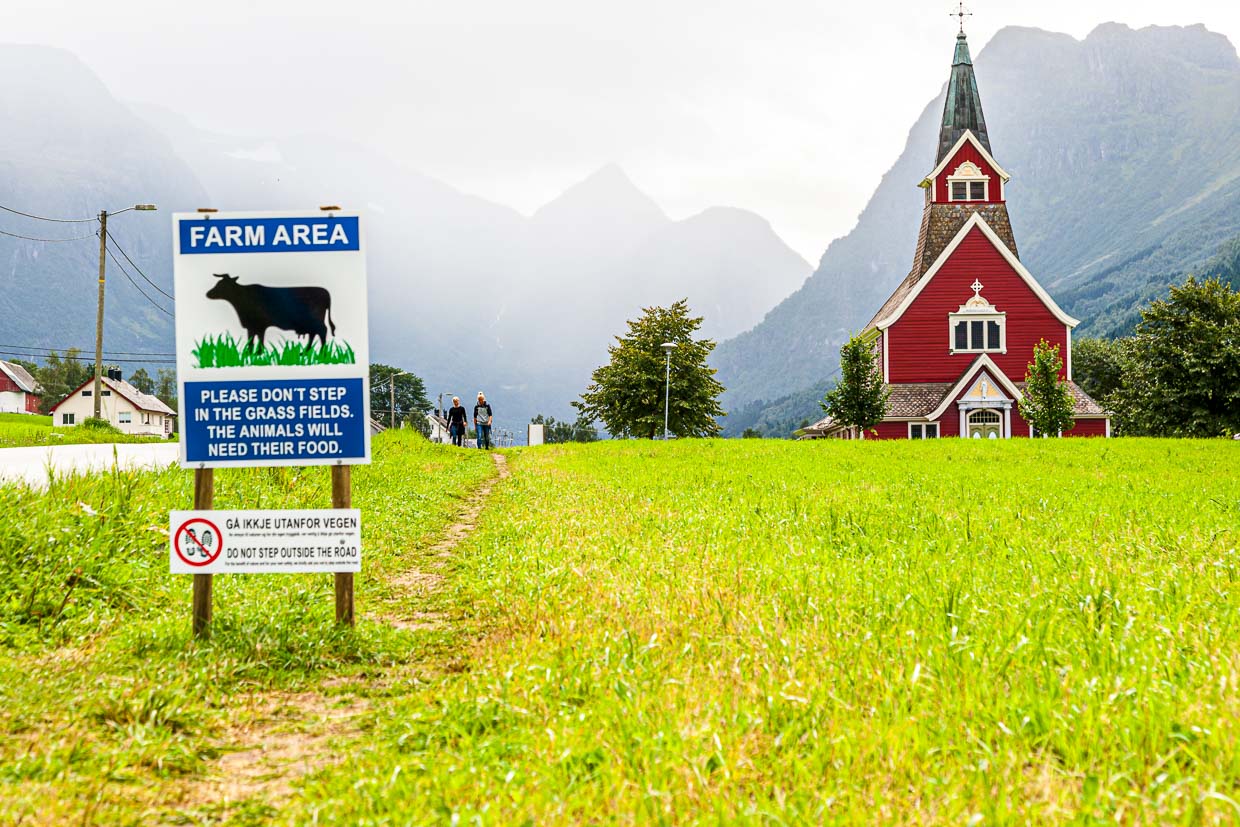
Olden has a population of just over 500 and lies where the Nordfjord ends. From here, the Oldedalen valley stretches some 20 kilometres south to the Jostedalsbreen glacier. The houses are scattered, each standing alone, small beneath low-hanging clouds. There was still snow on the peaks behind them in August.
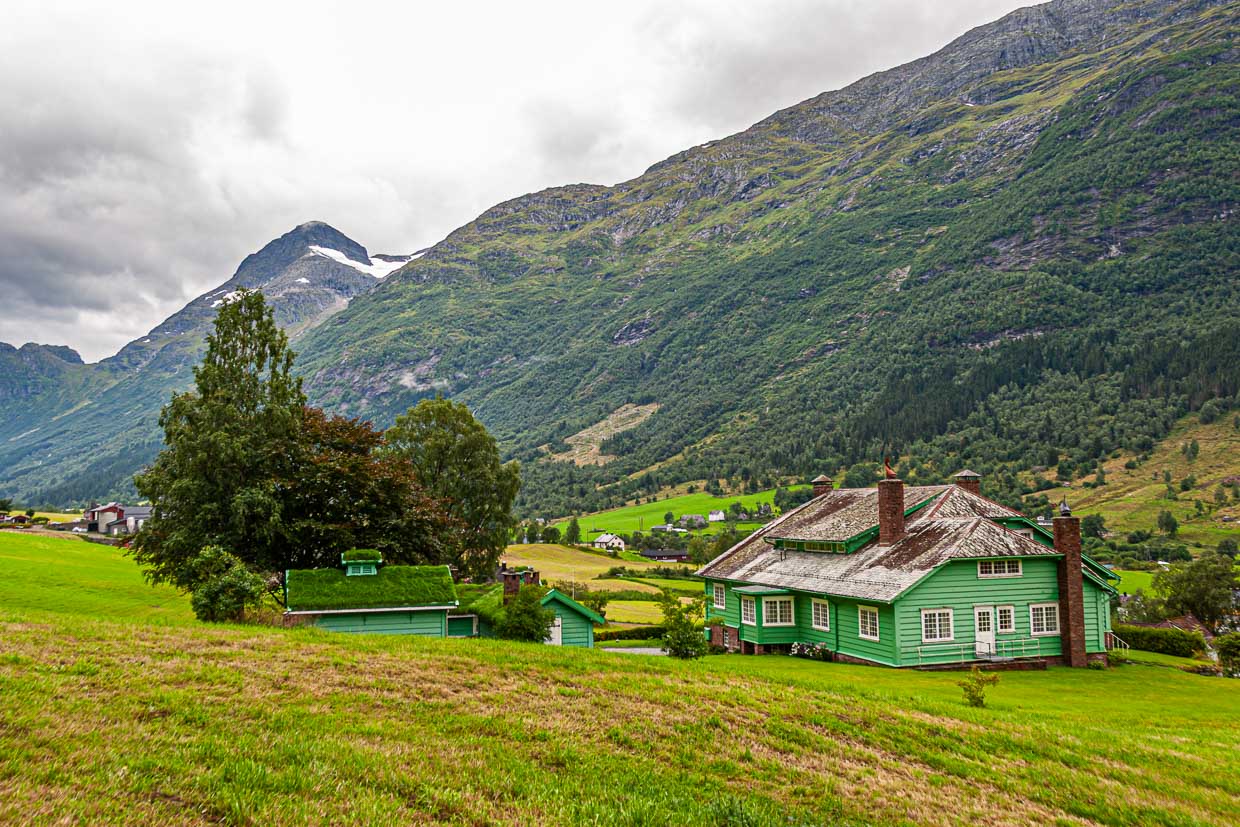
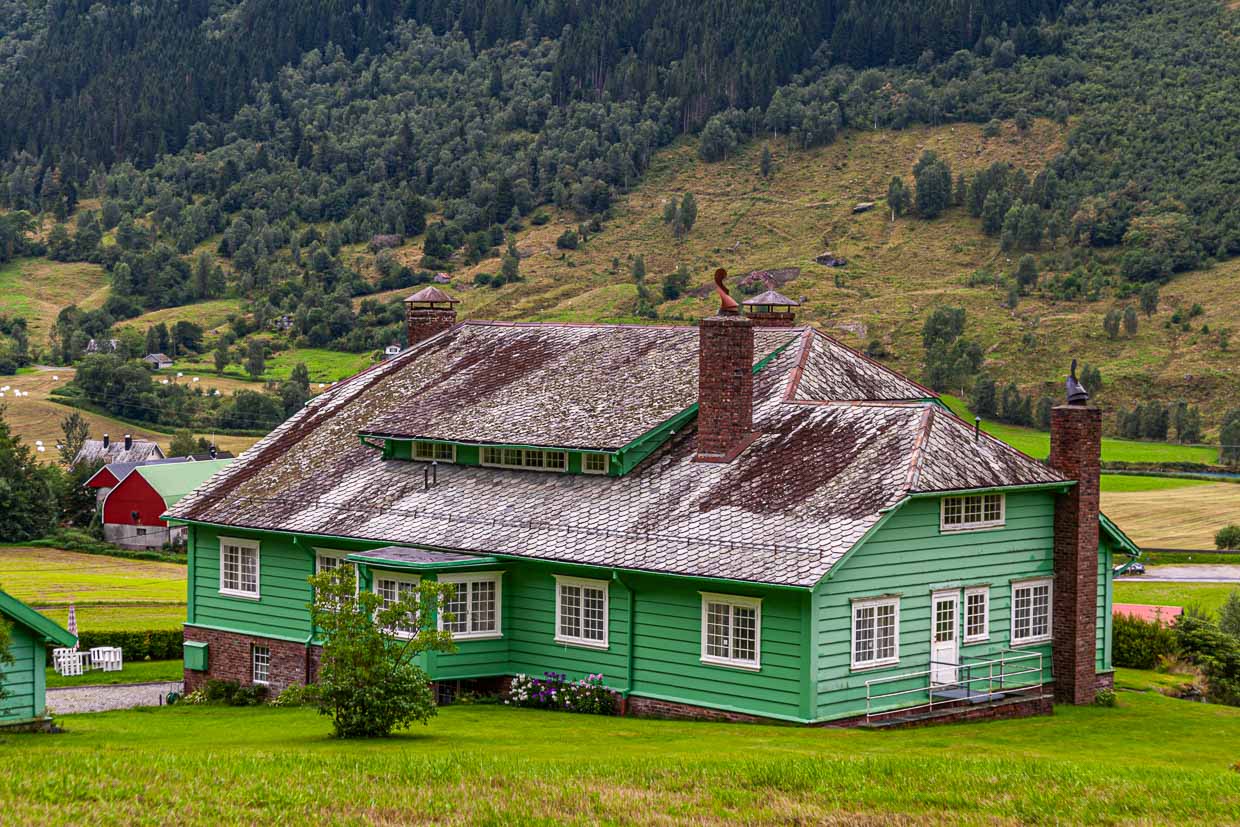
The largest house in the farmstead, which held such a magical allure for me, has a flat slate roof – grey and flecked with moss – and four brick chimneys. Small windows with white glazing bars. Lower buildings cluster around the villa, and grass grows on their roofs. The complex is called Singerheimen, which roughly translates as ‘Singer’s Home’. Norway’s National Heritage Board, the Riksantikvaren, has placed it under protection. Just as I thought – these houses, this greenery – it had to be something special.
Two Americans by the fjord
It was built by two Americans: William Henry Singer Jr. and his wife Anna Brugh Singer. He, the son of a steel magnate from Pittsburgh, chose to turn his back on the family business and pursue a career in painting. She stood by him from the very beginning. In Pittsburgh, Singer studied under Martin Borgord, a visiting lecturer of Norwegian origin. Borgord took the couple on their first study trip to Europe and brought them to Norway for the first time in 1903. That visit turned into a lifetime.
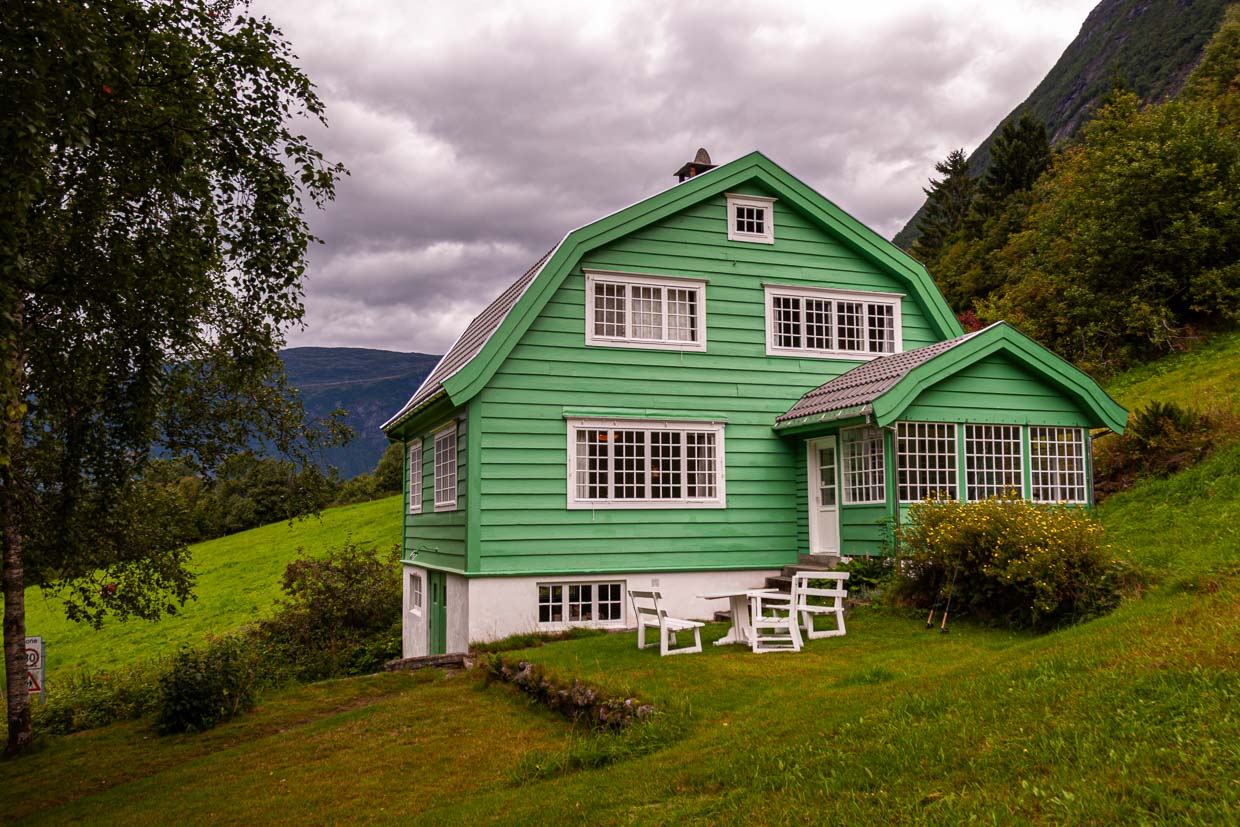
The Singers lived in Laren, the Netherlands, for many years. From 1913 onwards, they spent their summers in Olden, initially as hotel guests. Singer soon had a studio built, and after the First World War, Villa Dalheim, which was completed in 1922. Together they collected art. They funded the local hospital and spearheaded the construction of the road between Olden and Innvik. Singer painted what lay on his doorstep: mountains, water, the village. A whole farmstead sprang up beside the villa: with a cowshed for four cows and an ox, along with greenhouses and a vegetable garden.
A second steel heir
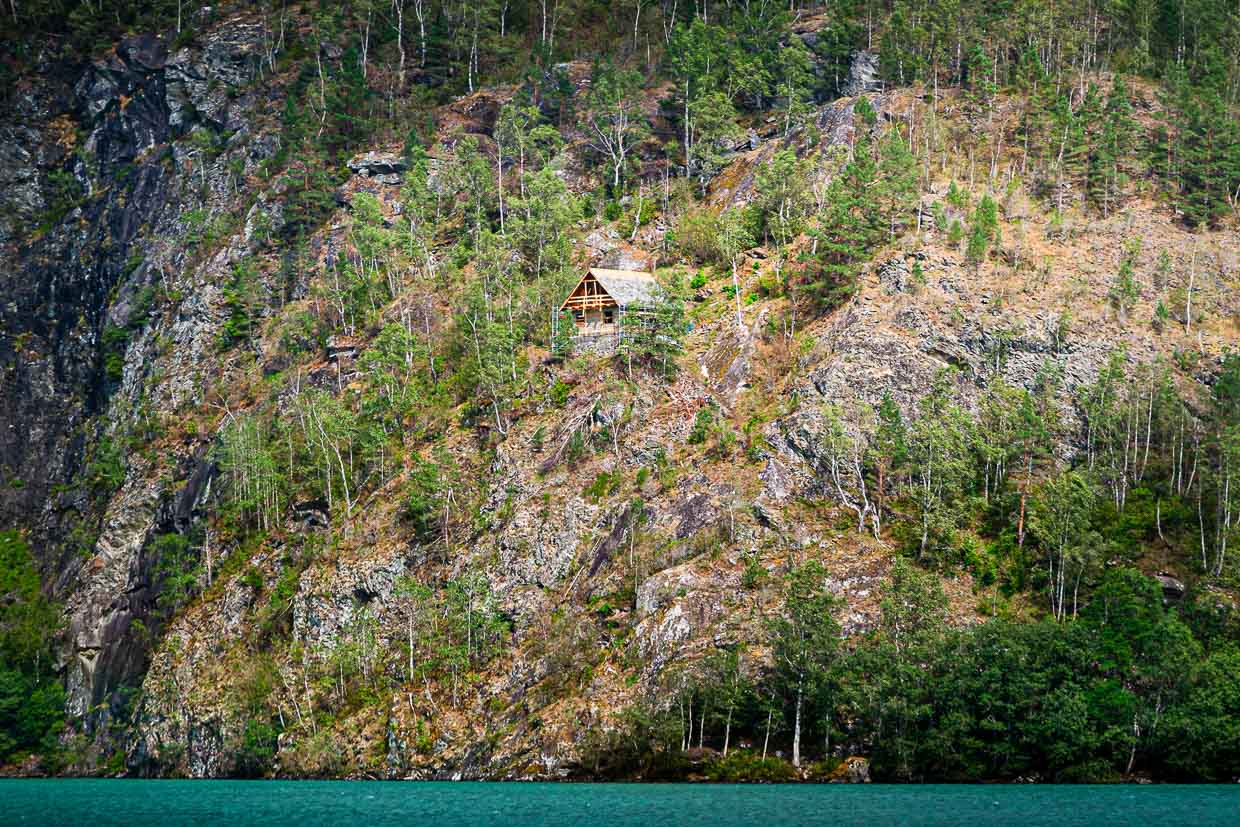
A good 50 kilometres to the south-east, at the end of the Sognefjord, a second steel heir appeared that same year. Ludwig Wittgenstein, son of a Viennese industrialist, arrived in Skjolden in October 1913. He, too, wanted to escape the family business. The philosopher went further than the couple from Pittsburgh. He left his inheritance to his siblings and had a simple hut built above Eidsvatnet in 1914. The Singers built a villa, a farmstead and a mausoleum, with art on the walls and vegetables in the garden. Wittgenstein built himself a cell in which to think.
Two roofs
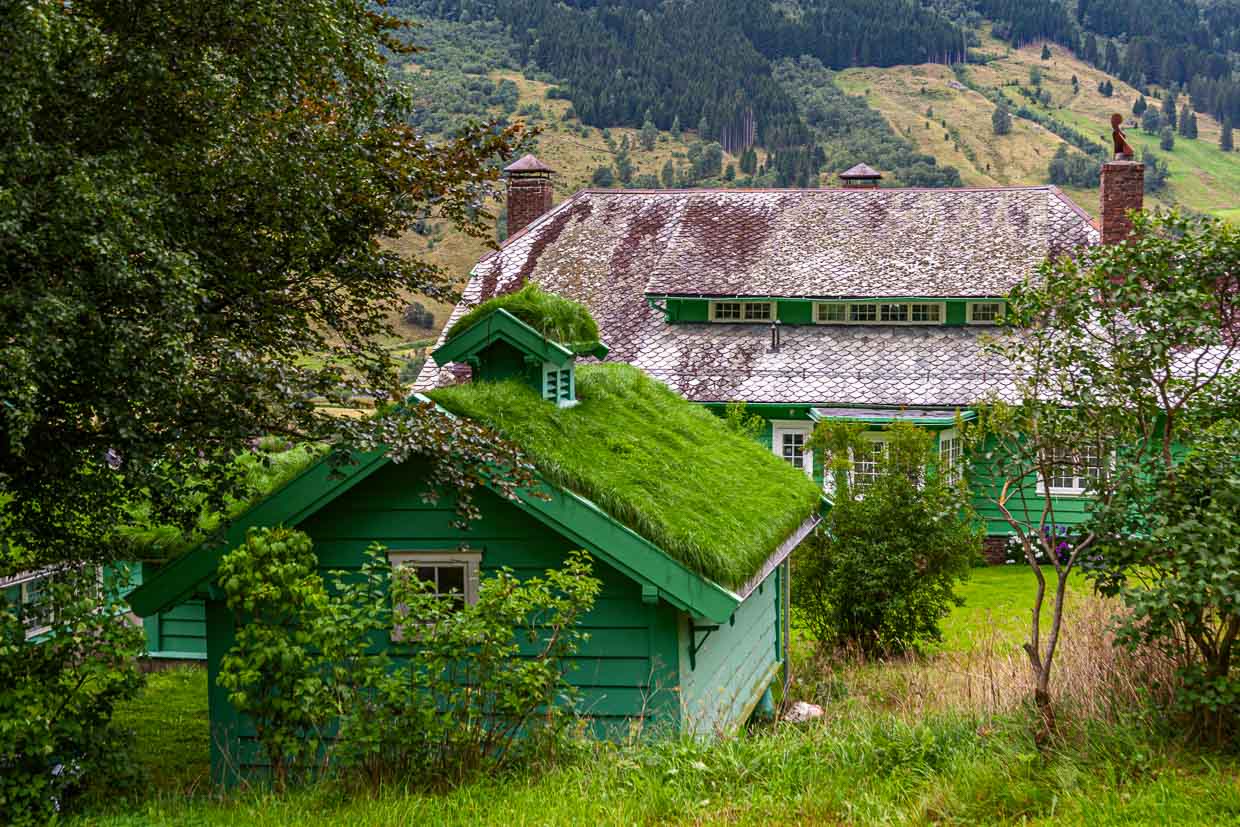
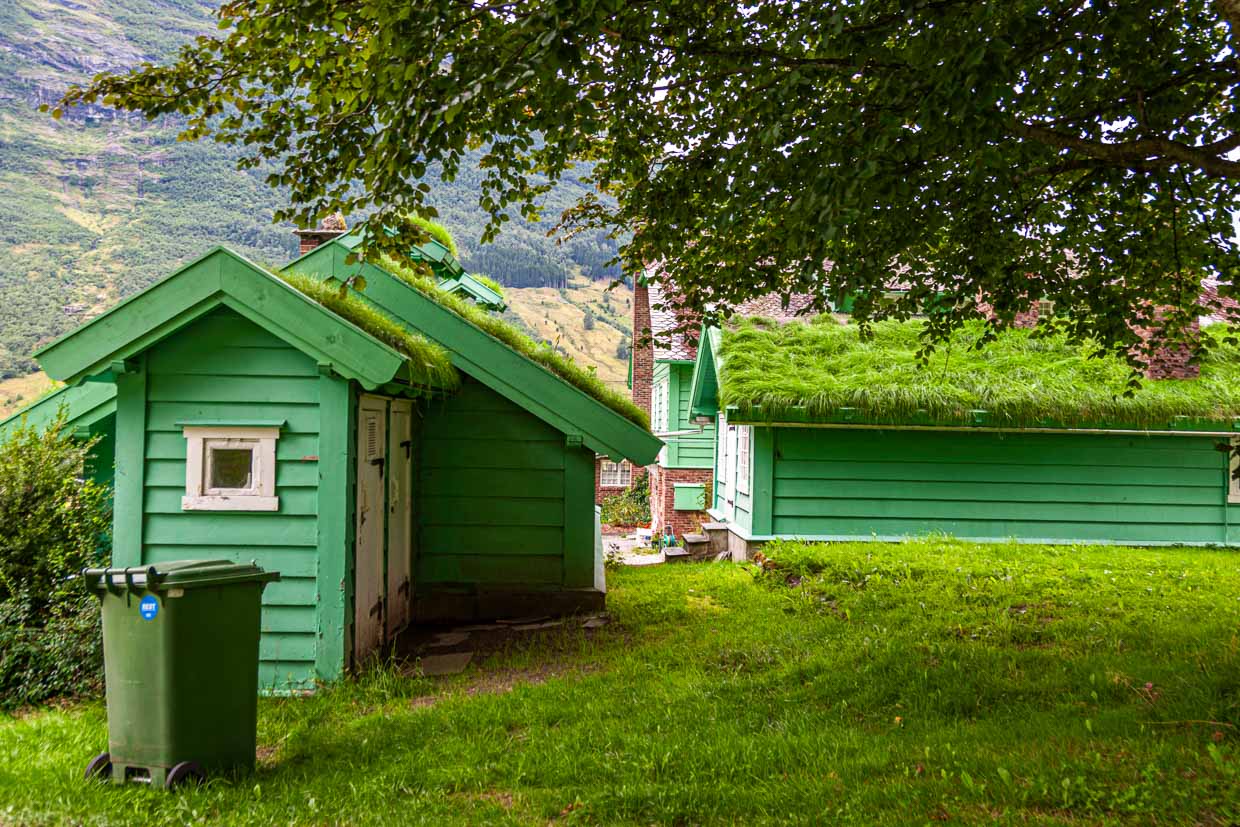
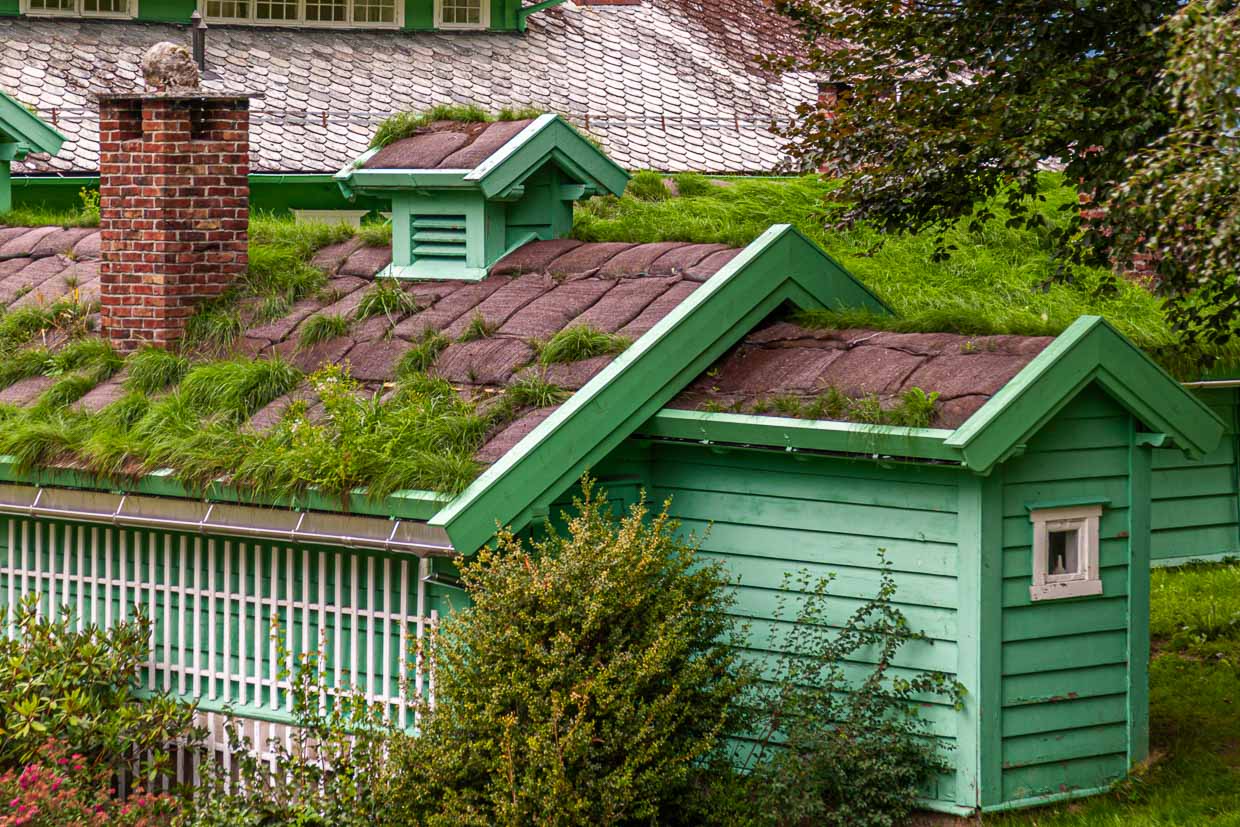
The Singers juxtaposed two architectural styles. They covered the villa with slate, and the outbuildings with local turf. Three of them are covered in turf: the Stabbur, the storehouse on stilts; the Drengestova, the servants’ quarters; and the kitchen building, the front room of which served as a dining room for the staff and is therefore called the Café. Beneath this lies birch bark, which does not let water through. The turf rests on top of this. It keeps the building warm, but is heavy. The roof structure must bear the weight that the meadow would otherwise leave to the ground.
In front of one of these buildings lie rolls, wrapped in plastic and stacked. Brown netting protrudes from the bottom, and a tuft of grass from the top. Craftsmen use such grass mats to repair the roofs.
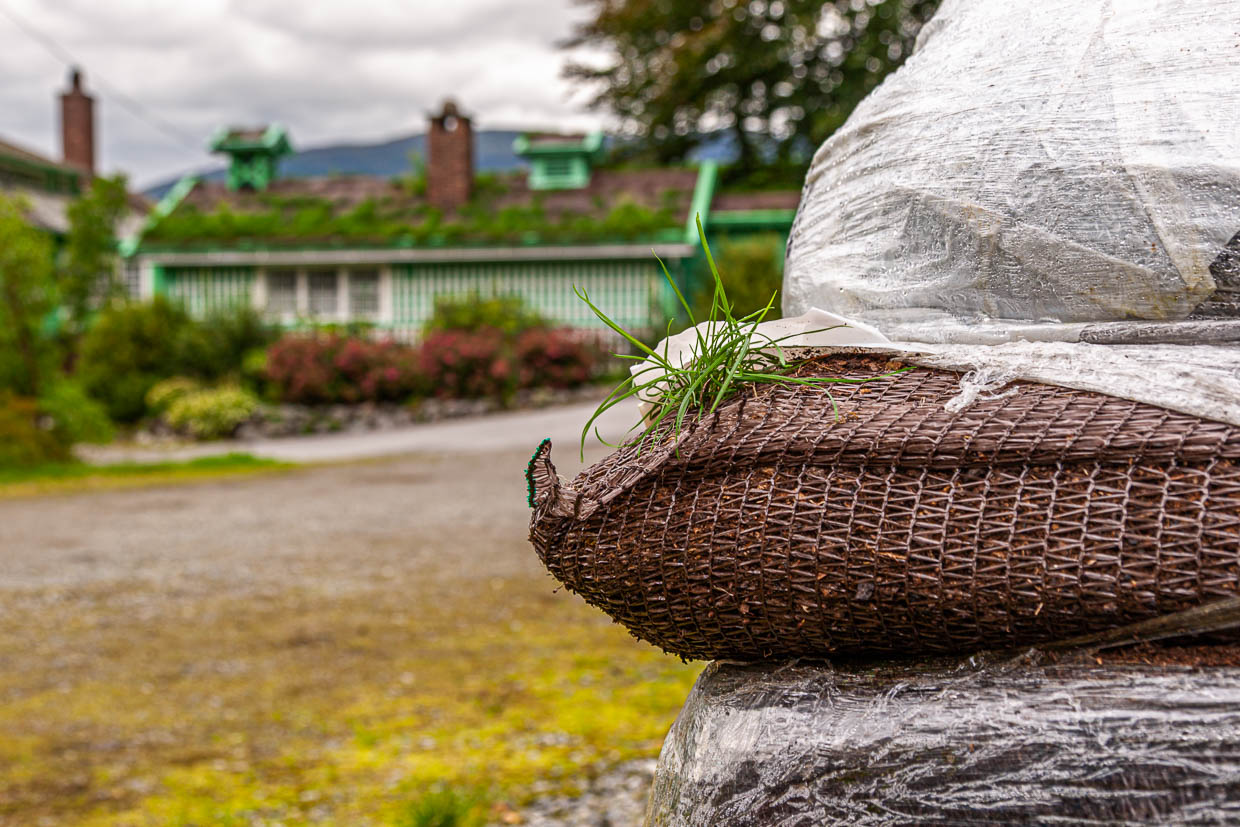
Thatched roofs are common here. It is the traditional way of roofing houses. Wet peat weighs a good 300 kilograms – as much as three fully-grown men per square metre.
A shade of green steeped in history
Green as a wall colour was hardly widespread before the 18th century. That only changed when copper and its by-product, arsenite, were mined in large quantities. In 1775, the Swedish chemist Carl Wilhelm Scheele discovered an inexpensive pigment: Scheele’s green. Before long, entire rooms were bathed in a rich green – from the wallpaper to the curtains. But the pigment contained arsenic. Anyone living in such rooms unwittingly breathed in the poison. According to legend, the most prominent victim was Napoleon. He is said to have personally ordered the redecoration of his exile residence on St Helena. The paint containing arsenic-based green may have been a cause of his death in 1821, although this can no longer be substantiated today.
Why green?
A painter and art collector from Pittsburgh came to Norway with money made from steel and built himself a farmstead there, much like those familiar to the farmers along the fjord. But he painted it in a colour that nobody else in the area used. Why the Singers chose this shade of green is not recorded. Nor is there any mention of it being a favourite colour of William or Anna’s in letters, diaries or accounts. The Heritage Agency describes the bold shade as a deliberate, non-local design element. It sets the property apart from the architecture of Western Norway. A creative choice would be a plausible explanation. Singer painted with bold strokes and clear, bright colours. The green could echo the landscape whilst at the same time emphasising the house as an artist’s home.
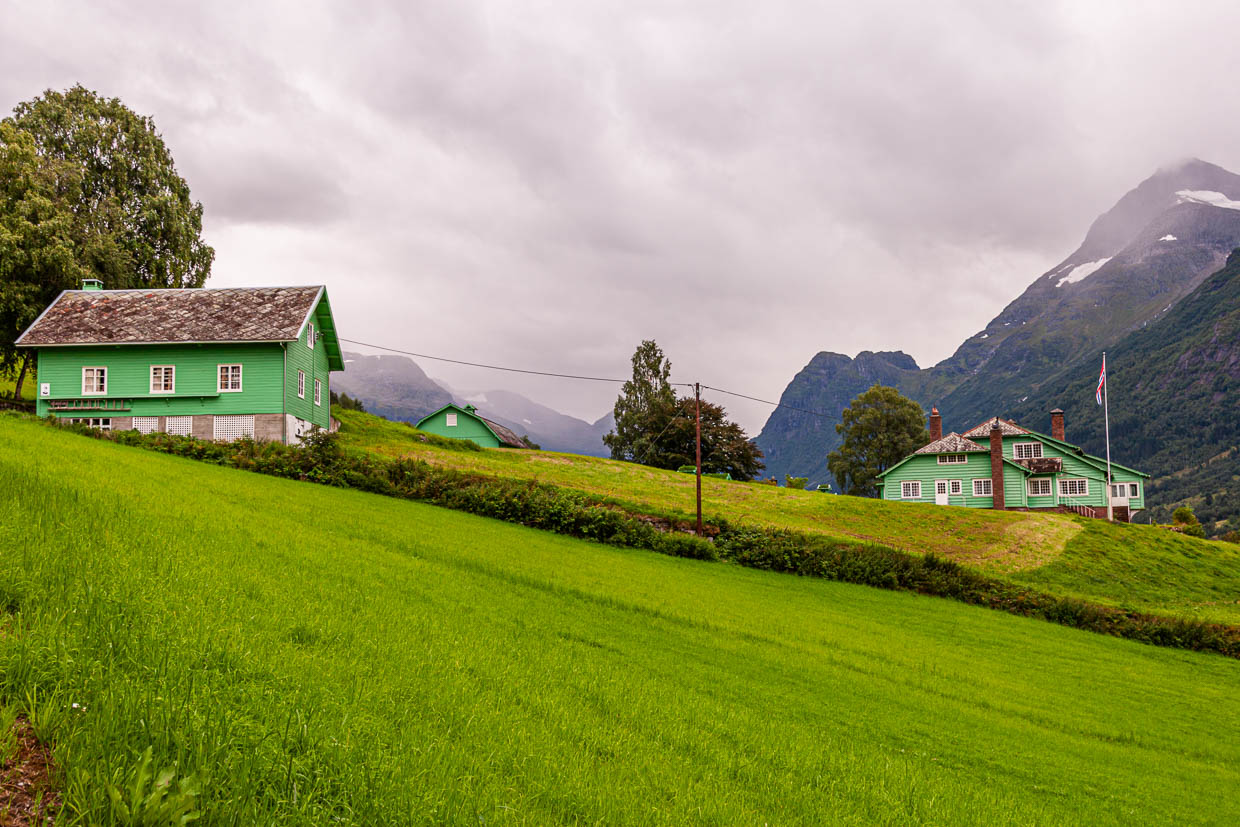
In any case, it was precisely this shade of green that led me astray from the path to the church. It is the hue of weathered copper domes in our old towns. It rarely occurs in nature. Here, someone has placed it right in the middle of it all. I like to imagine that the Singers had a specific idea in mind. They did not collect the abstract art that emerged during their lifetimes: the Blue Rider, Kandinsky, Picasso. The form and timber construction followed the Norwegian tradition. Presumably, they expressed their personal style through an exquisite interior and dramatic colour.
The grave in their own garden
The couple did not return to the USA. William Singer died in Olden in 1943, Anna in 1962. Both are laid to rest in the mausoleum on the estate that Anna had built. Anyone who creates a place like this for themselves truly loves it. After Anna’s death, the estate passed to the hospital, which used the villa as a retreat for nurses. Today, the house and collection belong to a foundation. In the summer, guests stay overnight in the villa. Breakfast is served on the glass veranda and there is a guided tour.
When I think of Singerheimen, I think of this colour. At home, it has become a code word. Two espresso cups feature exactly this shade in their design. Hopefully without arsenic. We call them Singerheimen.