
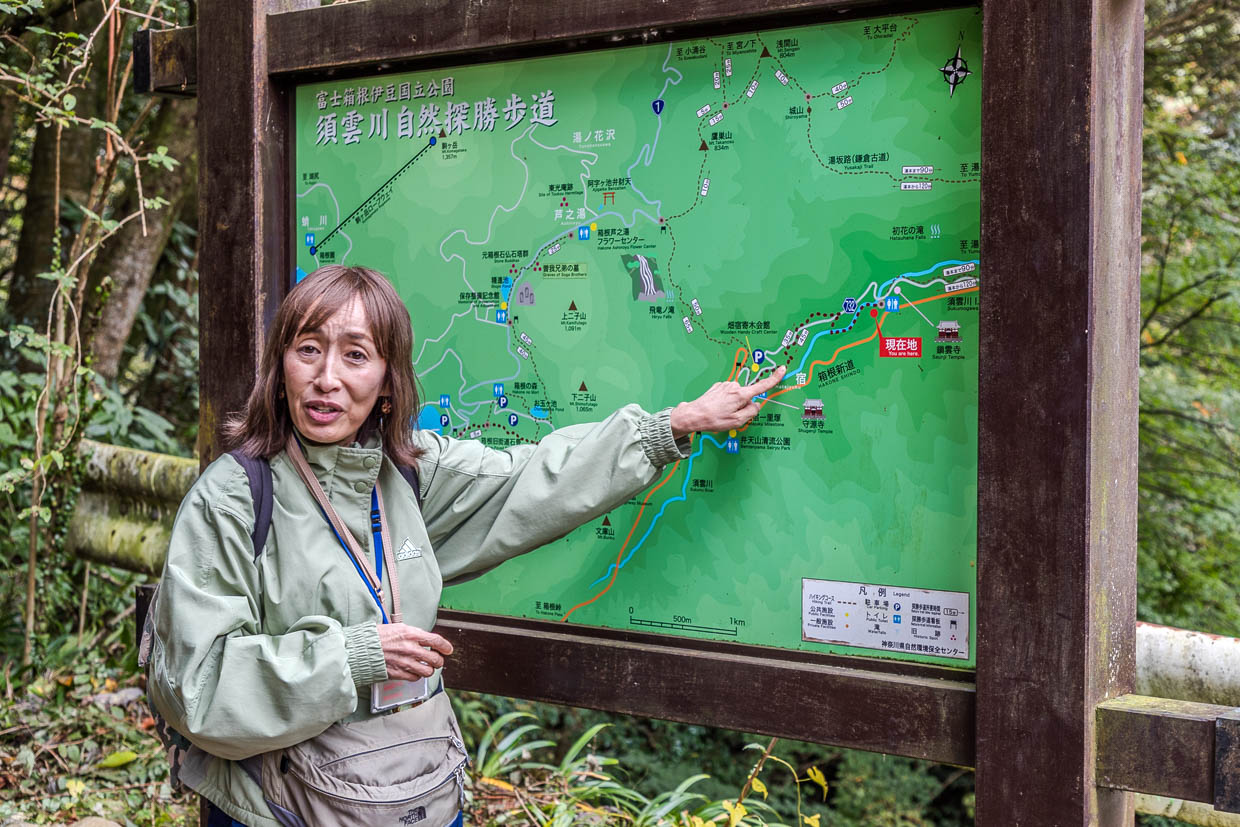
Kotoyo Okugawa knows every stone on this path. She has to know it: her family has been running the teahouse at the end of this path for thirteen generations. As a hiking guide, she leads her guests along the Sukumogawa Nature Trail in Fuji-Hakone-Izu National Park, following the historic eastern section of the old Tōkaidō Road between Hakone-Yumoto and Hatajuku. At the end of the tour, almost inevitably, her own family is waiting.

But first, the path takes its toll. Just past Hatajuku, the Sarusuberi-Zaka leads steeply uphill. Ahead of us lies the ‘Monkey Slide Slope’, named after a gradient said to make even monkeys stumble. It is the last strenuous stretch before the finish. Those walking the stage from Yumoto will already have passed the Wariishi-zaka, the ‘Split-Stone Slope’. According to legend, it was here that Soga Gorō, the younger of the two Soga brothers, on his way to avenge his father’s murderer, split a boulder in two with a single stroke of his sword. Historians consider the story to be a later invention. Nevertheless, it is still told to this day, at a spot where there was once a watering hole for pilgrims and packhorses.
The Road to the Eastern Sea
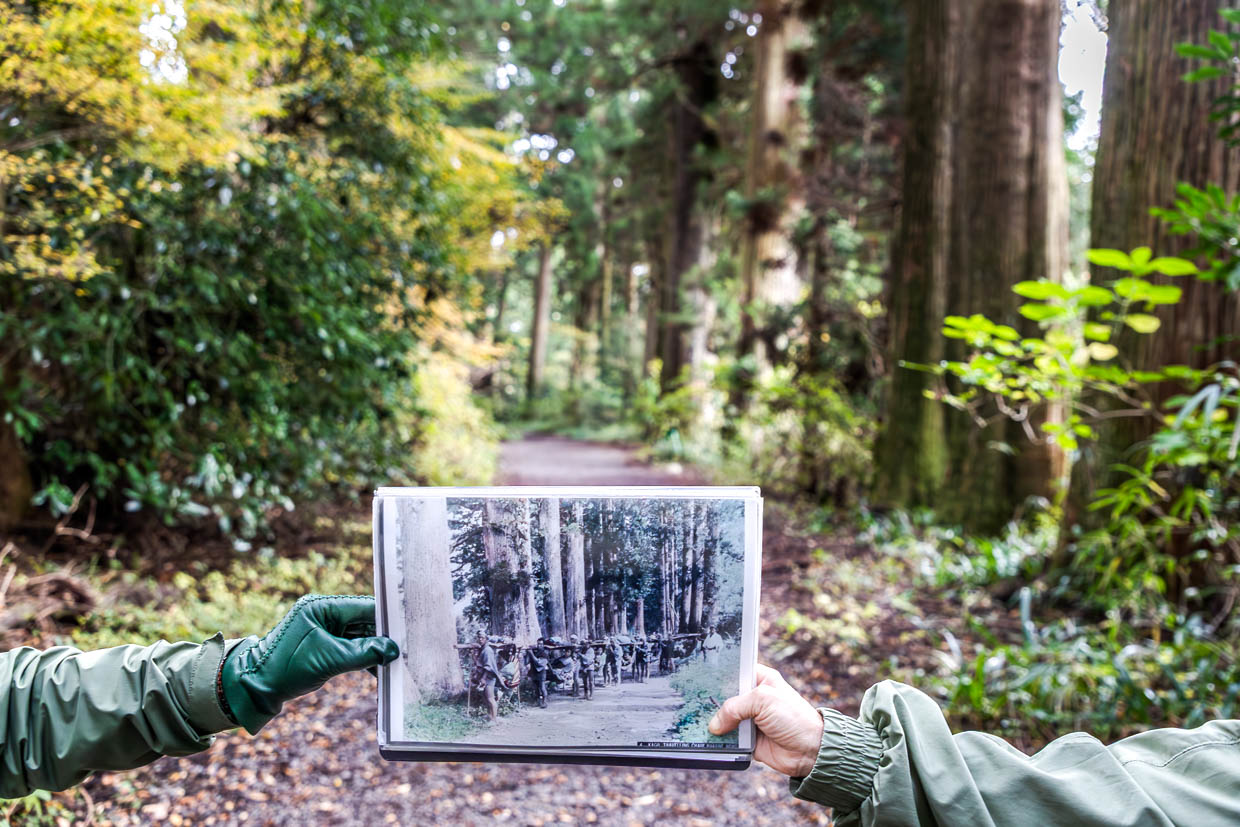
From the early 17th century onwards, the Tōkaidō, the ‘Road by the Eastern Sea’, linked Edo – now Tokyo – with Kyoto: a distance of around 500 kilometres, divided into 53 post stations with inns and rest stops. The Tokugawa shoguns made it the most important of the five main roads in their empire. In its heyday, spanning much of the Edo period (1603–1868), officials, merchants, pilgrims and entire princely processions travelled along the route. With the advent of the railway and, later, the Shinkansen line of the same name, the old road lost its original function, though sections such as the Hakone Pass have been preserved as hiking trails.
Amazake: the pilgrims’ and traders’ energy drink
At the top of Sarusuberi-zaka lies the Amazake Chaya, which, according to tradition, has been in existence since 1618. Whilst the exact date of its founding cannot be ascertained with certainty, it is the continuity that counts: the Yamamoto family has run the teahouse for thirteen generations, and it is now managed by Satoshi Yamamoto. It is famous for its homemade amazake, a heavily sweetened rice tea fermented for a day with kōji mould. It was the energy drink of travellers on their way to Edo, now Tokyo. From here, it is another 100 kilometres – mostly flat – to Tokyo. Just before the final leg of the journey, the Amazake Chaya was a place of rejuvenation where travellers could refuel.

The Yamamoto family’s teahouse
Life hasn’t always been easy for the family. In the 1950s, under Satoshi’s grandfather, there was sometimes only one hiker a week. Barely enough to make ends meet, the grandfather supplemented his income at the time by working part-time at a nearby onsen. However, the Yamamoto family lost their original teahouse. During the Kita-Izu earthquake of 1930, a boulder broke loose on Mount Futagoyama and destroyed the teahouse, which at that time was still situated on the opposite side of the road. In the 1970s, a fire destroyed parts of the building. The current building, with its thatched roof, was not built until 2009, but as much of the original structure as possible – such as the beams, blackened over centuries by smoke from the hearth – was re-incorporated into the new structure.

According to Satoshi, the new build was preceded by many family discussions about whether it was worth continuing to run the teahouse. However, in the 2000s, more and more foreign tourists began visiting Japan. The enthusiasm of these people from all over the world for this special place gave the Yamamoto family a sense of purpose and the confidence to keep the teahouse alive. Today, tourism in Japan is booming, the teahouse is very popular, and Satoshi’s son Tatsuhito, the fourteenth generation, is already helping out with the service.

Irori, the hearth in the room
The irori is the centrepiece of the house: a usually square pit filled with ashes set into the wooden floor. It has been an integral part of Japanese mountain dwellings since the Kofun period. A cast-iron kettle hangs above the embers from an adjustable hook, the jizaikagi. All round, on the wide wooden surround, are bowls of rice, steamed vegetables and tofu, accompanied by grilled fish and roasted mochi. This is the classic open-fire cuisine, which has remained virtually unchanged for centuries in the mountainous regions of central Japan. It is said that the constant smoke also helped to preserve the ceiling beams and kept vermin at bay.

At the Yamamoto family’s Amazake Chaya, the irori is round, consisting of two concentric circles framed by a wide wooden rim. Hanging from a hook above it is a wooden fish, often a carp. According to tradition, Satoshi Yamamoto tells us, the fish is meant to protect against fire: it lives in water, the natural antagonist of flame. Satoshi also has another explanation for the fish motif by the fire and points to the fish’s eyes, which have no eyelids. He says they symbolise that no one should fall asleep at the cooking area and lose sight of the fire.

We sit in this warm and convivial place whilst Satoshi Yamamoto recounts the tea house’s long history. Tatsuhito, his son, who now speaks passable English, helps with the service and explains how much he enjoys interacting with guests from all over the world. The wooden beamed ceiling, the shōji windows, the smoke from the fire: anyone who has walked a stretch of the old Tōkaidō themselves and now gazes at the embers comes as close as is possible in the 21st century to the feeling of the pilgrims of centuries past.
The Amazake Chaya is open 365 days a year. It opens as early as 7 am and closes at 5.30 pm. In between, it offers everything to delight today’s walkers: a sweet, lukewarm amazake is definitely a must!

Unassuming by the wayside
For Kotoyo Okugawa, her family’s teahouse is more than just a stop-off point on her tours. It is one of the last surviving relics of the old Tōkaidō section between Hakone-Yumoto and Hatajuku. It is a place where one can still experience something of Hakone’s old travelling atmosphere. She says she is proud of this.

When travelling with Kotoyo, you also discover the unassuming things by the wayside: be it the tiny but beautiful toad lily or the majestic sugi, Japanese cedars, which have towered into the sky for centuries and stand as silent witnesses to the countless travellers on the Tōkaidō. Kotoyo shares one of these fascinating stories with us during our walk together.
The fate of the girl Otama
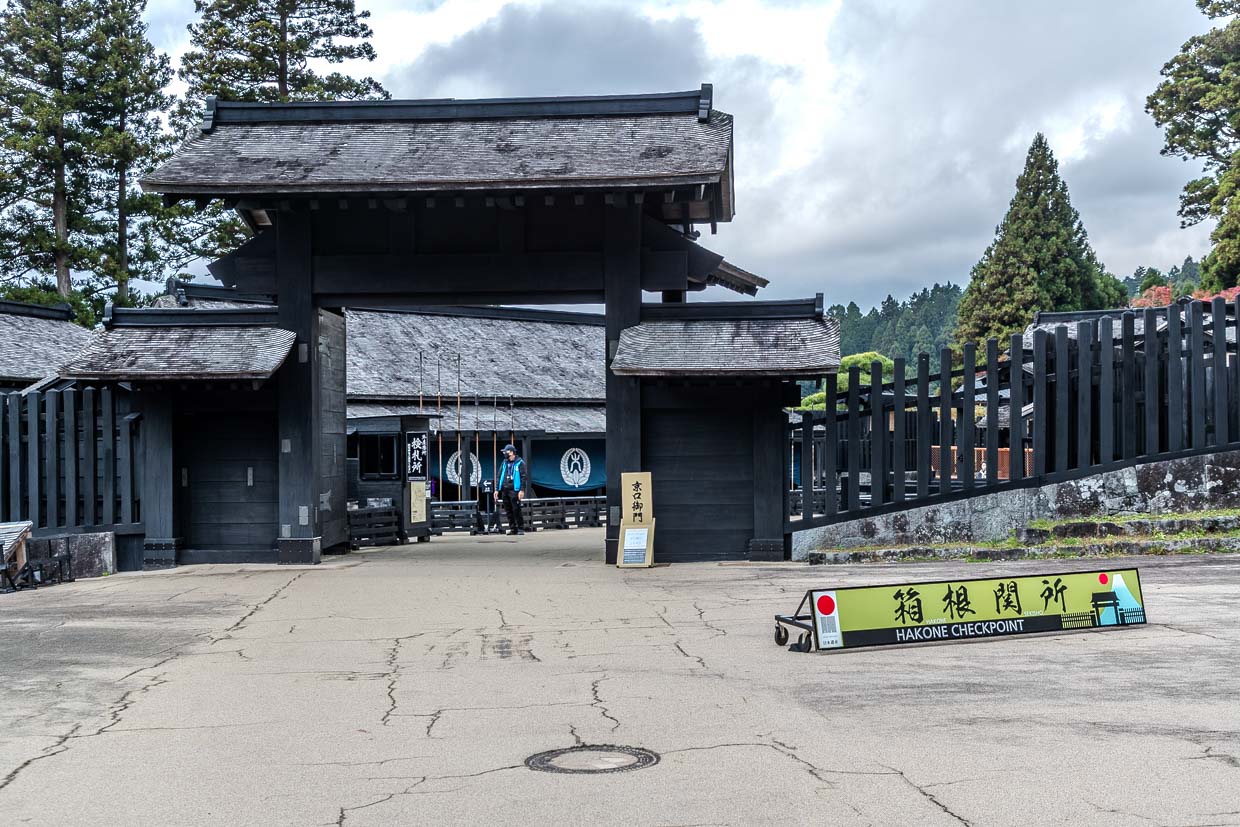
It is just a simple, heavily weathered memorial stone at the edge of a small pond. For Europeans who cannot read the inscription, the tragedy remains hidden. Kotoyo tells us about the girl Otama. Barely more than a child, she was sent from a small fishing village on the Izu Peninsula to Edo in 1702 to work. She could not bear being so far from home. After just two months, she ran away, wanting to go home. Her pursuers reached the Hakone checkpoint – which she had intended to bypass via the wooded hills – before she did. The checkpoint was heavily guarded, the rules strict and the punishments draconian. Only those with a pass were allowed through.

During the Edo period, the Hakone Checkpoint was a strictly guarded control point on the Tōkaidō. Its primary purpose was to prevent weapons from reaching Edo. Travellers had to present their travel documents; for women, the documents were checked particularly thoroughly, often accompanied by a physical search carried out by female guards. The officials looked out for disguises, distinctive features and the purpose of the journey. The aim was not only to control border traffic but also to consolidate the power of the Tokugawa shogunate. Of particular importance was the surveillance of the families of the regional lords, who lived in Edo as a kind of hostage to ensure they did not return to their home territories unchecked.
To deter unauthorised border crossings, the penalties were drastic and inhumane. A girl named Otama was arrested, imprisoned and executed by the small pond a few kilometres from the Hakone Checkpoint to serve as a warning to others. Locals erected a memorial stone and named the pond Otamagaike – ‘Ota’s Pond’.

Admittedly, this is a sad story, but it illustrates the political significance of Japan’s network of roads: the Tōkaidō in particular, and also the Nakasendo, were of great importance to the shogunate. The Nakasendo and the Kumano Kodo pilgrimage route are also popular walking routes today, featuring well-preserved post stations, temple complexes and shrines. On certain sections, such as in Hakone with the Amazake Chaya, one can get a sense of the era of pilgrims, traders and samurai: On the Nakasendo, we walked from post station to post station; on the Kumano Kodo, I walked a stretch in a kimono; and in Hakone, we used modern transport and glided in a gondola over the ‘Great Hell’.
The research trip was supported by the Hakone Tourism Association and JNTO