
“Schwein gehabt” (literal translation “had a pig”) is a German expression for unexpected luck. On a November morning in Mie Prefecture, I didn’t realise that this day had both in store for me: Luck and pig. How could I? In Ago Bay, the view opens up onto the vast Pacific Ocean. The people here have always lived from the sea. But for 130 years, everything on the coast of the Shima Peninsula with its deep bays has revolved around the pearl. More precisely, since 11 July 1893, when the Japanese Kokichi Mikimoto succeeded in growing the first fully cultured pearl after 13 arduous years full of setbacks. Mikimoto imitated the natural process of pearl formation and started pearl cultivation on a large scale. From Mie, his cultured pearls conquered the world.
Visit to the pearl village
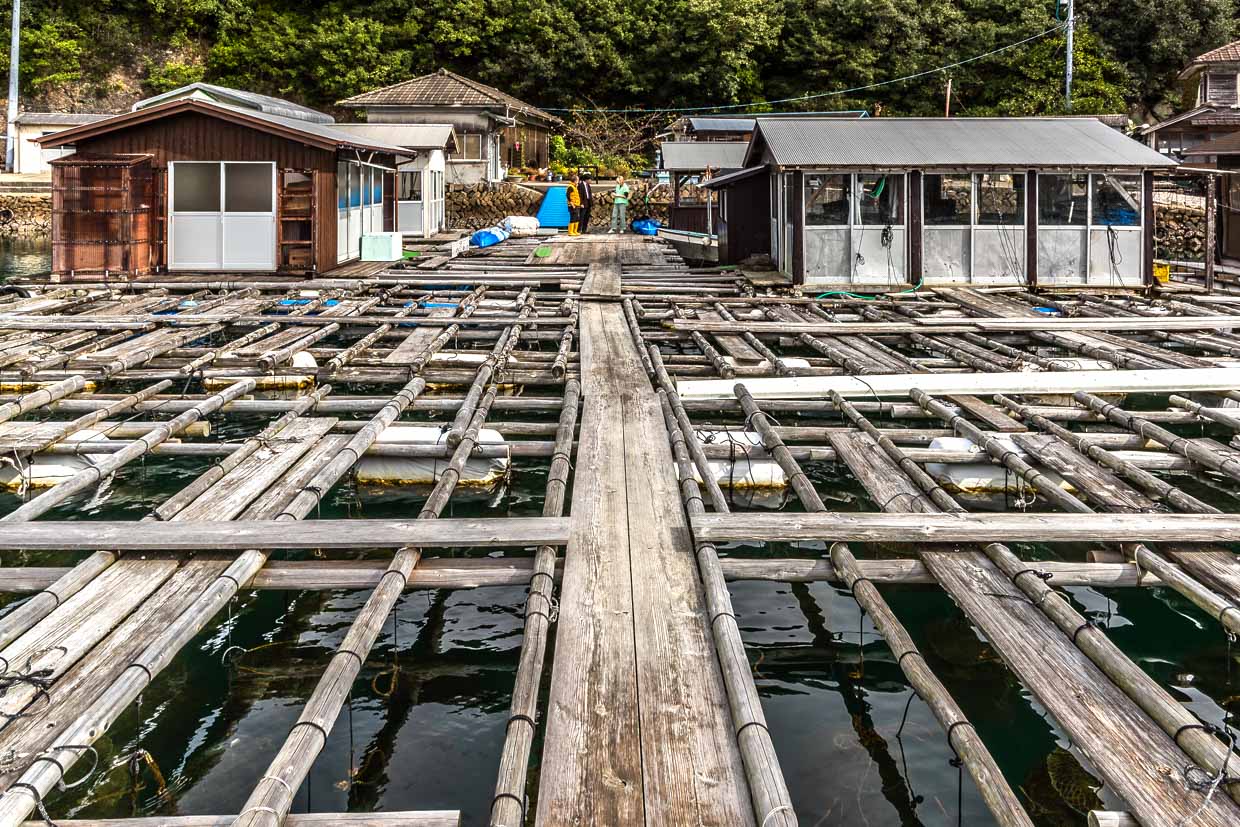
In a hidden cove framed by trees, a few huts stand by the water, connected by floating wooden walkways. Everything rocks gently to the rhythm of the waves. There is nothing to suggest that original souvenirs are being created here. But Shinju no Sato, the pearl village, specialises in introducing visitors to the art of pearl cultivation according to Mikimoto – with everything that goes with it: inserting a nucleus into an oyster, harvesting the pearls and designing jewellery.
From natural pearl to cultured pearl
Kokichi Mikimoto had been concerned since 1880 that the centuries-long hunt for natural pearls was wiping out the mussels of Ago Bay. He had observed how oysters coat foreign bodies inside them with layers of mother-of-pearl until a pearl is formed – a product of nature. Mikimoto wondered whether it would be possible to control this process so that every oyster produced a pearl. He began to experiment, inserting small foreign bodies such as splinters or scales into the mussels. However, the results were often misshapen – so-called snowman pearls, in which two differently sized spheres grew together like the spheres of a snowman.
Pearl picking in Mie
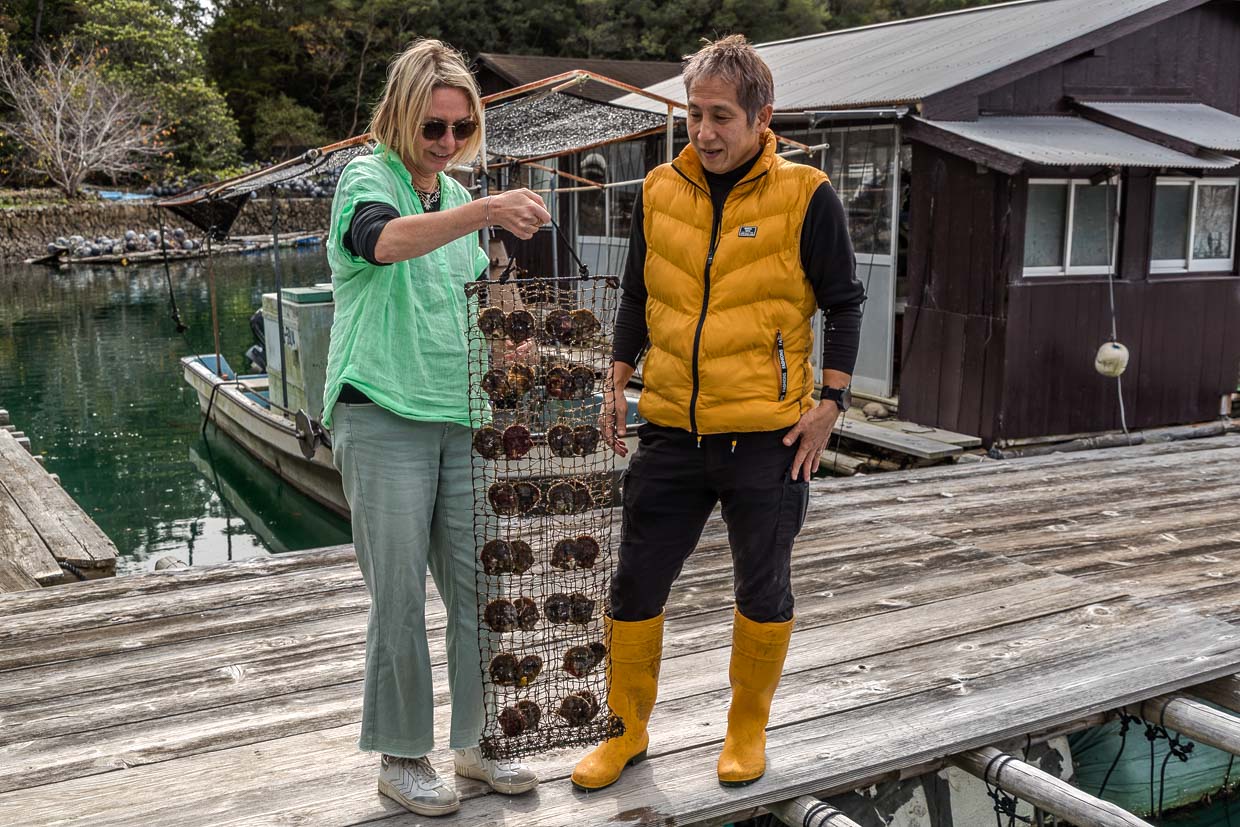
Back to the pearl village. Thirty oysters hang neatly lined up in a net. I’m supposed to pick one. Just one. But which one? Which oyster has formed the most beautiful pearl? My eyes wander from oyster to oyster, counting three, two, one – mine! A sharp knife opens the oyster. Not by me, I leave that to the expert. Then I put on my gloves and dip my fingers into the soft, slippery flesh of the shell. There should be a small, hard ball somewhere inside. I feel, push carefully, finally feel resistance. And then I hold it in my hand: my pearl.
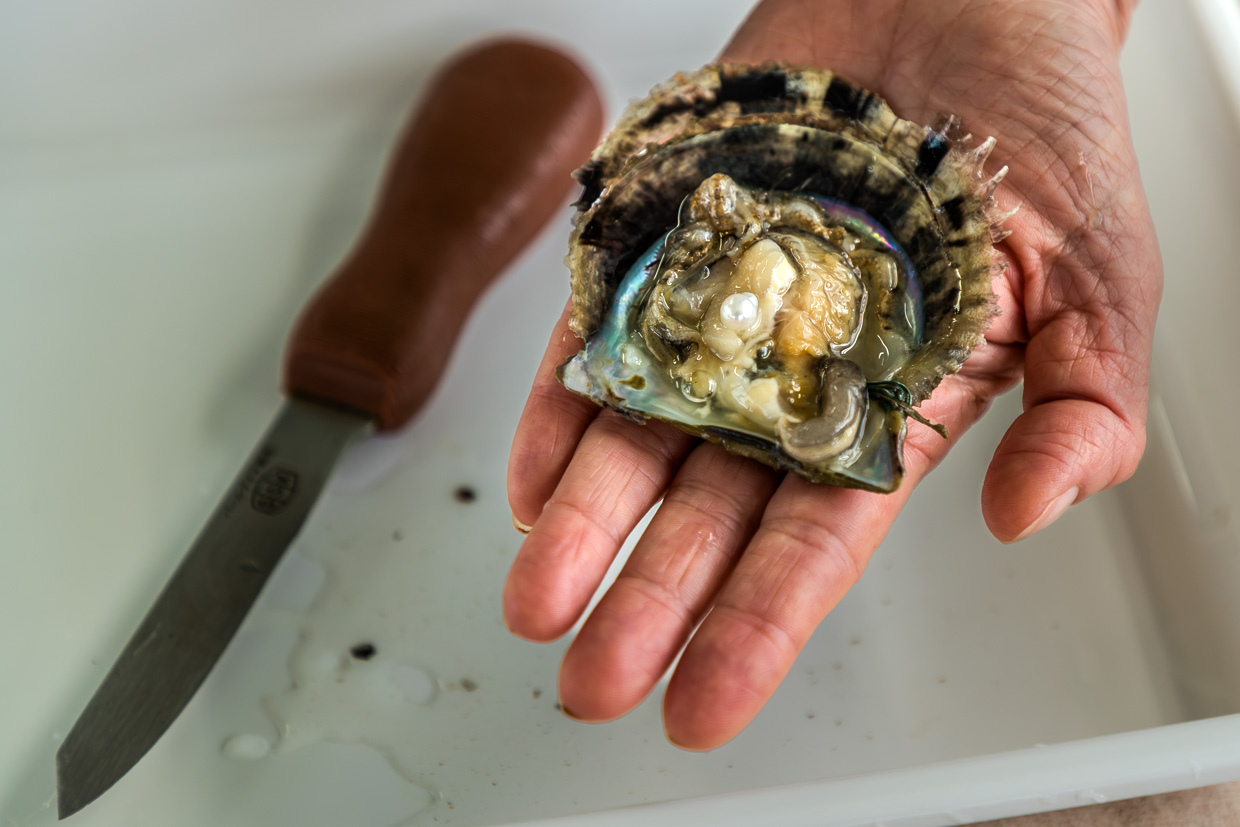
They tell me it’s good average. That sounds like my oyster has passed a test with a “satisfactory plus”. But it’s my pearl, from my oyster! A cloth polishes it, a measuring device measures it. Small in calibre, but in character: a tiny protrusion, a bonnet on the otherwise round shape. Not perfect. A hint of snowman. If I were a jeweller, I might sigh with disappointment. But I’m not one.
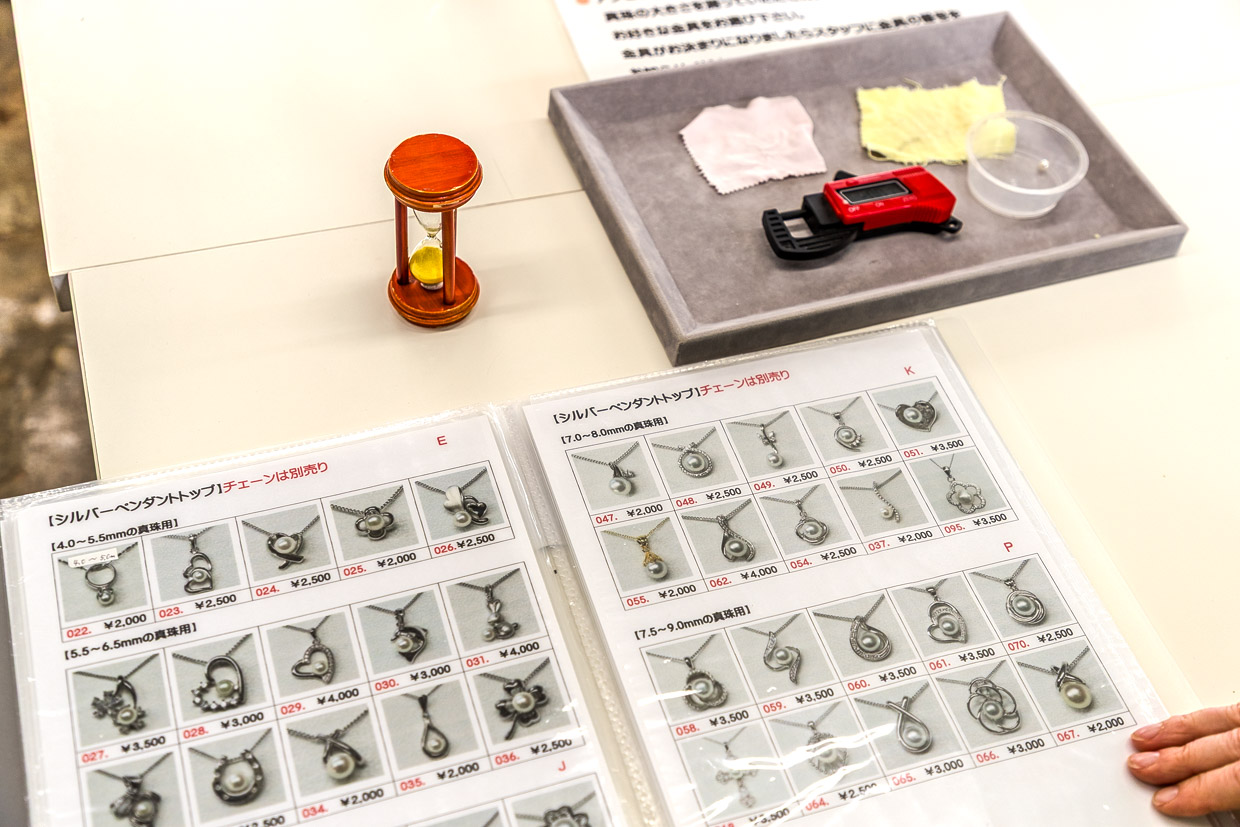
Now the catalogue. A thick tome full of pieces of jewellery with which my pearl could be combined. Glittering, sparkling, hearts, flowers, filigree metalwork – all beautiful, but nothing for me. Time is pressing, the group is waiting, I browse frantically. And then I discover it: a small, round pig made of shiny gold metal, with a friendly face. And my pearl – this small, not quite perfect sphere from the sea.
Throwing pearls before swine
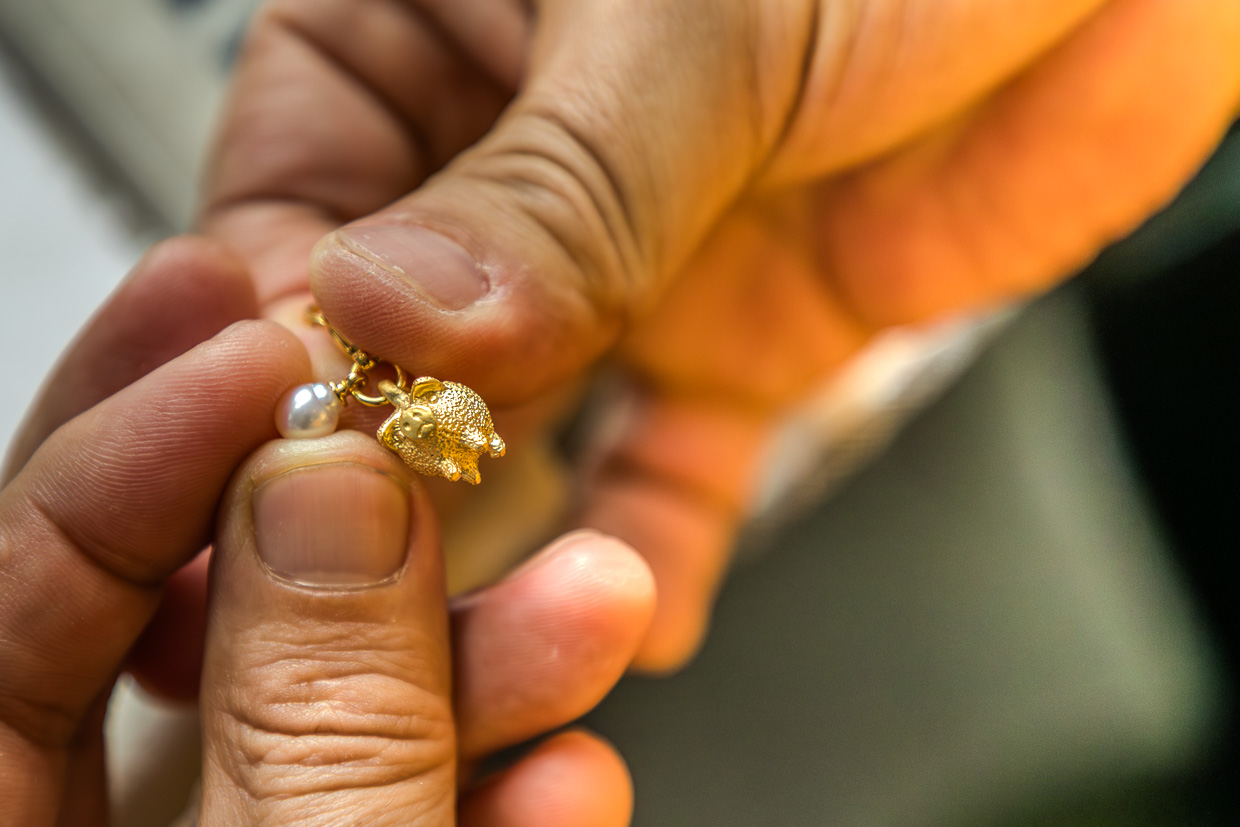
“Throwing pearls before swine” – the saying means wasting valuable things on the wrong people. But I think it’s the context that counts. Here, pearl and pig meet at eye level – both a bit quirky, both with a history, both not quite conforming to the norm. The employee of Shinju no Sato receives the pearl with the precision of a surgeon. He drills – calmly, precisely, right into the little bonnet, which I almost thought was a blemish. One drill hole, a little glue – and pearl and pig are inseparable. I hold the pendant in my hand and am touched. This is not a souvenir. This is a unique piece. Beyond any pearl necklace that my grandma loved to wear with her twin set.
Mikimoto Pearl Island. Where it all began
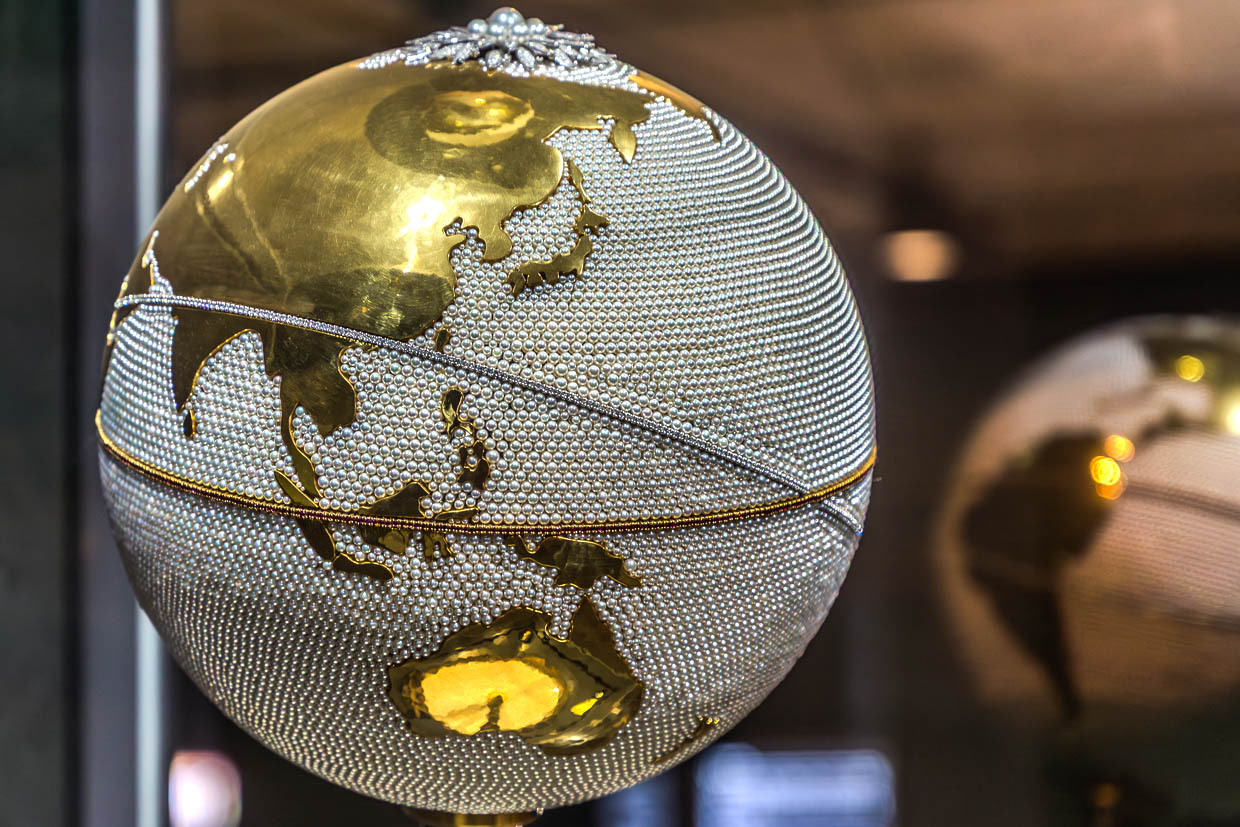
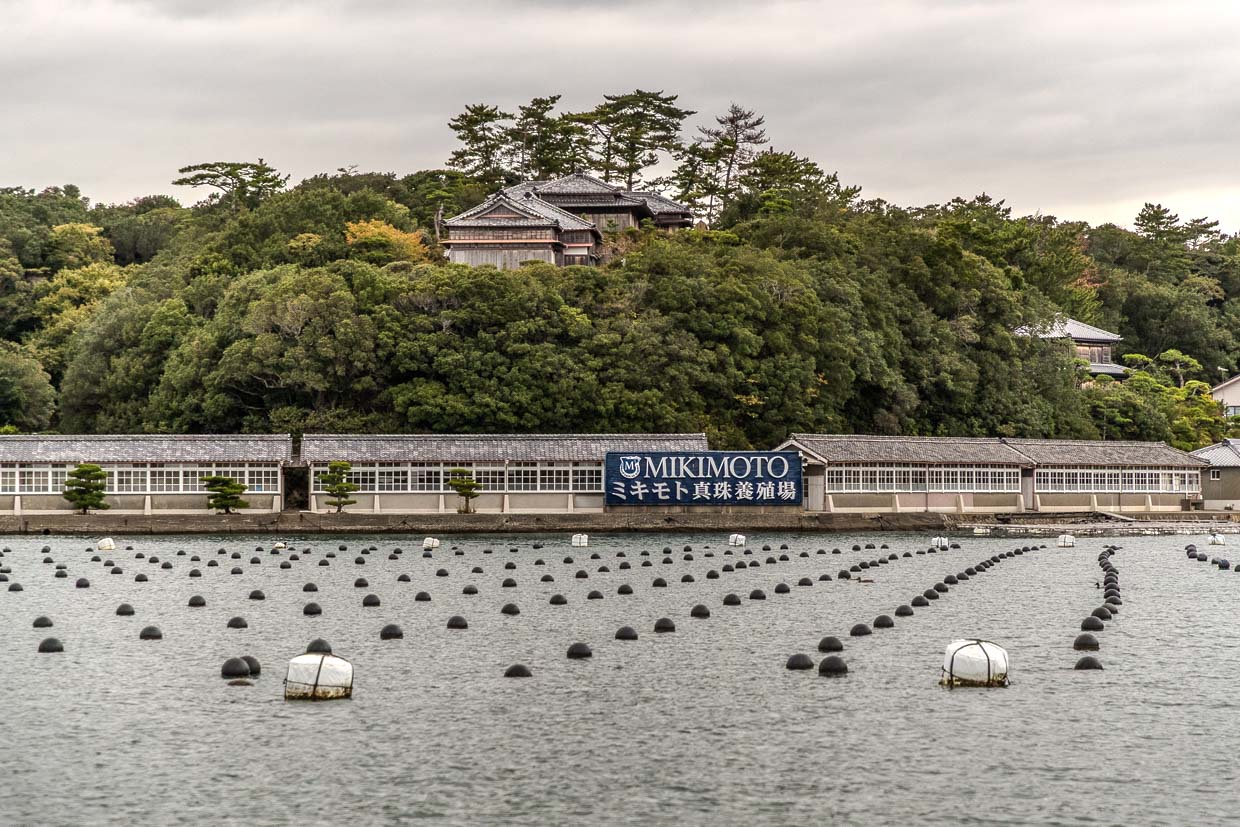
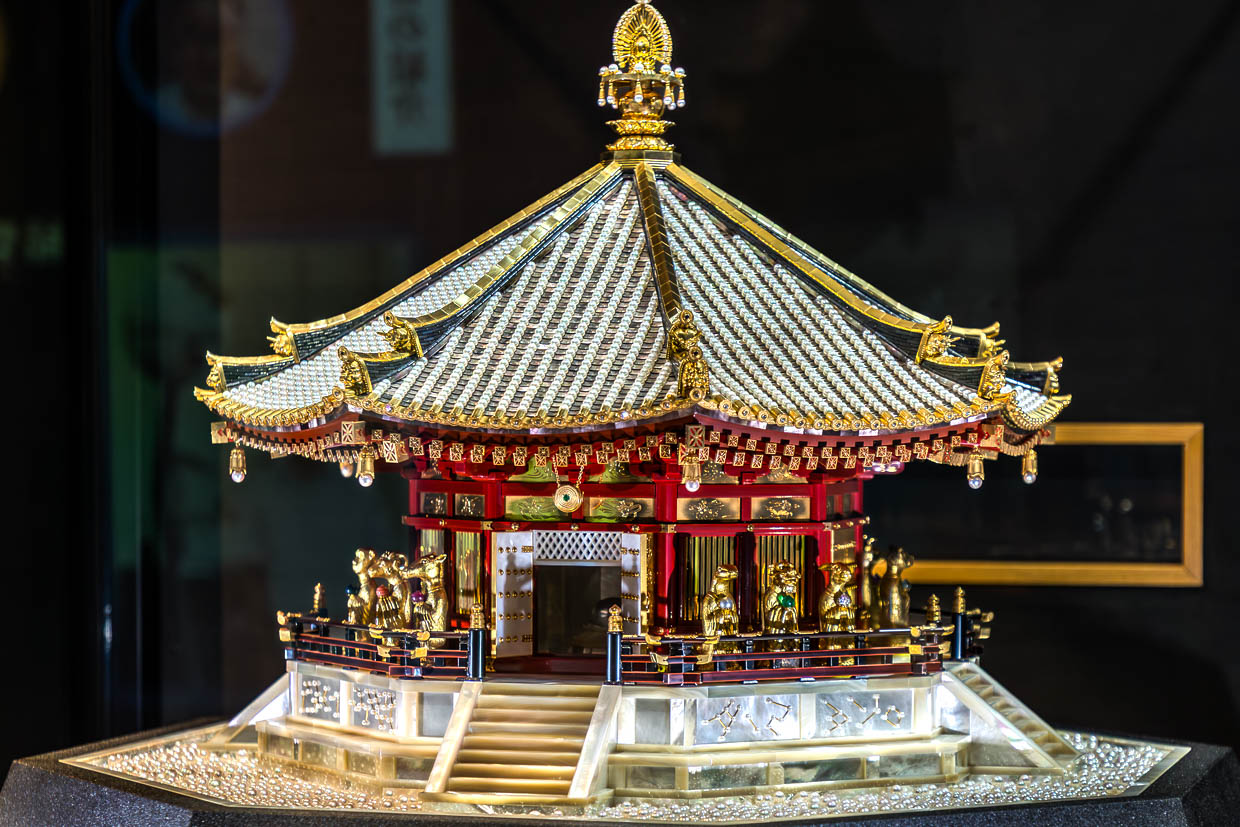
If you want to understand the history of the pearl, travel from Shinju no Sato to Toba. There, a bridge leads from the railway station to the small Mikimoto Pearl Island – the place where curiosity and perseverance created an entire industry. The museum shows on two floors how pearls are made: On the ground floor, a vivid exhibition explains the process of pearl cultivation – from inserting the tiny nucleus into the oyster to harvesting and sorting. On the upper floor, antique pearl jewellery sparkles alongside works of art made from pearls. These include a five-storey pagoda, a globe made of pearls and gemstones and royal crowns. Craftsmanship that makes you wonder how much labour time went into it.
Pearl king Kokichi Mikimoto
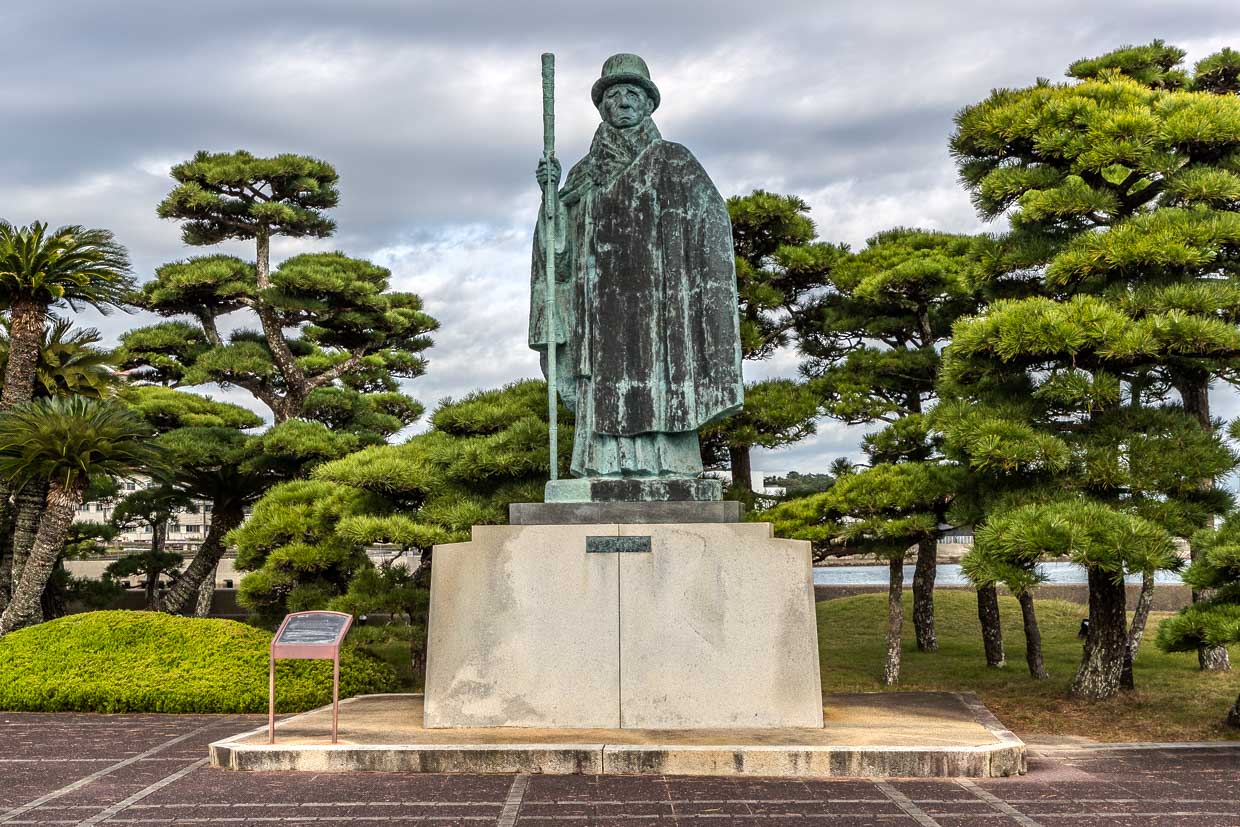
Kokichi Mikimoto, the son of a noodle soup seller from Toba, left school at 15, sold vegetables and later dedicated himself to cultivating pearl oysters. His ground-breaking idea: he implanted a round-cut mother-of-pearl centre together with a piece of mantle tissue into the oyster. Years of failure, doubt and experimentation followed – until the breakthrough came in 1893. Mikimoto presented the world’s first cultured pearl, had his method patented and set up a pearl farming industry in Ise Bay. In 1908 he was granted a patent for spherical cultured pearls, but by 1899 he had already opened his first shop in Ginza, Tokyo’s luxury neighbourhood. The son of a noodle chef became the pearl king.
Mikimoto and the women of the sea
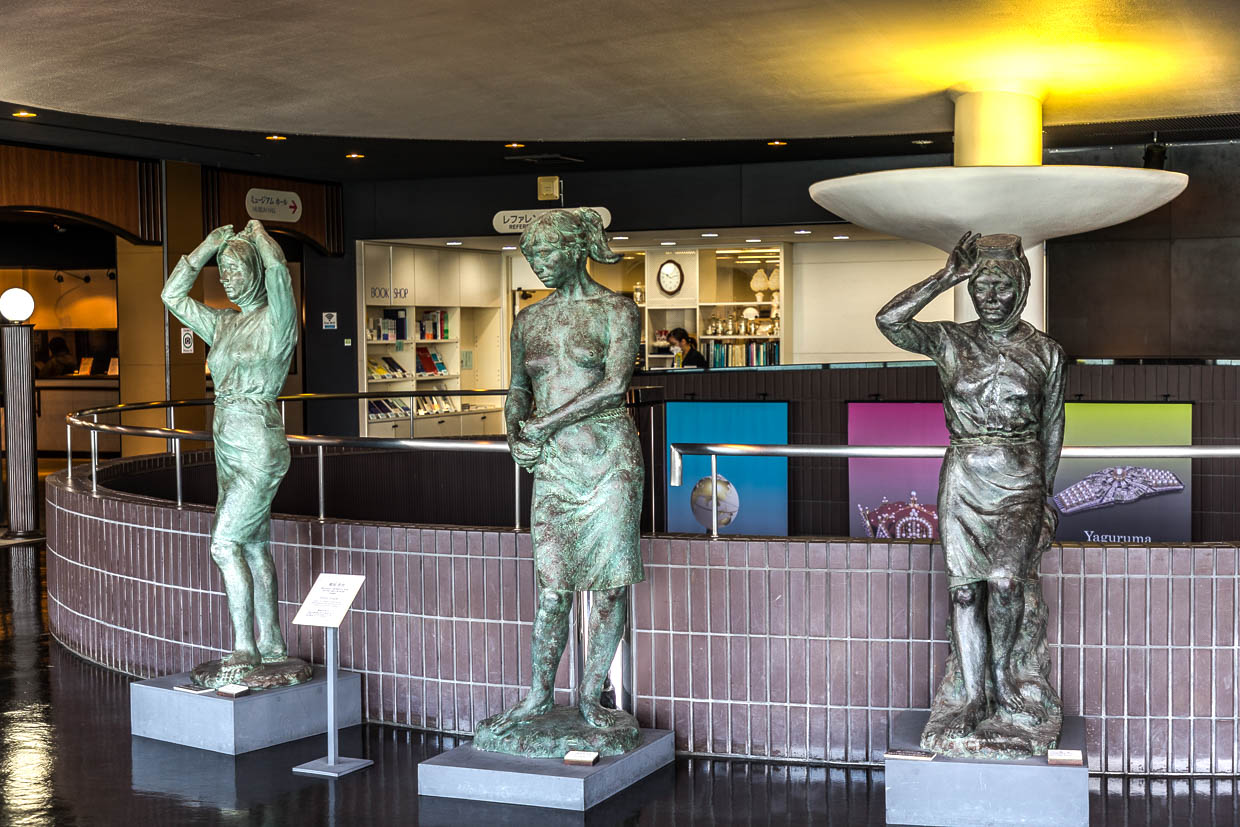
Mikimoto dreamed of adorning the neck of every woman in the world with pearls. A phrase that sounds old-fashioned today – and not just because the classic pearl necklace has gone out of fashion. It sounds like the old way of thinking about property, which sees women as a surface to be decorated. As if the jewellery were the subject and the woman merely the wearer. Nothing more. The fact that it was women, of all people, who made this splendour possible in the first place also faded into the background. The ama, the “women of the sea”, dived in Ise Bay in the early years of Mikimoto pearl farming. They took the oysters out of the water, put them back into the sea after the core implantation and protected the hanging oysters from storms and low tides. No oxygen equipment, no fuss, just physical strength and the knowledge they had learnt from their mothers. Their work was indispensable, their pay modest.
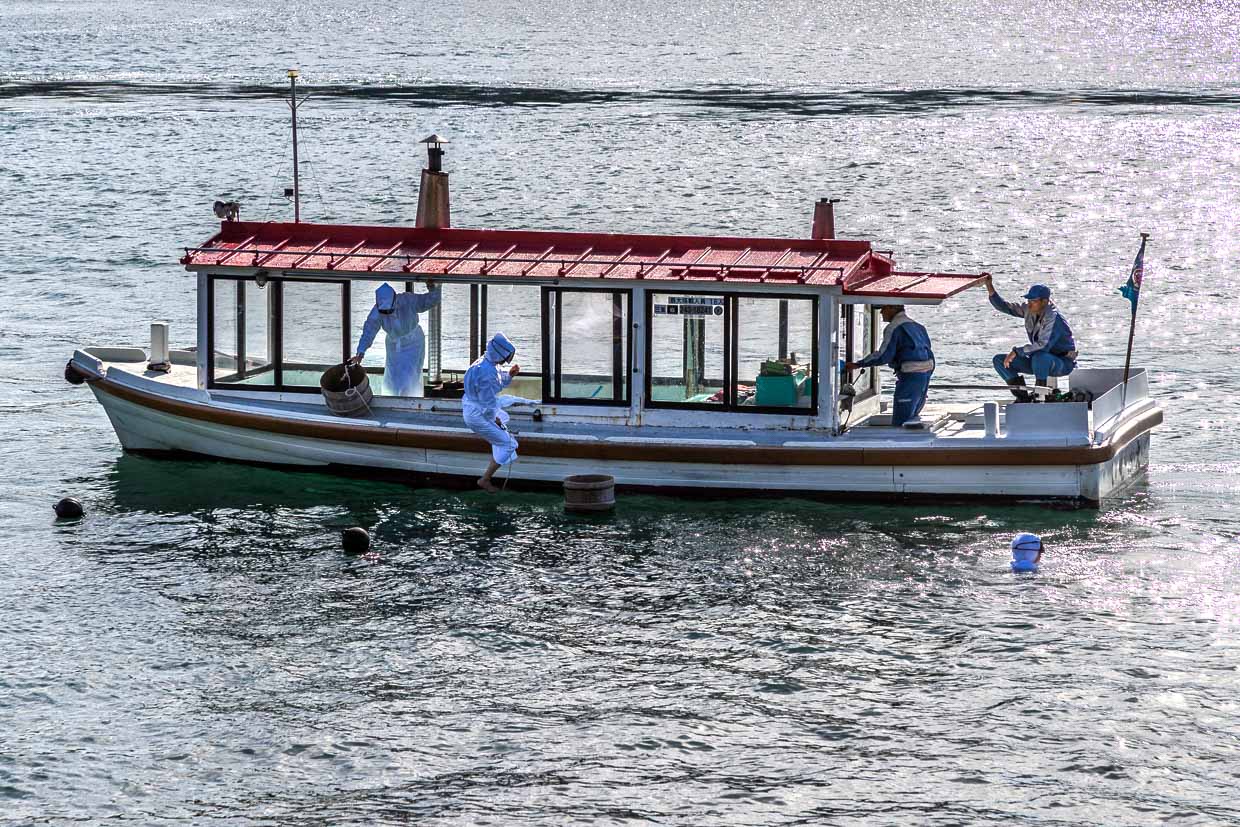
On Mikimoto Pearl Island, you can gain a small insight into their work. Several times a day, Ama divers show how their predecessors worked in a diving show. Dressed in white work clothes and without modern equipment, they dive into the bay in front of visitors. A performance that only gives an idea of how much effort goes into each pearl. But the whole story of the Ama – their tradition, their strength, their endangered craft – remains a separate chapter. If you travel to Mie and only see the pearls, you miss the real story: that of the ama, which Mikimoto called his “arms of the sea”.
The pearl that is still growing
Back to the pearl village. Those who leave Shinju no Sato take a pearl with them. Those who return can experience something special: In the pearl village, the patient can plant a seed in a living oyster themselves. This is hung in the water, cared for and guarded – until the pearl is harvested after two to three years. Three years for a souvenir – that requires Buddhist serenity. For all those who, like me, choose “pearl picking to go”, there is good news: even if the first oyster remains empty, no pearl picking ends without a pearl. You can open another oyster. And with a bit of luck, the pearl will be joined by a pig.
More episodes from Japan
Spiritual, culinary, fascinating. On our trip through the Japanese prefectures of Wakayama, Mie and Nagano as well as the cities of Osaka, Nara and the Hakone region, we hiked pilgrimage routes and ancient trade routes, bathed in hot springs and drifted through the street food streets of Osaka and packed lots of red tins from Nagano into our suitcase. There is no way around octopus there – especially not a takoyaki, the legendary dough ball with a tiny piece of octopus inside. In Tanabe, another world opens up: that of Umeshu, the amber-coloured plum liqueur, the nuances of which you can get to know in a small bar. If you can still walk afterwards, it is best to head straight for the famous Kumano Kodo pilgrimage route – and if you want to do it in style, wear a kimono. Yunomine Onsen is home to the oldest onsen in Japan, where hot water has been bubbling up from the earth for 1800 years for cooking, bathing and relaxing. You can learn about the history of the ama, the women of the sea, their tradition and their endangered craft in Mie. If you are looking for a souvenir, you can choose an oyster in Ise-Shima. You can only find out what’s inside at the Pearl Picking. In Ise itself, Japan’s most important Shinto shrine holds a secret that has been kept for twelve hundred years – by rebuilding it every twenty years. The somewhat quirky bag charm culture, in which soft toys dangle from bags, is a nationwide phenomenon.
The research trip was supported by Iseshima Tourism and Convention Organisation